The Homeric hero and Philhellenism

The mythical hero Theseus fights the Minotaur. Work of Antoine-Louis BARYE (1795-1875) (SHP collection).
For the Greek Revolution to prevail, it had to gain the trust and admiration of the international political scene and public opinion. A number of important personalities from Greece played a crucial role in this direction.
There are four Greek fighters of the Greek Revolution, whose lives and actions allowed the public to identify them with heroic figures of the Greek mythology and Homeric epics.
It is recalled that the western world had progressively adopted a Hellenocentric culture since the end of the 18th century. This culture had progressively passed into the educational system of every western society.
A key element of this education was the Homeric hero, who excited young people at the time. It is worth noting that in European mythology, the central figure was usually the wizard. We are all familiar with the wizard Merlin in England or even today Harry Potter.

Video with the trailer of a recent movie about Merlin https://www.youtube.com/watch?v=er_LjKgkO08

Video with the trailer of the first movie on Harry Potter https://www.youtube.com/watch?v=VyHV0BRtdxo
The Homeric hero falls into a different category. He is brave, selfless, a fighter with high ideals, and he takes his fate into his own hands. He fights for his values and for his community.
This form of hero shocks young people in Europe, especially when combined with the cultural wealth of ancient Greece and classical Athens. During the second decade of the 19th century, these values were promoted in the work of the great Romantic poet and Philhellene, Lord Byron.
So when the Greek Revolution began, public opinion was looking to identify in Greece, this very type of Homeric hero. And it found it mainly in the faces of two men and two women.
The two men are the heroes of the Greek Revolution, Markos Botsaris and Konstantinos Canaris. They are both brave and selfless. They fight for their ideals without seeking personal gain, while they refused to engage in civil conflicts.
In the same manner, the public opinion identified similar elements of a heroine in the faces of two Greek women. These were Bouboulina and Manto Mavrogenous. The first one stood out for her combativeness and militancy. The second for her education, selflessness and generosity. Both offered everything they had to the struggle of the Greeks.
The stories of these four Greek heroes became the subject of literary, theatrical and musical works, while their figures and scenes from their lives, were captured in many forms of philhellenic art.
Markos Botsaris and his heroic death, as well as the life and action of Konstantinos Kanaris, have been imprinted in paintings, literary works, poems, works of art, musical works, etc.

The death of Markos Botsaris (19th century). Based on a work by Jean-Charles Langlois (1789-1870) (SHP collection).

The oath of Lord Byron at the tomb of M. Botsaris. Variation of the work of Ludovico Lipparini (1800-1856) (SHP collection).

Letter from the American General and Senator William Rosecrans (1819-1898), explaining in 1891 that he identified in his life with the Greek hero Markos Botsaris, who was praised with an emblematic poem by the American poet Halleck (SHP collection).

Canaris and Botsaris. French porcelain dishes. Second quarter of the 19th century (SHP collection).

Victor Hugo, “Les Orientales”, 1829 (SHP collection).
Of particular interest is the poetic collection “Les Orientales”, of Victor Hugo, which refers exclusively to the Greek Revolution and is published in Paris in the context of his solidarity with the suffering Greek people, promoting the philhellenic spirit in Europe. It coincides with the views of Lord Byron and publishes the revolutionary actions of the Greeks for freedom from the Turkish yoke, choosing to highlight events that will move more, such as the siege of Messolonghi, the achievements of Kanaris and Botsaris, etc.
“To Greece, forward, oh friends! Revenge and freedom! “
Victor Hugo calls Greece the mother of western civilization:
“(…) Greece of Lord Byron, Greece of Homer
You sweet sister, you our mother “.
The following excerpt presents Canaris saying:
“My brothers, if I return alive, Messolonghi will be spared,
I promise to build a new church of Jesus Christ.
If I die and fall in the dark night of Death
From which no one can return
And if all my blood is spilled, what is left of it
You will bury in free soils my ashes
Under the sun’s light, the clear sky, you dig my tomb”.

Mantle clock with Canaris in his fireship. Second quarter of the 19th century (SHP collection).

Canaris in his fireship. French porcelain platter. Second quarter of the 19th century (SHP collection).
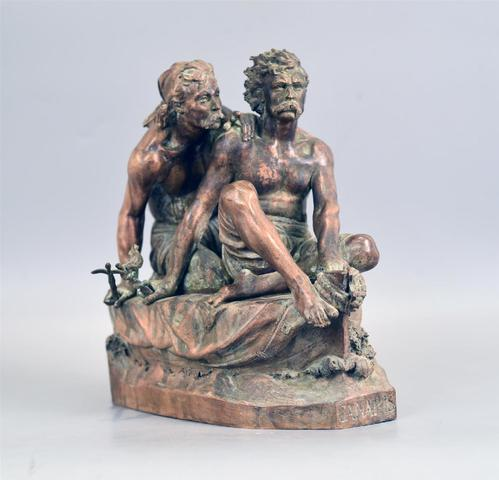
Canaris with Pipinos in their fireship. Composition in bronze. Work of Benedetto Civiletti (1846-1899) (SHP collection).

The work of Alexandre Dumas, entitled “CANARIS”, with the inscription “Canaris dithyrambe par Alexandre Dumas. Au profit des Grecs” (Dithyrambic. Sold in favor of the Greeks), France 1826. This copy is sent by Dumas with a handwritten dedication to the Duke of Orleans, King Louis-Philippe of France (SHP collection).
Manto Mavrogenous was described as the “Greek Jean d’Arc”, she had constant communication and correspondence with many Philhellene women, whom she regularly informed about the course of the struggle and the needs of the Greeks. In France and elsewhere, all women’s fashion was influenced by these two heroines. The women wore in their honour clothes inspired by ancient or even modern Greece. While they even combed their hair in a Greek way (bobeline). Even liqueurs were marketed under their own name.

Bouboulina – Manto Mavrogenous. French porcelain dishes. Second quarter of the 19th century (SHP collection).

Crême de Bobelina [Lyon, 1820s], lithograph label of a liqueur bottle. Under Bouboulina’s ship the inscription: “Bobelina faisant jurer à ses enfans de venger la mort de leur Père” [Bouboulina makes her children swear that they will take revenge for their father’s death]. Right and left of the title, the naval battle of Tenedos and the siege of Nafplio respectively. Below are the details of the distillery: Fab (ri) que de Liqueurs / de Roche Meunier & Mejasson / de Lyon (SHP collection).

Bouboulina. Container in the shape of a woman’s head, coloured porcelain. Work based on a lithography by Adam Friedel, The Greeks (SHP collection).
The action, especially of these four heroes, monopolized the interest of the European press and inspired the philhellenic movement during the Greek Revolution, but also for the entire duration of the 19th century.
If one examines the number of literary and artistic works, which concern from 1821 until almost the end of the 19th century, these four figures, and the impact they had, one will understand to what extent Greece owes its freedom to them.
At the same time, it must be emphasized that all societies, in all ages, are looking for models which affirm classical values and principles.


