Clement Harris – An English composer who died heroically fighting for Greece

SHP pays homage to Clement Hugh Gilbert Harris (8 July 1871 – 23 April 1897), who fought like a hero and died for the independence of Greece in the Greco-Turkish War of 1897. Clement Harris was a wealthy and charismatic English pianist and composer.
He was born in London (Wimbledon) and educated at Harrow School. Then he studied music in Germany (Frankfurt), where he was a pupil of Clara Schumann (wife of composer Robert Schumann). He was a friend of Oscar Wilde and Siegfried Wagner (son of the famous composer Richard Wagner and grandson of pianist / composer Franz Liszt), who decided to choose a composing and conducting career, thanks to Harris encouragement.
During a voyage in Asia, Harris sketched “Paradise Lost” after Milton, his most important symphonic poem. The work was completed in 1895 and performed that year in Bad Homburg, Germany, in the presence of the Prince of Wales, the King of Belgium, and various Grand Dukes and Duchesses. The English premiere took place in 1905 in Birmingham Town Hall, eight years after Harris’s death.

Clement Harris was an enthusiastic admirer of Greek culture. He travelled to Greece and studied Greek during 1896 in Corfu. Then, at the outbreak of the Greco-Turkish war of 1897, he organized a battalion of mercenaries to fight for the independence of Greece. He went to the mainland with the prosecutor of Corfu, Kyrgousios, in a boat full of ammunition intended for the front in Epirus. The ship anchored about two kilometers before the Turkish-occupied border and Harris went to Arta, where he shouted proud: “Anglos Philhellen! (Englishman, philhellen!), when he entered the Greek army camp being cheered with enthusiasm by the crowd.
On 5 April 1897, Harris declared: “I act, of course, out of free choice. No one has persuaded me to put my life at the service of the Greeks; rather, well-intentioned friends have hindered me from doing my bid so far […]. The step I take may seem like an act of madness to many. For me, who has thoroughly considered the matter, this is the least that a man of honor can do for a country calling for freedom in the name of the cross, and in turn insulted and hindered by each of the so-called civilized powers”.
The Greek poet Lorenzo Mavilis became a friend of Clement Harris.
During his presence in Greece, Harris wrote to his mother, Elizabeth Rachel Harris: “Dear mother! I am now completely in my element, far from all the futile obligations of modern society, and enjoy it to the fullest.”.
In one of his letters to Siegfried Wagner’s half-sister Daniela Thode, he wrote on 9 April 1897 the following: “Who knows if we will ever meet again. I do not want to trade with anything in the world, though I’m well aware of the local dangers. I only hope that the Greeks will win the war, which now seems unavoidable, and if I do not come back, at least you will know that I gave my life for the freedom of a people to whom I have learned to pay my admiration and that I, like children who, over time, become noble and great men and, worthy heirs of their historical ancestors, will honor the country.”
He was killed in action on 23 April 1897 at the age of 25.
Harris’ unit was approached by Turkish troops, who presented themselves insidiously as Greek Epirotes, saluting and greeting Harris’ soldiers and comrades. The Turks entered the camp, they took Harris’ unit by surprise and opened fire against them, starting the battle of Pente Pigadia in Epirus (Five Wells). Harris organized the defense of the unit and fought as a hero. Although he was wounded early in the day, Harris refused to leave his post, even when many of his fellow officers and soldiers started withdrawing from their positions. He stayed there and died in action, setting an example of heroism.
He was buried in the graveyard of the Anglican Church of St. Paul’s in Athens. A plaque at the church commemorates Clement Harris.

One of the last photos of Clement Harris before his death.
Harris’ family discovered all this much later. The London Times reported on 22 May 1897: “The relatives of Mr. Clement Harris, who was wounded in battle with the Greek troops in Epirus, have received authentic news of his death on 23 April at Pente Pigadia.”.
SHP has in its collection a letter sent by a Harris’ brother from Athens, to inform friends in England about Clement’s death and the erection of a commemoration plaque at St Paul in Athens.
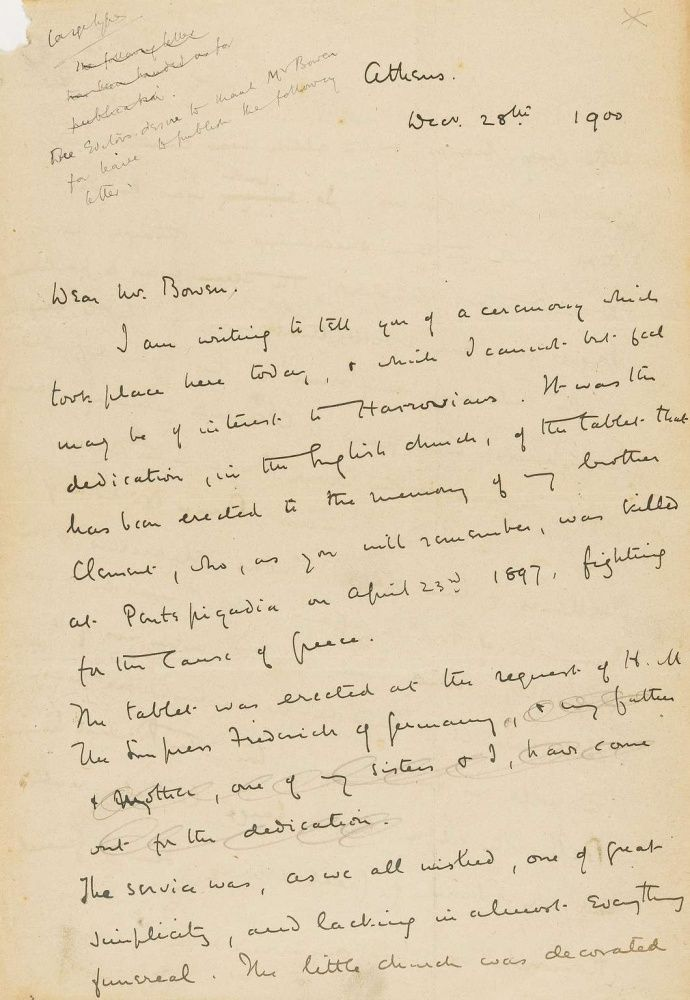
Harris (Walter B.) Autograph Letter signed to “Dear M.r Bowen”, 3pp., folio, Athens, 28 December 1900, “I am writing to tell you of a ceremony which took place here today, & which I cannot but feel may be of interest to Harrovians. It was the dedication, in the English church, of the tablet that has been erected to the memory of my brother Clement, who … was killed at Pente Pigadia on April 23rd 1897, fighting for the cause of Greece”.
Harris’s death was commemorated by the poet Stefan George in the poem ‘Pente Pigadia’ in his collection Der siebente Ring (The Seventh Ring). Stefan George (1868-1933), was an influential German poet, editor and translator.
During his life, Clement Harris, composed remarkable pieces for piano, including Il pensieroso and L’Allegro after Milton, romances for violin and piano and clarinet, cello and piano, and songs.
Greece honored Clement Harris memory in many ways. Decades after his death postcards with the portrait of Clement Harris were published. Harris’s symphonic poem “Paradise Lost” was performed on numerous occasions in Greece. It was first performed in 1937 in the ancient Odeion in Athens. Lately it was performed in 1999, in the Megaron Mousikis in Athens with the Orchestra Chromaton under Miltos Logiadis.
You may listen to a performance of Paradise Lost here.
Harris’ diaries were published in German by the Stefan George scholar Claus Bock.
We quote from his diary the following passage:
“Die meisten freien Nachmittage verbrachte ich in der Bibliothek. Ein anderer Lieblingsaufenthalt war der Kirchhof. Ich mag mich besinnen, wie ich einmal auf dem-selben Stein, auf dem schon Byron ge¬sessen und geträumt hatte, Tränen der Schwermut vergoss und wie dabei im Herzen die Sehnsucht erwachte, auch mein Name möge meinem Vaterland dereinst Ruhm und Ehre erwerben.“
(Free translation: “Most of the free afternoons I spent in the library. Another favorite stay was the cemetery. I recall that I once shed tears of melancholy on the same stone on which Byron had sat and dreamed, and how in my heart longing awoke, also my name may one day acquire fame and glory for my country.”)
In 1922–23 Siegfried Wagner composed the symphonic poem Glück as a memorial to Harris.
You may listen to a performance of Glück here.

Siegfried Wagner: Glück (dedicated to the memory of Clement Harris)


