Merry Christmas and Happy New Year 2026!
Dear Friends,
The Society for Hellenism and Philhellenism (SHP) and the Philhellenism Museum wish you a Merry Christmas and a Happy New Year 2026!
In 2026 we will organize a multitude of actions and anniversary events, including special thematic tributes regarding the 200th anniversary of the Exodus of Messolonghi. As every year, the Lord Byron Prize and Medal award ceremonies constitute the central axis of highlighting enduring Philhellenism, for which you will soon receive information and invitations.
In 2025, we delivered the Philhellenes’ Monument in the center of Athens, which commemorates 2.000 names of Philhellene volunteers and activists who contributed to the struggle for the independence of Greece. In early December, the SHP and the Philhellenism Museum announced the erection of an equivalent monument in Messolonghi, at a special ceremony that took place in the presence of the Mayor of Messolonghi, Mr. Spyridon Diamantopoulos.
Philhellenism, emerging within the context of Romanticism, captivated the European liberal intelligentsia of the 19th century. Since 1824, committees to support the rebellious Greeks have been established throughout Europe with the aim of raising public awareness of the necessity of increasing funds through charity sales and exhibitions that would contribute to the struggle. Politicians, artists and intellectuals were moved by the Greek cause, each projecting, in a unique way, the ideal of freedom in the struggle of the Greeks. As an expression of nostalgia for an unattainable Antiquity, Greece became within the eyes of the Philhellenes a symbol of the West, Christian civilisation and democracy, in contrast to an East that was identified with barbarism and despotism.
The Exodus of Messolonghi is the pinnacle moment of the Greek War of Independence, as with their heroic action, the Greeks declared to the international public opinion that they are notable descendants of the epic Greece of Marathon, Thermopylae and Salamis.
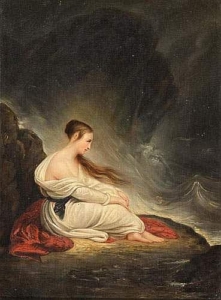
The French-Dutch painter Ary Scheffer captivated the public and critics with the modernity of his subject, where he captured the current events of the time and the historical representation of Greece on the ruins of Messolonghi through the allegory of a resigned female figure.
Depicted:
Ary Scheffer (1795-1858), Greece on the Ruins of Messolonghi, 1827. Oil painting on canvas.


