“Odysseus and Nausicaa” (Odysseus und Nausikaa)
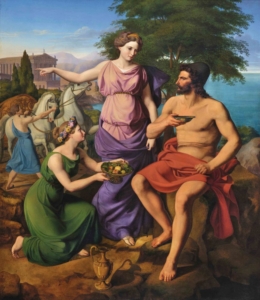
Oil painting by the German painter Carl Fielgraf (1804–1865) from the collections of the Philhellenism Museum.
In light of the recent discourse surrounding Christopher Nolan’s new film “The Odyssey”, and specifically the discussion regarding the female emancipation in Homer’s work, we present this painting to highlight that the figure of Nausicaa represents a progressive and dynamic woman.
Nausicaa serves as the archetype of a bold, compassionate, and autonomous young woman who rescues the hero. Similarly, Penelope, stands as an equal interlocutor and partner to Odysseus, possessing a profound strategic intellect that shapes the unfolding of the epic’s plot.
Homer presents advanced degrees of female emancipation, aspects that required thousands of years of cultural evolution to surpass, yet still remain unrealised today across a vast portion of the globe.
The artwork is one of the most recognisable and historically significant artifacts of the 19th century. It was first publicly exhibited in 1826 at the renowned Exhibition of the Berlin Academy of Arts (Berliner Akademie-Ausstellung), drawing the attention of critics of the time. The artist faithfully adheres to the principles of German Classicism and the Düsseldorf School, characterised by the clarity of lines, the theatricality in the figures’ posture, and the detailed rendering of the natural landscape.
Fielgraf draws direct inspiration from Homer’s Odyssey (Rhapsody VI), and the scene captures the moment when the shipwrecked Odysseus, naked and exhausted, awakens on the shore of the island of the Phaeacians (nowadays Corfu) at the sound of Nausicaa’s voice. The hero appears wild, disheveled, and full of diffidence, while Nausicaa presents a gracious noble figure; that she is the only one who is not frightened and chooses instead to assist him by offering him garments.
Information: info@phmus.org


