• Link to Facebook
  • Link to Instagram
  • EL
  • Communication
  • EL EL Ελληνικά el
  • EN EN EN en
  • The Society
    • Object
    • Advisory Committee
    • Scientific Committee
    • Friends of SHP / Philhellenism Museum
    • Donors – Sponsors
  • Actions
    • The Lord Byron International Prize
    • The Lord Byron Medal
    • International Philhellenic Committee
    • The Philhellenes’ Monument in Athens
    • Scholarships – Awards
  • Activities
    • News
    • Announcements
    • Presentations
    • Press – Media
    • Posts
    • Education
    • Lord Byron
      • The romantic poet
      • The celebrity
      • Lord Byron’s entourage
      • The Philhellene fighter
      • The international Lord Byron Prize
  • Archive
    • Philhellenes’ Archive
    • War of Independence – Historical names
    • Philhellenes
    • Video library
    • Library
  • Click to open the search input field Click to open the search input field Search
  • Menu Menu

The birth and evolution of Philhellenism – A journey through the collection of SHP

Presentations


Nike untying her sandal, is a sculpture of the 5th century BC, from the parapet of the temple of Nike (goddess Victory) on the Acropolis. It depicts Nike (Victory) slightly leaning her body to untie her sandal before she enters the sanctuary.

Georgios Vroutos (1843-1908) complemented the ancient sculpture and revived it in its original beauty. The sculpture belongs to the collection of SHP.

SHP has chosen this sculpture as a symbol of the honor and respect that we all show for those who laid the foundations of Greek culture, who expanded it, who protected it, who fought for the principles it stands for and who ensure its dynamics, in the future.


The Philhellenism

The Philhellenism emerged 3000 years ago and remains from the Hellenistic and Roman periods, the Renaissance, the Enlightenment, to this day, a dominant current that influences internationally historical, political and social developments, and of course the art and intellect.


The Renaissance

After a long dark period in history, the foundations of Greek culture reappeared during the Renaissance, paving new paths for the evolution of humanity.

Greek Mythology has been a constant source of inspiration for many painters since the Renaissance.

Aphrodite (Venus), married to Hephaestus, cheated on him with Aris (Mars), the god of war. The illicit relationship between Love and War inspired many artists. But as the great Renaissance philosopher Marcellus Ficinus wrote: “Aphrodite always rules Mars and never the other way around!”

Venus and Mars. Early 17th century, a painting by an unknown Dutch painter from the environment of Peter Paul Rubens (SHP collection).


Ancient Greece conquers European education

In the 18th century, Europe gradually discovered the richness and value of ancient Greek art.

In the middle of the 18th century, Johann Joachim Winkelman recorded Greek art and its beauty, presented Greek culture and laid the foundations for the science of archeology. His books were translated and circulated throughout Europe.

Johann Joachim Winckelmann, “Histoire de l’art chez les anciens”, Paris, 1766 first edition in French (SHP collection).

The trip to Greece

In 1778, archaeologist Jean-Jacques Barthelemy published The Journey of the New Anacharsis in Greece, which became a best seller. This work excited Rigas Feraios, who translated it, published it in Greek and got inspired to design the Charta and to write his Thοurios (two emblematic symbols which led to the uprising of the Greeks).

Voyage du Jeune Anacharsis en Grèce dans le milieu du quatrième siècle avant l’ère vulgaire, Paris 1788, first edition (SHP collection).

The new tour

The search for the cradle of Greek culture has given new dimensions to an early form of cultural tourism. A typical case is that of Choiseul Gouffier. His work Voyage Pittorèsque de la Grèce, shows already from the first page, enslaved Greece and the prospect of its release. Choiseul Gouffier is appointed head of the Greek-language hotel, a secret organization in France that aimed to support the liberation of Greece. Athanasios Tsakalov also took part in this organisation, and when in 1814 he took refuge in Odessa, he took over its archives and the valuable knowledge he had acquired on the operation of secret organizations.

Choiseul Gouffier, Marie Gabriel Florent Auguste de, French diplomat, Voyage pittoresque de la Grèce, Paris, J.-J. Blaise 1782 – the first page presents Greece in the form of a chained slave (SHP collection).

The Neoclassicism

Neoclassicism was born, along with the Enlightenment. One of the leading figures of this movement is the great French-Greek poet Andre Chenier (1762-1794), son of the Greek Cypriot Elizabeth Santi Loumaki Chenier. His mother’s literary salon in Paris was for many years the meeting point of the French intelligentsia and the catalyst for the establishment of the Greek-language hotel, the first secret organization aimed at liberating Greece.

Andre Chenier (1762-1794), “Elegy”, manuscript (SHP collection).


The Acropolis of Athens and the Parthenon

The Parthenon was the leading symbol of Hellenism. Top work of Greek architecture, but also a trademark of the Athenian Republic. It was the first monument whose construction was decided by free citizens through a democratic process, based on genius techniques and architecture, while recording with unique aesthetics’ sculptures the struggles of the people and their relationship with the divine. It was undoubtedly the monument that inspired most artists. It became the symbol of the debt of Europeans to Greek culture and therefore to the Greeks fighting for their freedom.
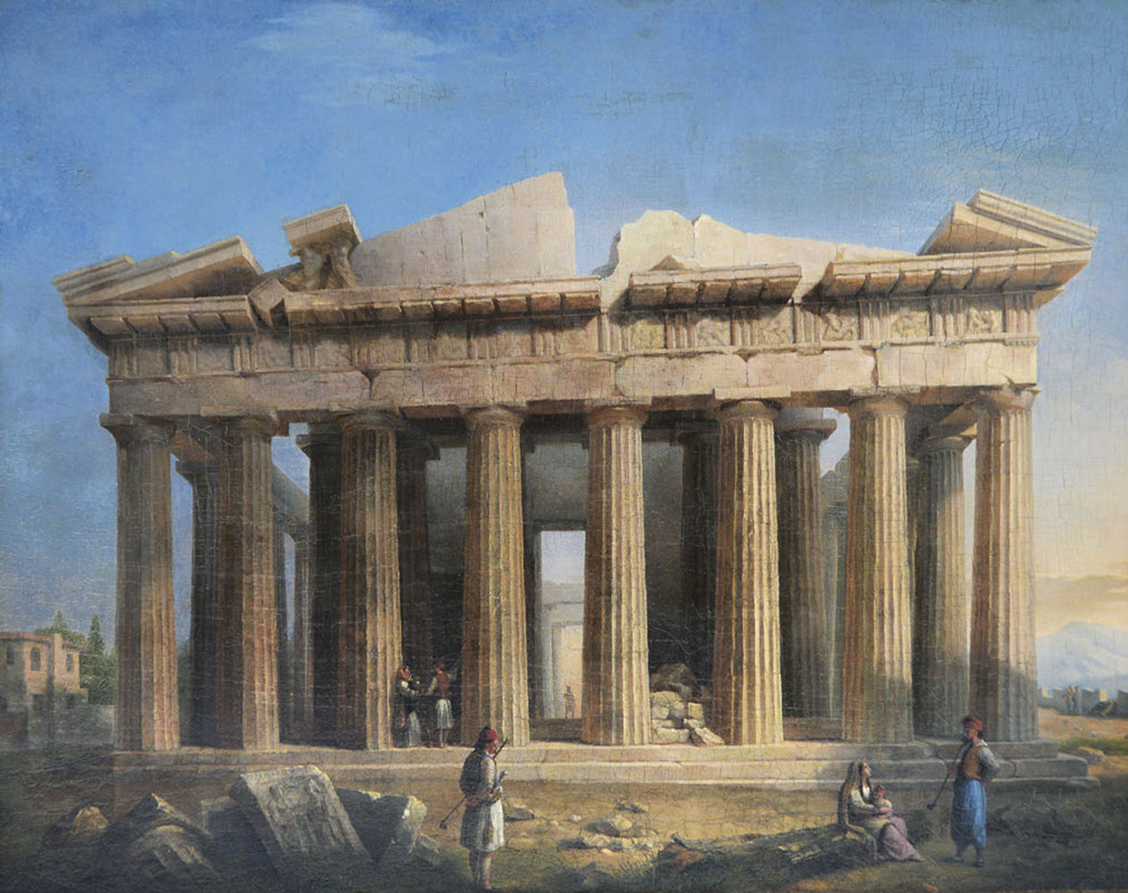
Early 19th century, a painting by the painter P. I. Witdoeck, the Parthenon of the Acropolis (SHP collection).

Romanticism

The philhellenic movement influenced education in Europe and systematically cultivated Greek-centered values ​​in many generations of young people.

One of them is Lord Byron, who relied on his education and visited Greece in 1810, in search of the ruins of ancient classical civilization. Lord Byron evolved into the main representative of Romanticism. A key feature of the romantic hero is the clash with superior forces for an ideal and especially freedom.

Lord Byron (George Gordon, Lord Byron, 1788-1824)
Early 19th century, a painting by an unknown painter, probably a British, depicts Lord Byron, inspired by the work of Childe Harrold’s Pilgrimage (SHP collection).

The Byronic heroes

Byron’s heroes are reflected in every art form. The bride of Abydos, the Giaour, the Corsair, Don Juan, etc. appear in porcelain, paintings, tapestries, table clocks, boxes, etc.

The work of Childe Harrold’s Pilgrimage records the feelings of a young man who realizes and regrets the decadence of the Greek civilization. This book became quickly famous throughout Europe.

“The mountains look on Marathon –
And Marathon looks on the sea;
And musing there an hour alone,
I dream’d that Greece might still be free.”

Mantel clock, early 19th century, the Byronic hero Don Juan (SHP collection).
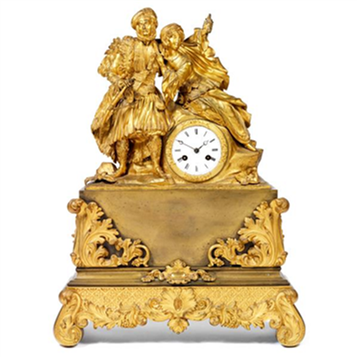
Mantel clock, early 19th century, the bride of Abydos, from the work of Lord Byron (SHP collection).

Mantel clock, early 19th century, Lord Byron next to the ruins of Greece (SHP collection).

Paper box, early 19th century, Lord Byron (SHP collection).

Beginning of the 19th century, Lord Byron, leading a unit of soldiers, enters in Messolonghi, a dish of the Monterey series (SHP collection).

The bride of Abydos

The Byronic hero Selim is saddened by his forbidden love for his beloved Zuleika.

Middle of the 19th century, a painting by the French painter Alexandre Marie COLIN (Paris, 1798-1875), the bride of Abydos, from the work of Lord Byron (SHP collection).


The Greek War of independence

The philhellenic climate that prevails in the public opinion of Europe is strengthened with the start of the Greek War of independence. The Byronic heroes gradually became Greek Revolutionaries and philhellenism influenced every form of art and literary expression. The news from Greece are captured by a number of artists in France.

The fighter’s rest. Middle of the 19th century, a painting by the French painter Eugene Delacroix, a Greek fighter at rest (SHP collection).


The first victory of the Greeks – The liberation of Salona

The siege began very quickly, on March 27, 1821. The siege was led by the chieftain Panargias, after he was blessed by the bishop of Salona, ​​Isaiah (a Greek who participated in battles and finally sacrificed himself for the cause). The Turks surrendered in 13 days, on Easter day, April 10, 1821. Panourgias promised to release them if they surrendered their weapons, a promise that he kept.

Early 19th century, hand-painted lithography by the French painter Louis Dupré (1789-1837), the occupation of the Salona fortress by the Greek fighter Nikolakis Mitropoulos raises the flag of the Struggle at Salona (SHP collection).

Konstantinos Kanaris, the fire ship Captain

The achievement of the Konstantis Kanaris (1793-1877) to set fire to the Turkish flagship in Chios (1822) with a fire ship, impressed the public opinion of Western Europe which compared him to David who kills Goliath.

Second part of the 19th century, bronze ensemble of Benedetto CIVILETTI (1846-1899), the fire ship captains Kanaris and Pipinos (SHP collection).

Second half of the 19th century, painting by Konstantinos Volanakis (1837-1907), burning of a Turkish flagship by Kanaris (SHP collection).

Kanaris’ son in Paris

The eldest son of the glorious fire ship Captin, Nikolaos, was educated in France with the children of King Louis-Philippe. Nikolaos Kanaris served as a member of the Supreme Court, a diplomat and then a member of the Greek Parliament and Minister of the Navy. The exact year of his birth is unknown, while he died in 1880.

Beginning of the 19th century, painting by an unknown painter from France, a teacher, educates the son of Kanaris in Paris in geography (SHP collection).

The oath of the Freedom Fighter

Beginning of the 19th century, the painting is attributed to the French painter Michel-Philibert Genod (1796 – 1862), on the subject of the oath and the departure of a young Greek freedom fighter (SHP collection). The artist gives the measure of the nationwide uprising of the Greeks by participating in the struggle of all ages.

Philhellenism as art de vivre

The philhellenic movement makes gradually its presence felt in all European countries and in the United States. Philhellenic committees are established in all major cities, fundraisers are held in favor of the Greeks, volunteers are recruited, weapons are sent in Greece, events are organized and manifestos circulate. This climate of support led to the spread of the philhellenic art repertoire in works of art and objects of daily use of an impressive variety: clocks, vases, cups, plates, bottles, and even wallpapers, represent basic philhellenic themes.

Early 19th century, a bronze ensemble of a Greek freedom fighter with his horse, an evolution of the Byronic hero from Byron’s work the Giaour (SHP collection).

Early 19th century, bottles depicting a Greek couple (SHP collection).

Early 19th century, dishes with themes from the Greek Revolution and reference to the names of Greeks and Philhellenes freedom fighters (SHP collection).

Mantel clock, early 19th century, with a Greek fighter who defends a wounded comrade (SHP collection).

Mantel clock, early 19th century, Greek fighter with his horse (SHP collection).

Mantel clock, early 19th century, with Kanaris the fire ship Captain (SHP collection).

Mantel clock, early 19th century Greek shipwrecked (SHP collection).

Table clock, early 19th century, Greek fighter defends Messolonghi (SHP collection).

The Greek Patriarch Gregorios the 5th

The three pillars on which Philhellenism relied were the sense of debt to the Ancient Greek Civilization, the liberal sentiments against tyranny, and the common Christian faith. Many Europeans saw the Greek Revolution as a struggle of the Cross against the crescent.

Second part of the 19th century, painting by an unknown painter, probably from the United Kingdom, depicts the hanging of Patriarch Gregorios the 5th (SHP collection).

The Souliote

The achievements of the great Souliote chieftains Marcos Botsaris and Kitsos Tzavellas, as well as the fact that they served in the French army (Régiment Souliote), propagated the fame of the Souliotes in Western Europe.
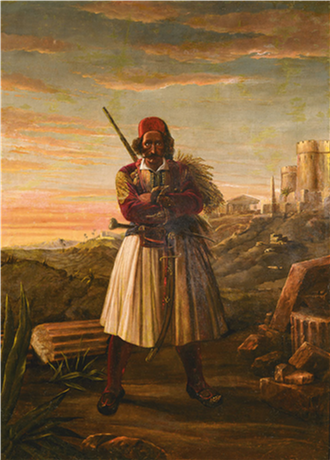
Early 19th century, painting by a follower of the Italian painter Lodovico Lipparini (1802 – 1856), a Souliote fighter (SHP collection).

The Greek fugitives

As we progress through the years of the struggle (the 1820’s), the depiction of scenes from the difficult life of the struggling Greeks is a frequent topic. The fugitives take refuge in the mountains with their wives and children.

Early 19th century, painting by Belgian painter Edouard Charles Dons (1798-1869) (SHP collection).


Louis I of Bavaria, the great Philhellene

Philhellenism reached and inspired all social layers. The leading German philhellene was King Ludwig I of Bavaria. Writer Zacharias Papantoniou wrote a century ago, in his book about the son of Ludwig I, and first king of modern Greece, Othon, about the three famous Whitelsbachs: “They had by excellence the romantic element – the power to leave their time for the past and from material life for the dream. All three refused to accept the tangible reality. Ludwig I for his philhellenism, Othon for his national ambitions for Greece (Megali Idea) and Ludwig II for his Wagner-mania, forgot the throne, to live the gigantic phantasmagoria of the ethics and art they created.”

Beginning of the 19th century, painting by unknown painter depicts Ludwig I, with his family, examining the emblematic painting of the German Philhellene painter Peter Von Hess, showing the arrival of Othon in Nafplion (SHP collection).

The German Philhellenism

Along with France, the philhellenic movement took also great proportions in Germany. In addition to Ludwig I, who wrote poems about the struggle of the Greeks, the great romantic poet Wilhelm Müller, known today from the lyrics of Schubert’s song circles “The Beautiful Miller Maid” and “Winter Journey”, was the Philhellene with the greatest influence on the consciousness of his compatriots.

Known in Germany as Müller of the Greeks (Der Griechen Müller), he wrote collections of “Greek” poems in 1820, 1823 and 1824, with characteristic titles such as “The Greeks to the friends of their antiquity”, “The Phanariote”, “The Maid of Athens “, “The Maniatissa”, “The old man of Hydra”, “The Holy Corps”, “The spirits of the ancient heroes on the day of the Resurrection”, “The ruins of Athens to England” and “The hope of Greece”. One of the most beautiful is “Greece and the world” where he connects freedom with Greece and the world, exclaiming:

“Without freedom, what would you be, oh! Greece without you, what would the world be like! ”
«Ohne dieFreiheit, was wärest du Hellas? Ohne dich, Hellas, was wäre die Welt? ».

Many German painters chose Philhellenic themes, expressing their solidarity with the struggle of the Greeks. At the same time, it is the German painters who, through their works, highlighted the heroic dimension of the Greek fighters and their struggle.

Early 19th century, painting by the German-Swiss Philhellene, military and painter Carl Wilhelm Freiherr von Heideck (1788 – 1861), Mosho and Lambros Tzavelas (SHP collection).

Early 19th century, a painting by the German Philhellene painter Peter Von Hess (1792 – 1871), a Philhellene in Greek costume during the Greek Revolution (SHP collection).

Early 19th century, painting by the German Philhellene painter Christian Johann Georg Perlberg (1806-1884), Greek fighters during the battle (SHP collection).

Early 19th century, painting by the German Philhellene painter Christian Johann Georg Perlberg (1806-1884), Greek fighters during a battle (SHP collection).

Early 19th century, painting by the German architect and painter Ludwig Lange (1808 – 1868), the ancient market in Plaka, Athens (SHP collection).

Early 19th century, painting by the German painter and Philhellene Jacobs Paul Emil (1802 – 1866), looting and kidnapping (SHP collection).

First part of the 19th century, dishes with philhellenic content of German production, present scenes from the Greek Revolution (SHP collection).

At the beginning of the 19th century, a pipe of German origin, it depicts Alexandros Ypsilantis and the Holy Corps (SHP collection).

The Sortie of Messolonghi

The heroic resistance of the Greeks in Messolonghi and the Sortie of the free besieged, shocked Europe, especially because Lord Byron lived and died there, and the event received tremendous publicity. After Messolonghi, Philhellenism took the proportions of an avalanche.

Sortie of the Messolonghi garrison (Exodus of the Guards), 10/22 April 1826. To the Most Reverend King of Greece Othon reverently entrusted to Theodoros P. Vryzakis, (Paris, Lemercier, 1856), lithograph engraved by A. Charpentier, based on the painting of Vryzakis (SHP Collection).

Philhellenism and Music

Many Philhellenes composers wrote songs, but also larger compositions dedicated to the struggle of the Greeks. The musical works were presented in order to organize fund raising events, to collect money to send to the Greeks.

Berlioz with La Revolution Grècque (you can watch it here ) and Rossini with Le Siège de Corinthe (you can watch it here ) were the most famous.

Louis Ferdinand Hérold, known from the ballet “The Badly Guuarded Girl”, composed music for the heroic drama “The Last Day of Messolonghi” (Le Dernier Jour de Missolonghi), drame héroïque en trois actes, en vers, avec des chants. Musique de Hérold, Paris, Barba, 1828 (SHP collection).

L’Echo de Navarin, romance hellénique paroles de A. Jarry, Bataille de Navarin: fantaisie brillante pour piano-forte par J. Payer (SHP collection).

The death of Karaiskakis

The “son of the nun”, Georgios Karaiskakis (1782-1827), was together with Kolokotronis, one of the greatest leaders of the Revolution. He took part in countless battles and was fatally wounded in the battle of Faliro on April 22, 1827. He died in the early hours of the next day, surrounded by his rivals.

Early 19th century, painting by the Italian painter A. De Feoli, the death of a Greek fighter, probably Karaiskakis (SHP collection).

The naval battle of Navarino

The naval battle of Navarino (October 1827), in which the combined fleets of England, France and Russia with the Admirals of Codrington, Derigny and Hayden destroyed the Ottoman fleet, was the decisive military event that led to the implementation of the Treaty of London for the Independence of Greece. In Europe, the news of the victory of the Christian forces was reminiscent of the Battle of Nafpaktos – Lepanto (1571) and was celebrated in all major cities in Europe and the United States. The Battle of Navarino was the last major naval battle fought exclusively by sailing ships.

Early 19th century, painting by British painter John Christian Schetky (1778-1874), the naval battle of Navarino (SHP collection).

The Philhellenes

Hundreds of Greek volunteers took part in the struggle of the Greeks and stood by their side in all the critical moments of the Revolution. Many of them have made history internationally.

The first steamship in history to take part in military operations, was the Karteria of the Greek fleet, commanded by the great British Philhellene Frank Abney Hastings (1794 – 1828), who had even financed its weapons. The most important success of Hastings and Karteria was in the Battle of Agali (Itea Bay) on September 17, 1827, where Karteria sank alone the Turkish flagship and destroyed 9 enemy ships.

Portrait of the great British Philhellene Frank Abney Hastings (1794 – 1828), created by the German Philhellene
Karl Krazeisen (1794-1878) (SHP collection).

The slave market

The Philhellenic movement continued also after the establishment of the first modern Greek state. It was present in the art, it financed aid missions to Greece and encouraged many initiatives in favor of the Greeks. One of them had to do with the purchase of Greeks who were sold as slaves in the slave markets of the Ottoman Empire. A large number of slaves were rescued and released after the end of the Revolution. Their drama was reflected trough art in many ways.

Early 19th century, painting by German painter and philhellene Paul Emil Jacobs (1802 – 1866), a scene from the trade of Greek slaves (SHP collection).

Second part of the 19th century, a marble sculpture by the Italian artist Antonio Rossetti (1819 – 1870), the Greek slave (SHP collection).


The Cretan knife – An emblematic gift honors a great Philhellene

The Philhellenic movement continued to make its presence felt throughout the 19th and even 20th centuries, and its contribution has always been critical and decisive for the liberation of Greece.

In fact, many Philhellenes of the period 1821 returned to Greece when their assistance was needed it again. The great American Philhellene doctor and philanthropist Dr Samuel Howe, was one of them. He came to Greece for the second time in 1866-67 bringing aid for refugees from Crete during the Cretan Revolution.

Cretan knife 19th century, gift of the Cretans to the American philhellene Dr. Samuel Howe (SHP collection).

Garibaldi’s sword

Philhellenism continued to manifest itself throughout the 19th century, but also into the 20th. For example, in the unsuccessful Greek-Turkish War of 1897, the Italian Philhellene Ricciotti Garibaldi, the leader of a Corps of Garibaldi red-tunics, fought bravely.

However, this Corps returned to Greece and fought again on the side of the Greeks also during the victorious war of 1912-1913, which liberated Greece.

Sword donated by the French to the Italian Ricciotti Garibaldi, when he fought on the French side in the Franco-Prussian War of 1870-1871 (SHP collection).


The noble hero composer musician Clement Harris

In 1897, the British composer and Philhellene Clement Harris came to Greece, he fought heroically and died for the independence of Greece in the Greek-Turkish war of 1897 in the Five Wells in Arta. He was buried in the Anglican Church of St. Paul in Athens.

A handwritten letter from a relative of Clement Harris to his friends in England, informing them that he was “killed in the Five Wells on April 23, 1897, fighting for the rights of Greece” (SHP collection).

The oath of Lord Byron next to the tomb of Markos Botsaris in Messolonghi,  painting by a follower of the Italian painter Lodovico Lipparini (1802 – 1856), oil on wood, 19th century (SHP collection).


Philellenism remains to this day an important cultural, political, social, philosophical and literary movement.

Philhellenism inspires educational and academic programs in all modern societies, and the values ​​on which it is based are the cornerstones of the civilized world.

The trip to Greece and the pilgrimage to the Acropolis of Athens and the other emblematic archeological sites throughout Greece, cause to every free man of today the same feelings as those they caused to Lord Byron 200 years ago.

The Society for Hellenism and Philhellenism supports the cultivation of this spirit internationally, with works and deeds.

30 April 2020
https://www.eefshp.org/wp-content/uploads/2020/04/CLIO-1a.jpg 617 588 Admin https://www.eefshp.org/wp-content/uploads/2019/05/logo_eefshp_svg_EN.svg Admin2020-04-30 17:09:092020-09-21 19:16:29The birth and evolution of Philhellenism – A journey through the collection of SHP

19th century porcelain production in Europe with philhellenic subject matter

Presentations

Christina Sotiropoulou


The primary centre of ceramics production with subject matter from the Greek War of Independence is France.

Fig. 1. ‘Markos Botsaris at the Turkish war camp’ and ‘Greeks receiving blessing in Missolonghi’, embossed seal: Montereau, diameter: 22,5 cm., Collection of the Society for Hellenism and Philhellenism.

Indeed, a large part of the allure of these plates lies in the fact that they constitute, in a way, the sum of several heterogeneous factors which, without exception, essentially contributed in creating a truly unique outcome. Its onset goes back to their manufacturing technique which reveals a longstanding history going back to the Middle East and disseminating to Europe much later, through Spain and Italy in the first place. Finally, it was also introduced to France where, after the early sixteenth-century, it developed into a fundamental economic and artistic activity.[1]. Moreover, when it comes to plates with philhellenic subjects, it is of particular interest that although addressed to the local market and were not intended for export, they opted for decorations illustrating a series of incidents from the Greek war of independence, revealing that it was much discussed in France at that time. Furthermore, considering that these were objects of mass production and not limited to the special interests of a small market, one can understand that it was a very popular subject which had attracted the audience’s sympathy. The huge success of these objects indicate the dynamism and popularity of philhellenism in France, not only among small groups of socially sensitive citizens, such as artists and intellectuals, but also on a larger scale.

According to Α. Amandry, there were three France faience factories which produced several series with subjects inspired by the Greek War of Independence, in Choisy le Roi, in Montereau and in Toulouse.[2].

As it had been customary, factories launched for each principal subject, such as the so-called ‘Greek Revolution’, series of twelve plates. Each series would further diversify by several subseries which explored variations on the same subject (fig.2).

Fig 2. Complete series of philhellenic plates signed Valentin (1830). Collection of the Society for Hellenism and Philhellenism.

Nevertheless, each series varied even further by changing the decorative bands of the same composition or choosing different colour schemes. More specifically, Amandry distinguishes four series for the factory in Choisy le Roi, three monochromatic in black and white and one in yellow and black (fig.3). For the factory in Montereau, she sees 8 series, with 8 different decorative bands in several different colours (fig.4). Finally, as far as the factory in Toulouse is concerned, there are four series which varied, not only according to their different decorative bands, but also according to their seal. As a matter of fact, the VALENTIN seal denoted the firm’s second factory, further specifying their exact place of production (fig.5).[3].

Fig 3. ‘Young Greek fights the Pascha’ from the Choisy le Roi series, National Historical Museum.

Fig 4. ‘Miaoulis conquers a Greek vessel’ from the Montereau series, National Historical Museum

Fig 5. ‘Young Greek goes to war’ from the Toulouse series made in the Valentin factory, National Historical Museum

The factory in Choisy le Roi (fig.6), seems to have been the first to introduce a series with philhellenic motifs around 1824. As a matter of fact, the lithographs used for the illustrations had been specially commissioned to the painter Loeillot, who had also been an active member of the French philhellenic community.[4]. The motifs from Loeillot’s lithographs were used to a great degree by the Toulouse factory in its series produced around 1829, though the latter go for a free interpretation of the originals and do not strictly adhere  to them.[5].

Fig 6. The factory in Choisy le Roi in 1910.

Finally, the intermediate series of Montereau, are dated sometime after 1826 and before the battle of Navarino, most probably in 1827.[6]. Moreover, it is considered that the series produced in Montereau were the ones that differentiated the most from  Loeillot’s lithographs and were the most historical in tone, figuring the names of the heroes of the Revolution while the other two factories chose to stick to more generalized titles for the depicted episodes (fig. 7).

Fig 7. Philhellenic plates from 5th series of the Montereau factory. (left) Μiaoulis conquering a Turkish vessel. (centre) Κanaris on his fire ship. (right) Mavrokordatos conquers a Turkish fort, Collection of the Society for Hellenism and Philhellenism.

The Montereau series must have been the most successful, taking into account that it was more widely disseminated than both the other two. The composition was combined with a specially designed decorative band with strong philhellenic connotations consisting of laurel wreaths with the names of three Greek independence war heroes, matched with those of three philhellenes (fig. 8).

Fig 8. The series of philhellenic plates from Montereau with decorative bands of laurel wreaths and the names of Greek heroes from the war of independence and philhellenes, Collection of the Society for Hellenism and Philhellenism.

It must be noted that besides the plates, the same factories also produced numerous other ceramic objects, providing full sets, which included soup bowls, serving trays, jugs etc. All those objects also figure subjects similarly inspired by the Greek war of Independence.

Fig 9. Small soup pot or bouillon and cup with philhellenic themes (Montereau, ca. 1830), Collection of the Society for Hellenism and Philhellenism.

Besides France, production of plates with philhellenic subjects has also been registered in Germany and Italy, as we can see in the following examples:

  1. The Schramberg factory in Germany.

Fig 10. Philhellenic plates with embossed seal from Schramberg factory, Germany (mid 19th century), a) Kephalos pflanzt die Freiheitsfahne auf den Mauern von Tripolizza auf b) Maurokordatos vertheidigt siegreich Missolunghi c) P. Mauromichalis erhebt die Messenier in Kallamata, Collection of the Society for Hellenism and Philhellenism.

  1. The Fontebasso factory in Treviso, Italy.

Fig 11. Philhellenic plates from Italy (Treviso, Fontebasso, mid 19 century) with embossed seal: anchor with the initials R. F. F., a) Teodoro Colocotroni, b) Demetrio Ipsilanti. Collection of the Society for Hellenism and Philhellenism. In the same series four plates from the Benakis museum are also included with portraits of Byron, Kanaris, Botsaris and Karaiskakis see Risorgimento greco e filellenismo italiano. Lotte, cultura, arte, [exh. catalogue], Rome 1986, p. 248.

The production of ceramics with philhellenic decoration inspired by the Greek Revolution of 1821 in Germany and Italy continues until, approximately, in the middle of the nineteenth-century.

This shift to philhellenic subjects for the decoration of plates in the nineteenth century was relatively brief since, as expected, after the emergence of the newly-founded Greek state, people’s interest turned to other, more recent events. However, as far as the iconography was concerned, themes from classical Greece always remained among the most popular subjects.

Nevertheless, it is important to acknowledge the intensity and the extent of that phenomenon. At that time, philhellenism constituted the expression of a genuine interest towards a people to which the Europeans felt very close to, despite the historical circumstances that have kept them apart for so long, an interest which was not limited to very small, isolated groups but, on the contrary, run through the entire society, notwithstanding social classes. The success of the production of plates with philhellenic subjects in France, Italy and Germany is an indisputable testament of that.

BIBLIOGRAPHY

Amandry, Αγγελική, Η Ελληνική Επανάσταση σε γαλλικά κεραμικά του 19ου αι, Αθήνα, Πελοποννησιακό Λαογραφικό ίδρυμα, 1982.

Jean Rosen, La faïence en France du XIIIe au XIXe siècle: technique et histoire. ΗΑL Archives Ouvertes, pp.163, https://halshs.archives-ouvertes.fr/halshs-01973891/file/Rosen%202018.pdf, accessed 1 October 2019.

REFERENCES

[1][1] Jean Rosen, La faïence en France du XIIIe au XIXe siècle: technique et histoire. ΗΑL Archives Ouvertes, pp.163, https://halshs.archives-ouvertes.fr/halshs-01973891/file/Rosen%202018.pdf, accessed 1 October 2019.

[2][2] Amandry, Αγγελική, Η Ελληνική Επανάσταση σε γαλλικά κεραμικά του 19ου αι, Athens, The Peloponnesian Folklore Foundation, 1982.

[3][3] Amandry, pp. 32, 40, 44

[4][4] Amandry, pp. 34, 38

[5][5] Amandry, pp. 49.

[6][6] Amandry, pp. 37

14 October 2019
https://www.eefshp.org/wp-content/uploads/2019/10/Πορσελάνη1a.jpg 797 708 Admin https://www.eefshp.org/wp-content/uploads/2019/05/logo_eefshp_svg_EN.svg Admin2019-10-14 17:52:082020-03-24 17:53:4619th century porcelain production in Europe with philhellenic subject matter

ToposText: A Tool for Philhellenism

Presentations

From the end of the 18th century, the Greek struggle for statehood found allies in a classically educated liberal elite in Europe and the United States. When Europeans visited Greece on the grand tour, they brought Homer or Herodotus or Pausanias with them. The Greek landscape, seductive always, was irresistible when connected with so rich a history and mythology. And crucially, back home in Europe, Periclean Athens was a powerful argument in their domestic political struggle against autocratic regimes.

Philhellenism proved a precious resource. The military impact of the philhellenes in the Greek War of Independence was small, but the debt modern Europe felt to Thucydides, Euripides, Plato, and Demosthenes was crucial in the gradual shift of the Great Powers away from anti-revolutionary hostility and toward active financial and ultimately military support for a reborn Greece. Even in the 21st century, Greece still derives enormous diplomatic and economic benefit from the philhellenism any broad liberal education encourages.

ToposText is a tool for keeping that tradition alive. It is a free mobile application (iPhone and Android) and website whose purpose is to allow any user to find the connections between the Greek landscape and the ancient authors that give that landscape its special magic.

ToposText is first and foremost a library of ancient literature in English translation, 750 works, about 20 million words, including all the important works that survive of Greek and Roman historians, geographers, mythographers, poets, and naturalists, but including many minor texts, even inscriptions, when they illuminate some place or idea. Some works are translated into English for the first time. In its size and scope, the ToposText library is unique. Almost every paragraph has a link to the ancient Greek or Latin original, and an accurate or approximate date for the events described.

Second, ToposText is a digital map, highly detailed and accurate for Greece, reasonably complete for Sicily, Cyprus, and the west coast of Turkey, sketchier for the rest of the ancient world, showing ancient cities, sanctuaries, mountains, rivers, fortresses, and other sites that left a trace in ancient literature. A tap on the map will zoom in to show the ancient places nearby. Tapping on the icon will summon up a list of every literary mention of a given place. Tapping on the extract will bring up the full text.

ToposText is also an index of more than 10000 proper names, a way to find every literary mention of a given historical or mythological figure. The search lists, of places, people, and texts, can be filtered or sorted by author, genre, language, or date, to focus on whatever is of particular interest.

Underlying ToposText is the belief that primary sources, the actual words of ancient authors, offer insights that guidebooks and Wikipedia do not. A unique feature of the website, designed for students and scholars, is a search tool that looks for any two words or phrases near each other in the ToposText library. Look for “Pericles” and “Aspasia” and discover what the ancient sources tell us about their relationship. https://topostext.org/search-tool

In creating ToposText as a free, weightless accessory, John Brady Kiesling was asserting his faith that an ancient tradition of curious travelers is still alive. People with the right tools in their pocket can become resourceful philhellenic adventurers, embracing the ancient Greek landscape along with its modern overlays. Such travelers become and remain the truest friends of Greece.


10 September 2019
https://www.eefshp.org/wp-content/uploads/2019/09/1-1.png 478 392 Admin https://www.eefshp.org/wp-content/uploads/2019/05/logo_eefshp_svg_EN.svg Admin2019-09-10 12:01:292019-09-09 17:21:48ToposText: A Tool for Philhellenism

The American Philhellenism and Philhellene Dr. Samuel Gridley Howe

Presentations


The American people were instrumental in growing the philhellenic movement internationally, and Philhellenism marked intensively the political, social and academic life in the United States of the 1820s, leading to a “Greek fever”. Many philhellenes worked for the cause of Greece in America, raised and repeatedly sent money and help, while others actively participated in the Greek war of independence.

Dr Samuel Gridley Howe was undoubtedly the most important American philhellene. Τhe history of this great man, and the broader context of his time, are indeed remarkable.

Dr. Samuel Gridley Howe (1801 – 1876) studied medicine at Harvard and Brown in Boston. His admiration for Lord Byron and Greek culture, but also the work of the American philhellenic committees, led him to travel to Greece in 1824 and offer important services to the Greek people.

The American philhellenic committees were organizing constantly speeches, fundraising events, balls, theater plays, etc. to fund and support the Greek causes.

The philhellenic movement starts when an important philhellene American academic and politician, Edward Everett promoted in the USA the appeal sent in March 1821 by Mavromichalis and the Messinian Senate in Greece, to the American people.

Many important figures of the social and political worlds took actions to support the Greek War of Independence. For example, Congressman Daniel Webster delivered an emblematic speech before the US Congress, urging it to recognize the Greek War of Independence.

The dynamics of the philhellenic movement and the support of Edward Everett pushed Dr. Howe in 1824 to travel to Greece, shortly after his friend Jonathan Peckam Miller. In Greece, Dr. Howe took part in the war of independence, as a military doctor in the first line both in the battlefield, and during naval operations. Later he was appointed doctor of the flagship of the Greek fleet (Karteria) and coordinator of all the naval doctors. His ability as a commander and his valor, gave to him the euphemistical title of “Lafayette of the Greek war of independence”. Dr. Howe supported the philhellenic movement in the USA sending often letters to the philhellenic committees and the press in America, but also with his literary work which constitutes an important historical source. Dr. Howe organized and managed hospitals in Poros and in Nafplio. He designed an advanced military medical logistics system, which included first medical assistance units in the battlefield and a plan to send the wounded to organised hospitals.

While in Greece, Dr. Howe cooperated with two other great American philhellenes and close friends. Georges Jarvis and Jonathan Peckam Miller.

Georges Jarvis arrived in Hydra in 1822 and joined the navy. He participated in 13 battles with Tombazis and Miaoulis. Then he went to Missolonghi where he was adjutant of Lord Byron and trainer of the elite corps of Souliotes. After the death of Byron he took command of this corps and directed the works to fortify Messolonghi with the engineer Cussings.

Georges Jarvis kept the personal belongings of Byron. After the death of Jarvis in 1828, these objects passed to Dr. Howe and they now form part of the collections of the Society. The emblematic helmet of Lord Byron was donated by the youngest daughter of Dr. Howe in 1926 to the Museum of History of Athens, Greece.

Howe, Jarvis and Miller never accepted a financial compensation from the Greek government. They lived with incredible privations and hardships. Howe describes in his notes their marches during military campaigns in the mountains, where he was carrying his gun, a sword (yatagan), two pistols in his belt, and a big bag with his medical tools. They often stayed sleeplessness for days, eating weeds and snails in the mountains, sleeping on the ground covered only with a blanket-cape. Howe informed in a letter his father that only during one night in the course of a battle, he made, working hard, so many surgeries, that he would require years to accomplish in America.

Jarvis was appointed colonel. He was financing a group of 50 elite soldiers who fought bravely in many battles. When Ibrahim Pascha arrived in the Peloponnese, Jarvis and Howe volunteered to go to the front line in Messinia. After intense fights, Ibrahim defeated the Greeks. Howe succeeded to escape, but Jarvis was captured prisoner with 1000 other Greeks. Ibrahim offered to Jarvis $ 100 per month fee and double salary for his soldiers to change side. They all denied the offer. Dr. Howe writes in his diary that Jarvis and his men were freed during a prisoner swap.

Jarvis received the rank of Lieutenant General and continued his campaign with Kolokotronis and then Karaiskakis. In the battle of Faliron, he fought on the side of Karaiskakis and stayed next to him until Karaiskakis’ death.

After the battle of Navarino the Greek government asked Dr. Howe to return briefly to America to present the situation in Greece. While in America Dr. Howe worked feverishly to reactivate the philhellenic movement. He wrote a book on the Greek war of independence which became a best seller, second in sales after Byron’s Child Harold. Howe toured all States and collected large amounts of money which financed eight ship cargos of aid with clothing and food for the Greeks. This is the largest aid received by Greece from abroad at that time. Howe returned to Greece and managed in an exemplary manner the distribution of the aid.

At the same time Howe selected a group of about 700 refugees, and paid them on his own for months to build the port in Aegina (capital of Greece at that time). Capodistrias donated to Dr. Howe 10,000 acres in Examilia of Corinth, where Dr. Howe organized a standard agricultural community named Washingtonia. Dr. Howe brought in this camp and housed 200 refugees, and hired 200 workers. He also founded an orphanage and a school.

King Othon awarded to Dr. Howe the Cross of the Order of the Savior / Redeemer.

In 1831 Howe returned to Boston and founded the first school for the blind in the United States, and directed it for 30 years. His work was continued by the husband of his daughter, Michael Anagnos (a Greek from Papigo, Epirus). In 1848 Dr. Howe founded a similar school for people with mental disorders.

Howe’s love for Greece continued and so he returned back again during the Cretan Revolution 1866 / 1867. This time he brought with him his wife and two daughters.

In order to place this revolution in its international context, one can remind the work of Jules Verne. At that time Jules Verne wrote his famous work “20,000 leagues under the sea”, which became a best seller internationally. In this work Captain Nemo has found a huge treasure (1000 kg of gold), and brought it to the Mediterranean. When the Nautilus reached the coast of Crete, he delivered the treasure to the Cretans to support their struggle. Jules Verne also presents in his cabin in the Nautilus paintings with the emblematic figures of Washington, Lincoln and Botsaris.

Nemo never arrived in Crete. However, Dr. Howe and the European squadron of the US Navy (now known as the 6th Fleet) were there and their help to the Cretan population was decisive.

Dr Howe raised large amounts of money and brought again a valuable aid to the refugees during the Cretan Revolution. Indeed, he visited Crete taking a serious risk, and organized a food and clothing distribution center for the refugees.

Dr. Howe was a great philhellene, but also an intellectual, a scholar, a scientist, a philanthropist, a humanist, an opponent of slavery and a freedom fighter. A very popular American poet, John Greenleaf Whittier, presents the story of Dr. Howe in a beautiful poem entitled “the hero”, attributing a well-deserved title to this great man.

American Philhellenism continued to grow throughout the 19th and 20th century. To illustrate the duration of the spirit of philhellenism, we very indicatively refer to a letter of 1891 by General and member of Congress, William Rosecrans, who identifies with the hero Marcos Botsaris from the emblematic poem of the 19th century by Fitz-Greene Halleck.

The same spirit encouraged Americans and Greek Americans philhellenes to come to Greece and participate as volunteers in the war of 1912-1913, as part of a corps of the Greek army, bearing an American war-flag.

Howe, Jarvis, Miller and all the pure, idealists and selfless young men who fought and even sacrificed in 1821, continue to inspire with their work the Greeks at all levels and deserve special honors.


6 April 2019
https://www.eefshp.org/wp-content/uploads/2019/05/howe.jpg 1000 2000 Admin https://www.eefshp.org/wp-content/uploads/2019/05/logo_eefshp_svg_EN.svg Admin2019-04-06 13:35:472020-09-21 19:38:05The American Philhellenism and Philhellene Dr. Samuel Gridley Howe
Page 4 of 41234

Search

Search Search

Latest Posts

  • The West refuses to assign Cyprus to the Ottomans24 July 2026 - 10:50 am

    A painting by the Italian Philhellene Giuseppe Lorenzo Gatteri (1829–1884) from the collections of the Philhellenism Museum. In this rare artwork, the distinguished history theme painter Gatteri depicts Marcantonio Bragadin (1523–1571), the heroic defender of Famagusta during the Ottoman siege (1570–71), refusing to surrender the city to them. The female figure on the right side […]

  • “Odysseus and Nausicaa” (Odysseus und Nausikaa)19 July 2026 - 7:42 pm

      Oil painting by the German painter Carl Fielgraf (1804–1865) from the collections of the Philhellenism Museum. In light of the recent discourse surrounding Christopher Nolan’s new film “The Odyssey”, and specifically the discussion regarding the female emancipation in Homer’s work, we present this painting to highlight that the figure of Nausicaa represents a progressive […]


Terms of Use

Sponsor: EUROPEAN DYNAMICS

Created by: SCHEMA

Scroll to top Scroll to top Scroll to top