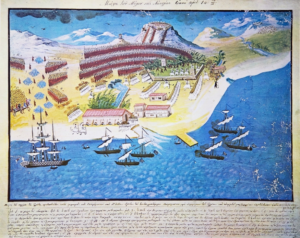
The Battle of the Mills was crucial for the survival of the Greek War of Independence. It halted Ibrahim Pasha’s forces for the first time, saved Nafplιο, which relied on the Mills for its water supply, and boosted both Greek morale and international public opinion, providing a significant impetus to the Philhellenic movement.
The Greek forces, numbering approximately 400 fighters, were commanded by Yiannis Makrygiannis and Dimitrios Ypsilantis. Opposing them was Ibrahim’s 6,000-strong Ottoman-Egyptian regular army, which included 600 cavalrymen.
What remains lesser-known, however, is the vital role that the Philhellenes played in this battle.
A portion of Ypsilantis’ fighters belonged to the first Greek regular army, established by the French General Charles Fabvier. This 60-man unit was led by Fabvier’s captain, Karpos Papadopoulos, a prominent Thracian fighter, member of the Filiki Etaireia, scholar, and ardent supporter of the Regular Corps and Fabvier.
The fortifications were devised and designed by Italian Philhellene Giovanni Montanelli, a soldier and graduate of the École Polytechnique in Paris. While Ypsilantis initially arrived at the Mills with 17 Philhellene volunteers, other sources indicate that dozens more participated as the battle unfolded. During the most critical phase of the Ottoman-Egyptian assault, the Philhellenes fought at the center of the defensive line alongside Makrygiannis.
The enemy launched their assault around noon on June 13th, intensifying their focus on the defense’s two weakest points: the center, held by Makrygiannis, and the right wing, defended by Ypsilantis, numerous regulars, and dozens of Philhellenes. A breach in the center would have exposed Makrygiannis’ irregulars and the right-wing defenders to a total massacre. Conversely, a defeat on Ypsilantis’ flank would have cut off the Greeks’ only escape route via the beach. After repelling three infantry attacks and one cavalry charge, the enemy artillery demolished part of Makrygiannis’ forward positions. A unit of Egyptian soldiers charged through the ruins. At this critical juncture, Makrygiannis, alongside five Philhellenes and a handful of brave fighters, launched a counteroffensive with swords, neutralizing the first infiltrators and routing the rest.
Present in the area were the British fleet under Philhellene Admiral Han Hamilton (at Nafplio) and the French fleet under Philhellene Admiral Henri de Rigny, whose flagship was stationed off the coast of the Mills. During the fighting, the French military band played the Marseillaise to encourage the Greeks. At a decisive moment, De Rigny’s flagship sounded the battle alarm and trained its guns on the Ottoman-Egyptian forces. This move greatly boosted Greek morale, signaling that foreign fleets were prepared to actively intervene.
The engagement was exceptionally fierce, costing the Ottoman-Egyptian forces about 200 dead and wounded. Among the few casualties on the Greek side (around seven men), one Philhellene lost his life. Notable participants included Montanelli, the Frenchman François Graillard (who was wounded and subsequently promoted to Colonel-in-Chief upon Ypsilantis’ recommendation), the American Jonathan Peckham Miller (who was also seriously wounded), and the Belgian Augustin (Guillaume) De Lannoy.
The Battle of the Mills had immense geopolitical consequences. It shattered the myth of Ibrahim’s invincibility, who until then had swept through the Peloponnese unchallenged (at Sphacteria, Maniaki, and Trambala). This marked the first time Ibrahim’s regular army was defeated by the Greeks in open combat. The victory saved Nafplio; as the city’s primary source of food and water, the fall of the Mills would have allowed Ibrahim to besiege the revolutionary capital, likely forcing its surrender and extinguishing the revolution. Admiral De Rigny’s subsequent report to the French government detailing the heroism of the Greeks and Philhellenes circulated widely across Europe, reigniting international Philhellenism and leading to increased financial and diplomatic aid in the months that followed.
Information: info@phmus.org