• Link to Facebook
  • Link to Instagram
  • EL
  • Communication
  • EL EL Ελληνικά el
  • EN EN EN en
  • The Society
    • Object
    • Advisory Committee
    • Scientific Committee
    • Friends of SHP / Philhellenism Museum
    • Donors – Sponsors
  • Actions
    • The Lord Byron International Prize
    • The Lord Byron Medal
    • International Philhellenic Committee
    • The Philhellenes’ Monument in Athens
    • Scholarships – Awards
  • Activities
    • News
    • Announcements
    • Presentations
    • Press – Media
    • Posts
    • Education
    • Lord Byron
      • The romantic poet
      • The celebrity
      • Lord Byron’s entourage
      • The Philhellene fighter
      • The international Lord Byron Prize
  • Archive
    • Philhellenes’ Archive
    • War of Independence – Historical names
    • Philhellenes
    • Video library
    • Library
  • Click to open the search input field Click to open the search input field Search
  • Menu Menu

Paul Emil Jacobs: A great painter and Philhellene

Biographies

Paul Emil Jacobs (August 20, 1802 – January 6, 1866) was a leading Orientalist German painter, noted for Orientalist themes, portraits and nudes, as well as subjects from the classical mythology.

Paul Emil Jacobs was the son of the philologist Frederick Jacobs. He received his art training at the Munich Academy of Fine Arts and first became known for his painting of Mercury and Argus (from Classical mythology). In 1824 he went to Rome, where he attracted critical attention by painting “The Raising of Lazarus”. In 1836 he made a series of historical paintings at the Welfenschloss in Hannover.

Jacobs was noted for his mastery of nudes, expressed particularly in the representation of such Orientalist themes as “A slave market” or of sleeping and waking naked boys.

Graceful depictions of the female body include his “A Harem Beauty At Her Toilette”. His image of Scheherezade from Arabian Nights is noted for its light effects. The famous Ali Pasha was depicted by Jacobs in a moment of relaxed intimacy with Kira Vassiliki.

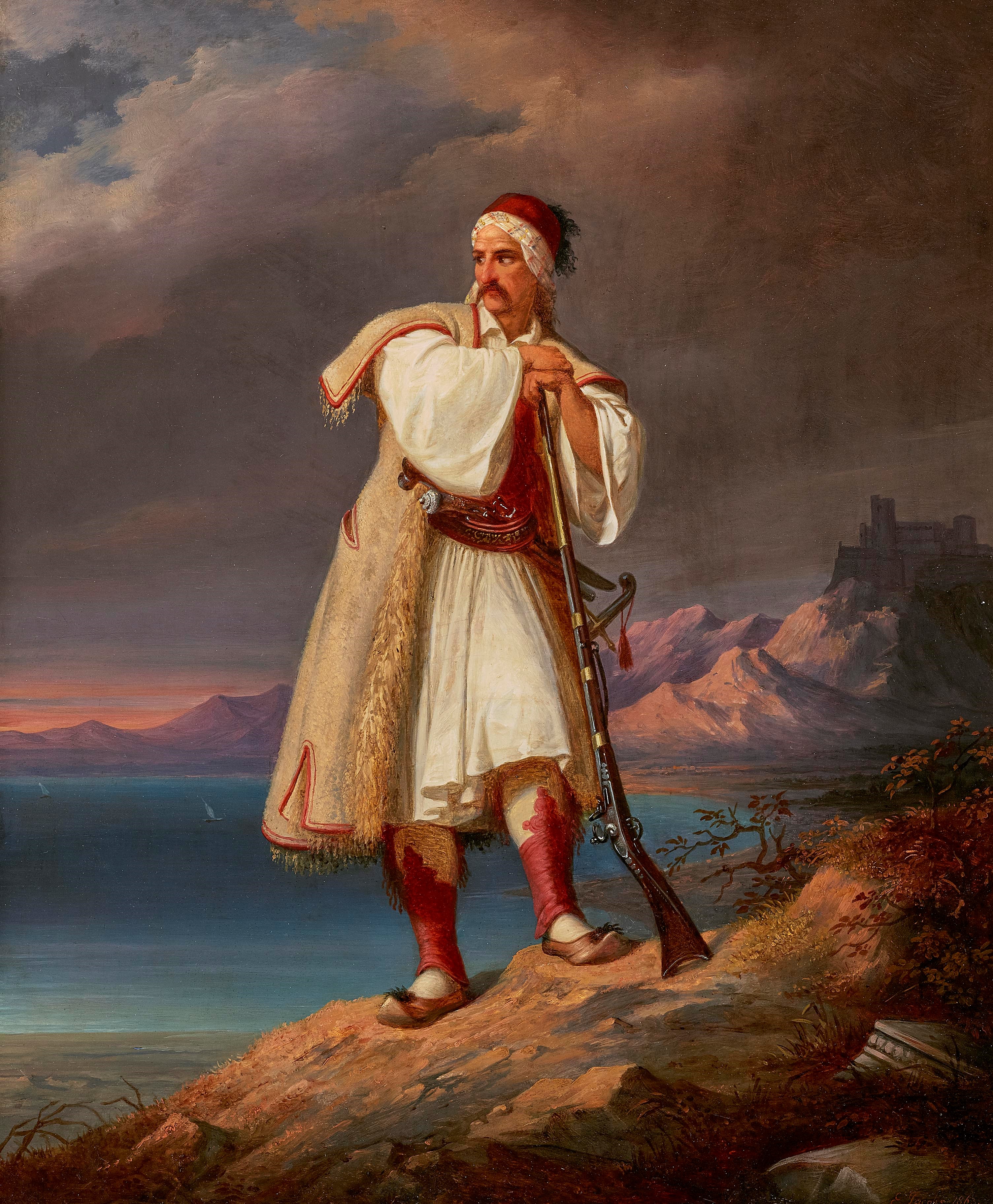
Like many Europeans of his generation, Jacobs was a Philhellene who expressed sympathy for the Greek War of Independence, which took place when he was in the early stage of his artistic career. This was manifested through various paintings showing sympathetic pictures of “Greek Freedom Fighters”, remarkable and powerful scenes from the Greek War of Independence and scenes showing Greek slaves.

Jacobs was also a portrait painter. Lithographed portraits by him include those of Goethe, Karl Gottlieb Bretschneider and Döring.

In 1844, Jacobs created the monumental altarpiece “Calvary”, for St. Augustine’s Church in Gotha (his birthplace). It was removed from St. Augustine’s in 1939, and since 1998 the altarpiece has been located in the church of Hohenleuben.

Jacobs was married to Louise Jahn, and his grandson Emil Jacobs (1868–1940) was a librarian and head of the library at the University of Freiburg.

His artistic work of Philhellenic inspiration had a strong impact in Europe and inspired many generations of Greeks and Philhellenes around the world.

The SHP has 4 emblematic paintings of Paul Emil Jacobs in its collection, and it will prepare in the following months an event in Athens, Greece, to honor this great painter and his contribution to Hellenism and Philhellenism.


The Paul Emil Jacobs monument in Gotha


Paintings of Paul Emil Jacobs in the collection of the SHP


4 June 2019
Share this entry
  • Share on Facebook
  • Share on X
  • Share on Pinterest
  • Share on LinkedIn
  • Share on Tumblr
  • Share on Vk
  • Share on Reddit
  • Share by Mail
https://www.eefshp.org/wp-content/uploads/2019/06/PEJ_front.jpg 1000 1000 Admin https://www.eefshp.org/wp-content/uploads/2019/05/logo_eefshp_svg_EN.svg Admin2019-06-04 16:21:232020-05-04 15:49:04Paul Emil Jacobs: A great painter and Philhellene

Search

Search Search

Latest Posts

  • The West refuses to assign Cyprus to the Ottomans24 July 2026 - 10:50 am

    A painting by the Italian Philhellene Giuseppe Lorenzo Gatteri (1829–1884) from the collections of the Philhellenism Museum. In this rare artwork, the distinguished history theme painter Gatteri depicts Marcantonio Bragadin (1523–1571), the heroic defender of Famagusta during the Ottoman siege (1570–71), refusing to surrender the city to them. The female figure on the right side […]

  • “Odysseus and Nausicaa” (Odysseus und Nausikaa)19 July 2026 - 7:42 pm

      Oil painting by the German painter Carl Fielgraf (1804–1865) from the collections of the Philhellenism Museum. In light of the recent discourse surrounding Christopher Nolan’s new film “The Odyssey”, and specifically the discussion regarding the female emancipation in Homer’s work, we present this painting to highlight that the figure of Nausicaa represents a progressive […]


Terms of Use

Sponsor: EUROPEAN DYNAMICS

Created by: SCHEMA

Link to: National Herald – 22 March 2019 Link to: National Herald – 22 March 2019 National Herald – 22 March 2019 Link to: Le philhellénisme en France au 18eme et 19eme siècle Link to: Le philhellénisme en France au 18eme et 19eme siècle Le philhellénisme en France au 18eme et 19eme siècle
Scroll to top Scroll to top Scroll to top