• Link to Facebook
  • Link to Instagram
  • EL
  • Communication
  • EL EL Ελληνικά el
  • EN EN EN en
  • The Society
    • Object
    • Advisory Committee
    • Scientific Committee
    • Friends of SHP / Philhellenism Museum
    • Donors – Sponsors
  • Actions
    • The Lord Byron International Prize
    • The Lord Byron Medal
    • International Philhellenic Committee
    • The Philhellenes’ Monument in Athens
    • Scholarships – Awards
  • Activities
    • News
    • Announcements
    • Presentations
    • Press – Media
    • Posts
    • Education
    • Lord Byron
      • The romantic poet
      • The celebrity
      • Lord Byron’s entourage
      • The Philhellene fighter
      • The international Lord Byron Prize
  • Archive
    • Philhellenes’ Archive
    • War of Independence – Historical names
    • Philhellenes
    • Video library
    • Library
  • Click to open the search input field Click to open the search input field Search
  • Menu Menu

Naval Battle of Navarino, a decisive victory for modern Greece
News, Νέα


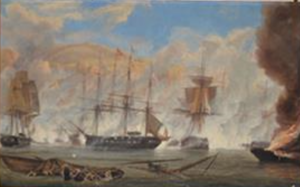
At noon on October 20th, 1827, in the bay of Navarino, in the bay of Pylos in the Western Peloponnese, one of the largest natural harbors in the world, one of the most brilliant victories of the Greek War of Independence and the greatest naval disaster in world history took place.

In 1827, a year after the Exodus of Messolonghi, the looting, barbarities and atrocities against the Greeks strengthened Philhellenism in Europe. The Great Powers intervened in the Greek question, supporting the Greeks and paving the way for independence with the Naval Battle of Navarino.

The British Philhellene Prime Minister George Canning, has given clear instructions to implement the Treaty of London, even by force of arms. British Admiral Edward Codrington enters the Bay of Pylos with his fleet, and sends a Greek officer to deliver a message to Ibrahim. He is shot by a Turkish sailor and the naval battle begins.

The naval Battle of Navarino is the culmination of naval operations during the Greek War of Independence and the only naval battle worldwide that took place with anchored ships. The Turkish-Egyptian fleet, with 89 warships and over 100 including the transport ships, estimates that it is superior to the only 27 ships of the allies and opens fire.

The ships were so close that their masts were entangled. The noise of the cannons echoed in Zakynthos and Kythera, while clouds of smoke covered the wider area. The allied ships, in addition to the cannons of the opponents, also faced cannons from the Turkish forts on mainland. By the afternoon, the seamanship of the allies and the unity of the Greeks had determined the victory. The armistice was signed aboard Codrington’s flagship.

European public opinion perceives the victory at Navarino as a victory of civilised peoples who united to reverse the bloodshed of the struggling Greeks. It was the first military operation in history aimed at supporting a nation struggling for its independence.

During the 20th century, Jacques-Yves Cousteau explored the bottom of the bay, even locating wrecks of the ships that participated in the naval battle, evidence of Greece’s struggle for freedom.

On three islands surrounding the Bay of Navarino, an equal number of monuments commemorate the contribution of the allied Philhellenes to the creation of the independent Greek state, while in the center of Athens three streets bear the names of the Philhellenes who led to the historic victory (Codrington, Derigny, Hayden).

At the Philhellenism Museum, important historical documents, rare works of art, and personal belongings of leading figures depict the emblematic Naval Battle of Navarino.


Above is depicted an 1831 oil painting by the British painter John Christian Schetky (1778-1874)


Information:

SHP | Philhellenism Museum

www.eefshp.org  | www.phmus.org

T. +30 2108094750

20 October 2025
Share this entry
  • Share on Facebook
  • Share on X
  • Share on Pinterest
  • Share on LinkedIn
  • Share on Tumblr
  • Share on Vk
  • Share on Reddit
  • Share by Mail
https://www.eefshp.org/wp-content/uploads/2025/10/NavarinoSPHPhoto.jpg 755 1200 elpiniki https://www.eefshp.org/wp-content/uploads/2019/05/logo_eefshp_svg_EN.svg elpiniki2025-10-20 14:09:112025-10-20 14:09:11Naval Battle of Navarino, a decisive victory for modern Greece

Search

Search Search

Latest Posts

  • The West refuses to assign Cyprus to the Ottomans24 July 2026 - 10:50 am

    A painting by the Italian Philhellene Giuseppe Lorenzo Gatteri (1829–1884) from the collections of the Philhellenism Museum. In this rare artwork, the distinguished history theme painter Gatteri depicts Marcantonio Bragadin (1523–1571), the heroic defender of Famagusta during the Ottoman siege (1570–71), refusing to surrender the city to them. The female figure on the right side […]

  • “Odysseus and Nausicaa” (Odysseus und Nausikaa)19 July 2026 - 7:42 pm

      Oil painting by the German painter Carl Fielgraf (1804–1865) from the collections of the Philhellenism Museum. In light of the recent discourse surrounding Christopher Nolan’s new film “The Odyssey”, and specifically the discussion regarding the female emancipation in Homer’s work, we present this painting to highlight that the figure of Nausicaa represents a progressive […]


Terms of Use

Sponsor: EUROPEAN DYNAMICS

Created by: SCHEMA

Link to: Conference: The French Scientific Mission of Morea today – Discovering the Peloponnese Link to: Conference: The French Scientific Mission of Morea today – Discovering the Peloponnese Conference: The French Scientific Mission of Morea today – Discovering the... Link to: Invitation, Finnish Institute at Athens Link to: Invitation, Finnish Institute at Athens Invitation, Finnish Institute at Athens
Scroll to top Scroll to top Scroll to top