Painting by the German painter Christian Johann Georg Perlberg (1806-1884). It depicts an emblematic figure of a Greek fighter (dimensions 65 cm x 53 cm without the margins).


SHP and the Philhellenism Museum present a series of reproductions of emblematic paintings of the Museum’s collection. The copies are of excellent quality and are printed on canvas.

Price: 33 Euros

For orders:
Code: ASP1
Tel: 6974750361
email: info@eefshp.org


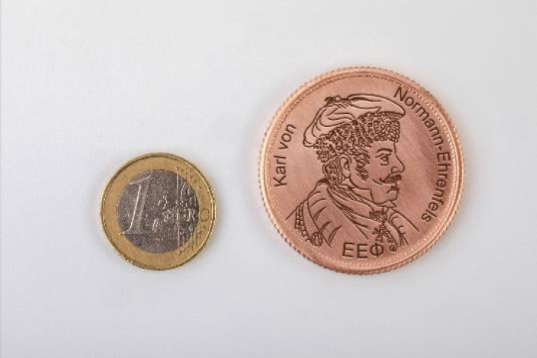
Third medal: The Polish Philhellene Franciszek Mierzejewski


After the first quadrilingual and luxurious anniversary edition related to the Philhellenism, we present an impressive collection of medals depicting 10 emblematic Philhellenes and 20 Greeks who contributed to the liberation of Greece.

Side A (recto) of the medal presents the emblem of the Friendly Society (Filiki Etairia), which organized the Greek Revolution, based on the values ​​of Hellenism and Philhellenism. Side B (verso) presents the figure of an important Philhellene or Greek actor of the Greek Revolution. The design and implementation of the medals is a product of the work of the Greek creator Mr. Thanassis Dovas, in collaboration with SHP and the Museum of Philhellenism.

The medals have a diameter of 40 mm and a thickness of 3.5 mm. They are offered in bronze, brass and silver, and are available individually (in a package of one medal) or in a case of ten.

Medal price (bronze or brass): 49 Euro.
Medal price (silver 925): 99 Euro.

For orders:
Tel: 6974750361
email: info@eefshp.org


Second medal: George Gordon Noel Byron, Lord Byron


After the first quadrilingual and luxurious anniversary edition related to the Philhellenism, we present an impressive collection of medals depicting 10 emblematic Philhellenes and 20 Greeks who contributed to the liberation of Greece.

Side A (recto) of the medal presents the emblem of the Friendly Society (Filiki Etairia), which organized the Greek Revolution, based on the values ​​of Hellenism and Philhellenism. Side B (verso) presents the figure of an important Philhellene or Greek actor of the Greek Revolution. The design and implementation of the medals is a product of the work of the Greek creator Mr. Thanassis Dovas, in collaboration with SHP and the Museum of Philhellenism.

The medals have a diameter of 40 mm and a thickness of 3.5 mm. They are offered in bronze, brass and silver, and are available individually (in a package of one medal) or in a case of ten.

Medal price (bronze or brass): 49 Euro.
Medal price (silver 925): 99 Euro.

For orders:
Tel: 6974750361
email: info@eefshp.org


The Nike untying her sandal is the symbol of the Museum of Philhellenism. The great sculptor George Vroutos (1843-1908), completed the ancient sculpture of the 5th century BC, from the parapet of the temple of Apteros Nike on the Acropolis, and rendered its original beauty. This modest Nike, which is placed at the entrance of the Philhellenism Museum, leans slightly her body to untie her sandal entering the sanctuary, as a sign of respect for the contribution and sacrifices of the Philhellenes to Greece, the memory of which is honored by the Museum.

The Greek designer Mr. Thanassis Dovas, designed and implemented, in collaboration with SHP and the Philhellenism Museum, a collectible jewel for the opening of the Museum and the anniversary of 1821-2021.

The frame of the jewelry is made of silver (925) and hosts the sandal wearing Nike. Each piece of jewelry is numbered.

Price: 55 Euro

For orders:
Tel: 6974750361
email: info@eefshp.org


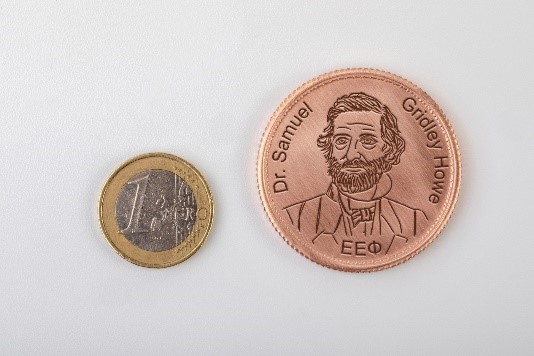
First medal: The American Philhellene Dr Samuel Gridley Howe


After the first quadrilingual and luxurious anniversary edition related to the Philhellenism, we present an impressive collection of medals depicting 10 emblematic Philhellenes and 20 Greeks who contributed to the liberation of Greece.

Side A (recto) of the medal presents the emblem of the Friendly Society (Filiki Etairia), which organized the Greek Revolution, based on the values ​​of Hellenism and Philhellenism. Side B (verso) presents the figure of an important Philhellene or Greek actor of the Greek Revolution. The design and implementation of the medals is a product of the work of the Greek creator Mr. Thanassis Dovas, in collaboration with SHP and the Museum of Philhellenism.

The medals have a diameter of 40 mm and a thickness of 3.5 mm. They are offered in bronze, brass and silver, and are available individually (in a package of one medal) or in a case of ten.

Medal price (bronze or brass): 49 Euro.
Medal price (silver 925): 99 Euro.

For orders:
Tel: 6974750361
email: info@eefshp.org


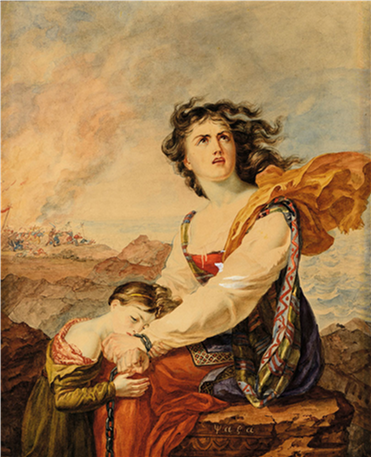
The desctruction of Psara, painting by Suzanne Elisabeth Eynard (1775-1844), daughter in law of the great Swiss Philhellene J. G. Eynard


Dear friends,

2020 was a difficult year for all of humanity, with unprecedented challenges and restructuring caused by the pandemic. However, it was also a year that confirmed the importance of the values ​​that Hellenism stands for, on which our societies are based.

In 2021 we celebrate the 200th anniversary of the Greek Revolution, of which Philhellenism was a central pillar. This Revolution led to the establishment of the Greek state, which is today the guardian of the values ​​of the western world.

The Society for Hellenism and Philhellenism participates in the festive events with many important actions which will be announced soon.

The first of these actions concerns the establishment of the Museum of Philhellenism, which will be inaugurated in January 2021.

We also released our first edition. The book – diary on Philhellenism (information – orders: info@eefshp.org / +30 6974 750361 ).


Many other editions will follow.

Our aim remains to promote the principles of Hellenism and Philhellenism internationally, and to encourage the societies inspired by them, to find a position and an equal role on the side of the Greeks, who continue to be the guardians of the humanistic values. We will aim to launch a new philhellenic movement for the 21st century.

We thank you all for your interest in contributing to our work. In this regard, we are preparing a framework for the involvement of our friends and volunteers, which will be soon presented to you (in line with the progress of COVID19).

We wish you all a Merry Christmas and Happy and Creative Anniversary Year 2021.

Society for Hellenism and Philhellenism

info@eefshp.org


SHP is pleased to announce the participation of Professor Michalis Tiverios, member of the Academy of Athens, in its Advisory Committee.

Michalis A. Tiberios studied at the Faculty of Philosophy of the University of Thessaloniki and was awarded a doctorate by the institute in 1976. He completed his studies at the Archaeological Institute of Bonn, as a fellow of the Alexander von Humboldt Stiftung (1977-1979). From 1975 to 2014, when he retired receiving the title of Emeritus Professor, he taught (as of 1987 as a primary professor) at the Faculty of Philosophy of the Aristotle University of Thessaloniki in the Department of History and Archeology. From 1989 to 1993 he was the President of this Department, while from 1997 to 1999 he was the Director of the Postgraduate Studies. He conducted excavations, among others, in the ancient settlements located near today’s Sindos (1990-2002) and in Karabournaki of Thessaloniki (1994-2014).

In 2011 he was elected a full member of the Academy of Athens in the Class of Letters and Fine Arts at the Chair of Archeology [Ceramics]. He was, among others, a member of the plenary session of the Greek National Commission for UNESCO, a member of the National Advisory Council for Research (1994-98), a member of the National Council for Research and Technology (2001-04 and 2008-09) and a member of the Board of Directors of the Educational Institution of the National Bank (1995-2015). He is a member of many scientific committees and institutes, such as the Academia Scientiarum et Artium Europaea and the German Archaeological Institute in Berlin. In 1999 he was proclaimed Honorary Doctor by the University of Bern.


Armenia and the people of Armenia, are once more under attack by the forces of Azerbaijan, assisted by the Neo-Ottoman regime of Erdogan, which uses violence and terror to impose itself in the broader region, constituting a major threat for peace and for the values of our western civilization (Armenia being one of its pillars).

This article will reveal an unknown period of the life of Lord Byron, during his stay in Venice in 1816.

Plaque outside the Armenian Monastery in the island of San Lazzaro in Venice
“To the memory of the English Poet,
LORD BYRON,
Devoted friend of Armenia,
Who died for the liberation of Greece.”

“The visitor will be convinced that
There are other and better things
Even in this life.”
Byron, 1788 – 1824

During his visit in Venice in 1816, Lord Byron studied the Armenian language at the Armenian Monastery in the island of San Lazzaro, he assisted in the preparation of the first Armenian – English dictionary and financed its first publication.

On 5 December 1816, Byron wrote in a letter to his friend Thomas Moore:

“By way of divertisement, I am studying daily, at an Armenian monastery, the Armenian language. I found that my mind wanted something craggy to break upon; and this — as the most difficult thing I could discover here for an amusement — I have chosen, to torture me into attention. It is a rich language, however, and would amply repay any one the trouble of learning it. I try, and shall go on;—but I answer for nothing, least of all for my intentions or my success.”
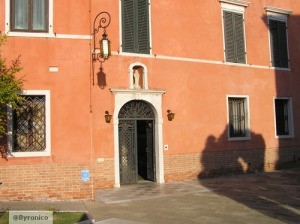
Entrance to the monastery at San Lazzaro degli Armeni, Venice

The island of San Lazzaro was the world’s centre for Armenian culture since 1717, the year in which it was donated to the Armenian abbot Mekhitar, the founder of the Mekhitarist order, a congregation of Benedictine monks of the Armenian Catholic Church. This is probably the most important repository of Armenian culture outside Armenia, with a museum and a library containing manuscripts and rare editions, like “Byron’s grammar”. The monastery was considered by Napoleon a cultural institution, which let it survive the Emperor’s decision to abolish all religious institutions in the city of Venice.

In the same letter of 5 December 1816, Byron went on:

“There are some very curious MSS. in the monastery, as well as books; translations also from Greek originals, now lost, and from Persian and Syriac, &c.; besides works of their own people.”

Manuscripts and books in Byron’s studio


Byron was conveyed every day by gondola to San Lazzaro, where he often remained in the convent from morning until evening working in a room and in the library, where he studied Armenian.


In spite of Byron’s efforts, the language proved to be very difficult to master.

“To Hobhouse, 19 December 1816

My Armenian lectures still continue. I have about mastered thirty of the thirty-eight cursed scratches of Mesrob, the maker of alphabets, and some words of one syllable. My lessons are in the Psalms and Father Pasqual is a very attentive preceptor.”

The monks devoted their time in teaching Byron their language, who, in turn, to repay them for the tuition he received, financed the publication of the Librarian’s Armenian-English grammar:

“By way of requital for his instructions (as I could not offer sordid money to these friars), I have taken upon me the expenses of his Armenian and English grammar, which is now printing. It costs but a thousand francs to print five hundred copies, and being the first published in these joint languages, I think ”I do the state some service,” almost as much as Mr. Valpy of Tooke’s Court, who is Polidori’s printer.”

AUCHER, P. Paschal. A Grammar of Armenian and English. Venice: The Armenian Press of St. Lazarus, 1832. The second improved and enlarged edition. “In the present edition will be found some specimens of Armenian Poetry, and some translations of Lord Byron from the Armenian into English; and there are added, by way of exercise, extracts from the best Armenian writers”.

In another letter of 24 December 1816, to Mr. Moore, he wrote:

“My ‘way of life’ is fallen into great regularity. In the mornings I go over in my gondola to hobble Armenian with the friars of the convent of St. Lazarus, and to help one of them in correcting the English of an English and Armenian grammar which he is publishing.”

In the letter of 27 December 1816 he gives once again details of this daily routine, as well as of Father Pasquale:

“I am going on with my Armenian studies in a morning, and assisting and stimulating in the English portion of an English and Armenian grammar, now publishing at the convent of St. Lazarus. The superior of the friars is a bishop, and a fine old fellow, with the beard of a meteor. Father Paschal is also a learned and pious soul. He was two years in England.”

Finally, in another letter, Byron mentions a preface he had written and that was unfortunately omitted from the Grammar. The reason was probably because Father Pasquale objected to the reference to the Turks, as the Armenian people lived under Turkish rule. Byron took this refusal very badly and the fact that Father Pasquale agreed to add Byron’s name to the grammar constitutes a sign of reparation.

The Museum inside the convent at San Lazzaro

Byron’s portrait in his studio at San Lazzaro

The following quote from the fragment from one of his letters, seems to have been intended as a Preface to the Grammar, which was unfortunately omitted when it finally appeared:

To Mr Murray, Venice Jan 2, 1817

“The English reader will probably be surprised to find my name associated with a work of the present description, and inclined to give me more credit for my attainments as a linguist than they deserve.

“As I would not willingly be guilty of a deception, I will state, as shortly as I can, my own share in the compilation, with the motives which led to it. On my arrival at Venice in the year 1816, I found my mind in a state which required study, and study of a nature which should leave little scope for the imagination, and furnish some difficulty in the pursuit.

“At this period I was much struck—in common, I believe, with every other traveler — with the society of the Convent of St. Lazarus, which appears to unite all the advantages of the monastic institution, without any of its vices.

“The neatness, the comfort, the gentleness, the unaffected devotion, the accomplishments, and the virtues of the brethren of the order, are well fitted to strike the man of the world with the conviction that ‘there is another and a better’ even in this life(…)

Piazza San Marco seen from San Lazzaro. One can see the bell tower of San Giorgio Maggiore at the right of the bell tower of San Marco.


SOURCES – BIBLIOGRAPHY

Massimo Vangelista, article in Byronico.com


On May 19, 1919, Mustafa Kemal, landed in Samsous and carried out the second and most cruel phase of the Pontian genocide, which ended in 1923. More than 350,000 people were killed by those who founded the modern Turkish state, after they exterminated every Christian element in Ionia and Pontos. Greeks, Armenians, Assyrians, Chaldeans and many other peoples, disappeared from the land in which they lived for thousands of years.

The Turkish state ignores the millions of casualties that it caused, and continues to take an arrogant and offensive stance, refusing to apologize and offer reparations. Instead, it is ready to carry out similar atrocities throughout the region, from Libya to Syria.

The photos shows scenes from the atrocities and deportations suffered by the Greek population of Pontos.


24 April 1915 is a sad day in the history of mankind. The Turks started the first organized genocide of 1,500,000 Armenians. Along with the genocide of Greeks in Asia Minor and Pontos, as well as other peoples of the region (Assyrians, Chaldeans, etc.), Turkey managed to brutally exterminate the Christian population that lived there for many centuries.

The Armenian Genocide is the second greatest crime against humanity (after the Holocaust of the Jews during World War II), which remains unpunished. The perpetrators still defiantly refuse to acknowledge it and even apologize to the proud Armenian people.

Humanity honors the memory of all those victims and especially of the thousands of women who were horribly slaughtered by the Turks.

The SHP reminds that the commitment to the values ​​of freedom, democracy and humanity, advocated by Hellenism and Philhellenism, is a guarantee for the avoidance of such acts in the future.

The photo shows scenes from the martyrdom of the Armenians as described by eyewitness Aurora Mardiganian and the monument to the genocide in Yerevan, Armenia.