INVITATION

FINNISH INSTITUTE AT ATHENS

October 30th, 2025, at 7:00 pm


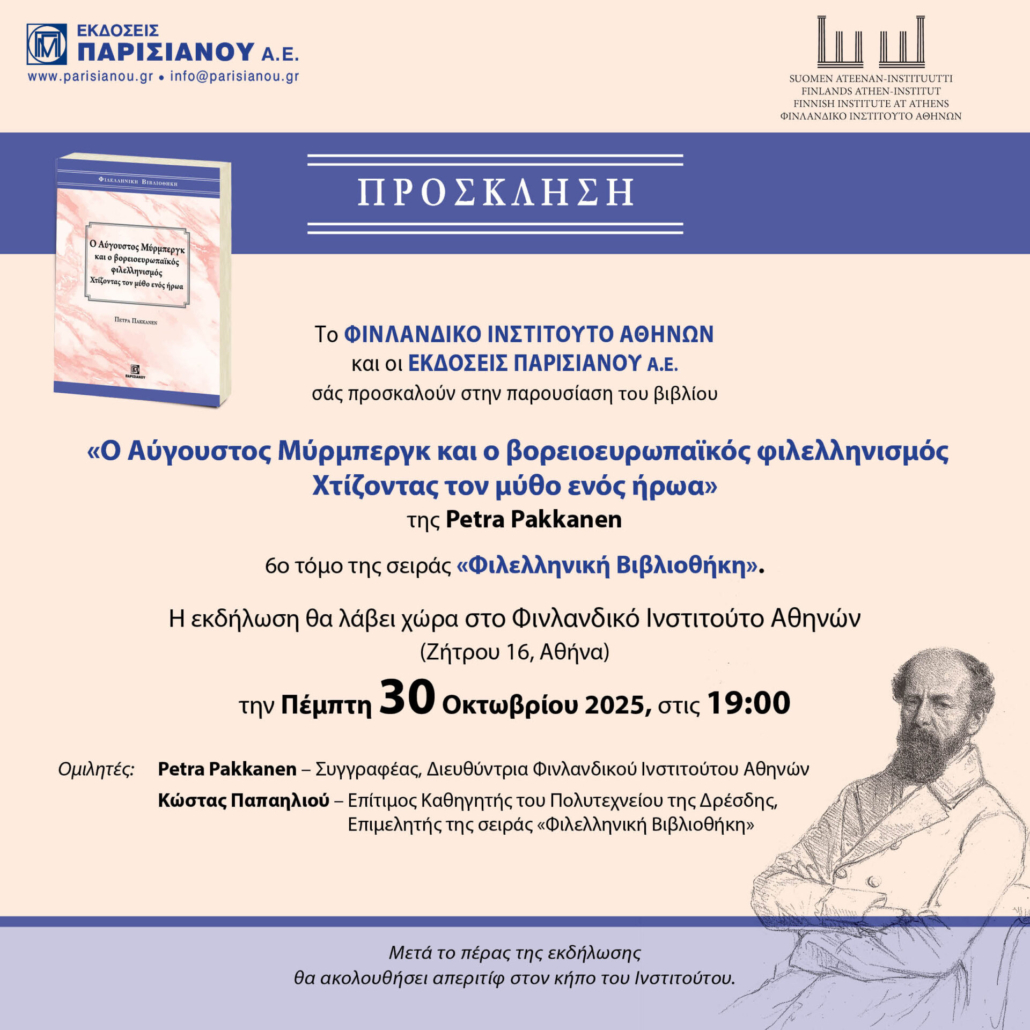
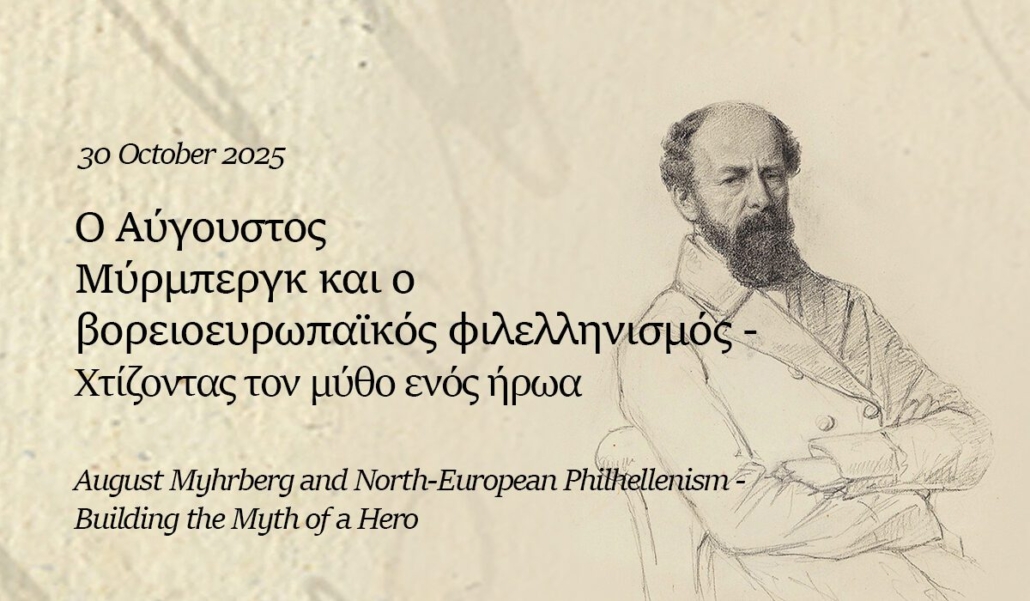
The Finnish Institute at Athens and the Vice-President of the Society for Hellenism and Philhellenism, Professor Emeritus of the Technical University of Dresden, Costas Papailiou, invite you on Thursday, October 30 at 7:00 p.m. to the presentation of the book: August Myhrberg and Northern European Philhellenism – Building the Myth of a Hero.

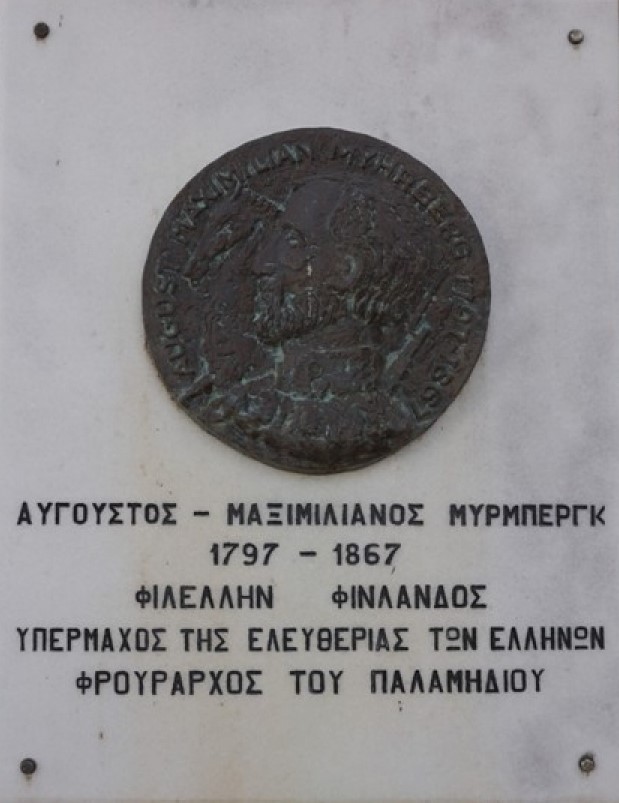
The author of the publication is the distinguished historian Petra Pakkanen, Director of the Finnish Institute at Athens. The Finnish Philhellene Auguste Maximilian Myhrberg served as commander of the Palamidi fortress until 1831. In 2009, in the presence of the Finnish Minister of Culture Stefan Wallin, the unveiling of the relief bust of the Philhellene Myhrberg took place near the Venetian Land Gate in Nafplio.

The edition will be included in the “Philhellenic Library” publishing series of Parisianou Publications.

A reception will follow at the Institute’s garden.


Information:

Finnish Institute at Athens

16 Zitrou, 11742 Athens

office@finninstitute.gr

+30 210 922 1152


BY JIM SMYTH


ABSTRACT

In his book, The Philhellenes, C.M. Woodhouse comments:

“Again and again, it will be found in the story of the Philhellenes that they originated from the minority peoples of the British Isles” (p.64)

Yet he offers no more than a cursory explanation for this, and other writers on the topic tend to use the collective term “British” for all participants.

Given that this is formally accurate since English colonialism had long brought the so-called Celtic Fringe under its control – however challenged this control was in reality – it begs the question as to what motivated this group to engage with the Greek War of Independence as opposed to the minimalist involvement of the English themselves.

In raw numbers Irish participation was small, numbering about 40. However, among that number there were individuals who played an important part in a number of crucial areas: political, military, fund raising, journalistic and other literary activities. This would include participants such as Richard Church, Charles Napier, Rowan Hamilton, Edward Blaquiere, Thomas Moore and James Emerson[1].


THE COLONIAL INHERITANCE: GREECE AND IRELAND

The actual geographical possession of land is what empire is in the final analysis all about.

  • Edward Said[2]

Although while Ireland and Greece do not share a common history, they were both subjected to domination for centuries: four in the Greek case and double that for Ireland. Said’s ‘final analysis’ is clearly correct, and it marks a starting point. Colonial domination takes many forms, and the enforced possession and exploitation of land differs from case to case. These differences structure both social and economic realities, as well as forms of resistance.

These different models of domination had important consequences for the emergence of social movements which were eventually to coalesce around a struggle for nationhood. Geography played a part: Ireland, an island floating on the edge of Europe, was insulated from the bloody struggles which consumed the continent for centuries starting with the decline of Roman rule. The affinity with a historical past -a central aspect of nationalist ideology- was fractured for Greek speakers by centuries of Roman occupation followed by the impact of Byzantine rule and after the final implosion of this Empire in 1453 to be followed by four centuries of Ottoman domination.[3] In contrast, it was not until the Anglo-Norman invasion of the 12th century that the very nature of Irish culture was challenged on the general grounds that the “mere Irish” were uncivilized barbarians[4]. To achieve the objective of seizing, occupying and making a claim to ownership, England saw no option of a compromise with the Irish-apart from a small minority they could coerce or bribe into submission.[5] One important consequence of this was the creation of a disaffected population that refused to accept the rule of a small clique- the “Ascendency” that had confiscated their land by force and regarded the masses as ‘a seething mass of barley repressed sedition.

The impact of the French Revolution had caused turmoil the length and breadth of Europe and as much in Ireland as anywhere else. Conflict in Ireland over the previous two centuries had scattered the Irish all across Europe as soldiers of fortune in the armies of Austria, Spain and, in particular France. Irish Colleges spread across the continent for the education of priests as well as displaced Irish and their sons. These connections ensured that ideas underpinning the revolution soon reached Irish shores. As in pre-revolutionary France, the creation of public opinion through the medium of newspapers, broadsheets and pamphlets was a crucial motor of revolution. A single subversive text in whatever form, in the hands of a single literate individual, was sufficient to spread revolutionary ideas to a whole-already discontented – community. The United Irishmen, a radical movement that emerged in the wake of the French Revolution was made up of -initially- members of the urban middle classes in Belfast and Dublin and, crucially, membership crossed the religious divide. The organisation was adept at harnessing the power of print and by 1796 newspapers were ‘universally’ read and the common people were aware of events passing on the continent. The first newspaper to be published in Ireland was the Belfast News-Letter in 1737 and the United Irishmen, founded in 1791 was quick to produce a more radical press, The Northern Star, in 1792 in an attempt to use the new media form as a tool of political education. A similar process was underway in Dublin:

‘By the 1790s in Dublin there were at least fifty printers in Dublin, thirty-four Irish provincial presses….and at least forty newspapers in print. There were fifteen booksellers and printers in the Dublin Society of the United Irishmen.’[6]

The impetus for change began in the cities of Belfast and Dublin, the latter already the ‘second city of Empire’ with more than a hundred thousand inhabitants and a centre of commerce and administration and it was through the medium of print that the movement spread to the country as a way of bringing in secret societies such as the Defenders that were initially formed to achieve agrarian reform, by force if necessary. The situation in Greece was significantly different[7]. Newspapers, initially handwritten, began to appear in Greece around 1821 with the first printing presses arriving from abroad around the same date. The first printed newspaper, Salpinx Eliniki appeared in Kalamata in August 1821 but ceased publication after three issues. It was not until 1828 that print journalism began to find its feet but again it was bedevilled by short print runs, poor circulation and political interference. The general attitude seems to have been: ‘The press is free, as long as you don’t write’[8].

The emergence of urbanisation, literacy and radicalism in late 18th century Ireland had, paradoxically, much to do with the land question. While the Ottomans were content with the extraction of taxes and rent, land in Ireland fast became a commodity to be bought and sold. In many ways Ireland was a laboratory for the testing out of the colonial project that was to expand to a global empire[9]. This was nowhere more evident than in the form developed for the confiscation and control of land. The Ottomans were colonisers in the basic form of gaining the control of land by force, but they did not, to any great extent, dispossess those who had worked the land directly under Byzantine of feudal rule. While ownership of the conquered lands was vested in the Sultan and a complex system of taxation imposed, private property in land was prohibited although the use of the land was passed from father to son[10]. This had the effect of slowing the emergence of an organized and discontented dispossessed population, as in Ireland, filled with seething resentment at their situation and liable to revolt at any opportunity[11]. As land was not a commodity under Ottoman rule there was little basis for the emergence of an urban middle class as in Ireland as a further potential source of radical ideas.

Unlike the Ottomans the English state was not in a position to retain direct control of the occupied lands in Ireland. The numerous military campaigns had nearly bankrupted the state and by the end of another military campaign in the 1690s the question became critical: how to dispose of the confiscated Irish estates to pay down the government debt[12]. In essence, the lands were offered for sale thus opening a market for land, that not only further enraged the native population- apart from those who managed, by hook or by crook, to acquire lands themselves-and created a middle class of brokers, accountants, lawyers etc. as well as an enlarged state bureaucracy and occupying military. This led to the further formation of an urban middle class and the circulation of revolutionary ideas which were to take hold in the last decade of the 18th century[13].

The objectives of the United Irishmen were radical and, however confused, pointed towards the “freedom of Ireland’ and a clear rejection of English rule. The leadership of the rebellion were mainly of the urban middle classes -both Protestant and Catholic- although artisans, weavers, printers, and other tradesmen made up a significant part of the urban membership. Support for the United Irishmen whose cause could be described as ‘Enlightenment anticolonialists’[14] crossed a broad spectrum of opinion both in Ireland and England including such unlikely figures as (Irish born) Edmund Burke -philosopher and statesman- and Richard Brinsley Sheridan, a prominent London based -and Irish born- playwright[15]. Both were Members of Parliament and Burke’s pamphlet Reflections on the Revolution in France, became a central and defining text of British conservatism.

For both the radicals and the conservatives the problem lay with the small clique of big landlords- the Protestant Ascendency[16]. From Burke’s point of view the Ascendancy, who defined themselves by religion, were the cause of the problem which could only be solved by the emancipation of the catholic population and the return of their lands. He concluded, somewhat optimistically, that this would lead them to accept the status quo. For others a successful rising would open the door to separation from England and the emergence of a Catholic middle class, stunted by the Penal Laws that forbade the ownership of land, entry into the professions and public administration and the practice of their religion although these laws were gradually being diluted from the early 1790s onwards[17].

In reality the Uprising failed. French support did not materialise to any significant extent, and the rebels, poorly armed and untrained, were no match for a British Army well-equipped with muskets, canon and mounted cavalry. Over 10,000 (at least) Irish lay dead, a number, taking into account population size, was probably more than died during the French Revolution[18].

The consequences of the failed uprising were profound. The rhetoric of independence and separation from England was now firmly on the agenda but the horrific nature of the repression of the uprising led others to push for reform rather than revolution and the mass movement for Catholic Emancipation led by Daniel O’ Connell was to dominate politics for a generation. For liberal Protestants, participants and sympathisers, the failure of the project led to a disengagement from politics. Many of them were executed, others narrowly escaped retribution and, as we will see, the majority of the Irish Philhellenes were the children of 1798, born between 1780 and 1800 to parents who were directly or indirectly involved in the uprising.


THE TWO GENERALS AND A SEA CAPTAIN: CHARLES NAPIER, RICHARD CHURCH AND GAWAN WILLIAM ROWAN HAMILTON

These three senior British Army and Naval officers all of Anglo-Irish background, played a significant part in the Greek struggle.

Charles Napier was born in London in 1782 but having moved to Ireland at the age of three spent his childhood there. His father was an Army officer of limited means but, in contrast, his mother, Lady Sarah Lennox, was extremely well connected with the English royal family being a great granddaughter of Charles the Second and King George the Third proposed marriage to her. She herself -and other members of her family- were well known for their radicalism. She attempted, unsuccessfully, to employ Jean Jacques Rousseau as tutor for her children. One of her sisters married the Anglo-Irish Duke of Leinster who was leader of the radical Patriot Party. One of their children -a first cousin of Napier- was Lord Edward Fitzgerald, a leader of the United Irishmen who died in prison during the 1798 rebellion. Another sister was married to Thomas Conolly, a catholic reform politician something that put Napier’s family at the heart of Irish radical/reform politics as they lived in close vicinity to his mansion in Celbridge, County Kildare[19]. One central preoccupation of the Radicals -that was to leave a permanent impression on Charles- was the question of agrarian reform in the interests of the rural poor. This, of course was a central issue in Ireland where the landlord class, intent on extraction of rental income had little interest in any change. Indeed, the reality was that, if a tenant improved his rented land, the landlord would increase his rent accordingly.

The family background and their radical beliefs did not hinder them from purchasing Charles a commission in the British Army at the age of eleven. This was a far from uncommon practice among upper class English families. Younger sons had no rights of inheritance, and the choice was between entering the clergy, a profession, or the armed forces[20].

As Napier rose through the ranks, his radicalism did not seem to wane as a letter to his mother in June 1816 seems to testify[21]. Yet this radicalism took second place to his role as a British Officer and colonial administrator. He was appointed in March 1822 to be military Resident of Cephalonia with the power of martial law based on the principle that ‘The natives …could not be safely entrusted with power’[22]. Here we begin to see the nature of Napier’s radicalism. As in his criticism of politicians and landlords in Ireland -and England- he blamed the power holders, but not the common people as a proper colonialist would do. He enjoyed being a despot[23].

He also wrote about the Greeks: ‘Seeing how fit and unfit such a people were for war I longed to lead them and resolved to do so. The idea constantly arose that my destiny was to command a Greek army against the vile Turkish horde’[24].

He was, in fact, offered the post of commander of the Greek forces but it all came to nothing[25]. Although Napier was a strong and vocal supporter of Greek independence, this was tempered by his imperial mind-set, as he thought that the Ionian Islands should remain under English control because of its strategic importance for control of the Mediterranean Sea. Still, his radical bent did distinguish him from the bulk of his fellow officers and when he was ordered to confront the Chartist movement in the North of England- a cause for which he had some sympathy- he seems to have managed to control the situation without restoring to violence unlike some other Generals. Perhaps his mind-set is best summed up by the following quote: ‘…. but the Greeks are more like the Irish than any other people; so like, even to the oppression they suffer, that as I could not do good to Ireland the next pleasure was to serve men groaning under similar tyranny’[26].


Portrait of Lieutenant General Sir Charles James Napier


GENERAL SIR RICHARD CHURCH

If information on the early life of Charles Napier is extensive and accessible, the same cannot be said for Richard Church. He was born in Cork, Ireland, in 1784 to a Quaker merchant family and left home at sixteen to join the British Army. Given that the Quakers are pacifists, this would have been very unusual and he and his family were disowned by them yet he seems to have remained an ardent Christian during his lifetime- and also had good relationship with his family.

During his first posting –at the age of sixteen- to Egypt during the Napoleonic Wars in 1801- he developed a strong regard for the Greeks and nothing but contempt for the Turks:

‘The Greeks who are slaves to the Turks and are Christians, are as opposite a people as possible, a brave, honest, open generous people…If they make any money by trade, when it pleases the Turk to take it from him, and if he murmurs, death is his redresser. Oh, how I hate the Turks’[27].

One cannot but compare his attitude towards Greeks and Turks with that of Napier. Although both were horrified by the Ottoman treatment of the Greeks, an understandable reaction given their background and upbringing[28] in a country recently devastated by a colonial power they now served, Napier seems to have been driven by ambition and lust for fame, while Church devoted his life to the Greek Cause at some personal and professional cost. He has been described as: ‘… a fiery Bible-reading Irishman with an unusually deep connection to the Greeks’[29].

Although Church was more than sympatric towards the Greek cause and spent a large part of his modest fortune in support of it, his participation was beset by problems which faced all Philhellenes unfamiliar with the reality of Greek society and politics. This involved the difficulty of dealing with the fragmentary and divisive nature of Greek politics and factional infighting, the problem of setting up a regular style army in this context and, indeed, disputes among foreign participants themselves. His success as a military commander was a mixed one, from the debacle of the attempt to rescue the Greek garrison in Athens to his successful guerrilla campaign in western Greece aimed at extending the boundary of an independent Greece that, again, was marred by political interference and political infighting.

Yet he did gain the respect of the Greeks themselves and spent the rest of his life in Athens in the house purchased from the Scottish historian, George Finlay[30]. He died in Athens on March 20, one hundred and fifty years ago. He was given a state funeral and the inscription on his monument in the First Cemetery in Athens reads:

Richard Church, General, who, having given himself and all he had, to rescue a Christian race form oppression and to make a Greek nation, lived for her service and died among her people, rests here in peace and faith.

In general, most of the members of the British armed forces who embraced the Greek cause were either Irish or Scottish. Of all the British officers who served in the Ionian Islands, the Irish were the ones who supported more the Greek cause. Along with his engineering officer, John Pitt Kennedy, who was also Irish, Church was accompanied to the Ionian Islands by another Irish born officer, Hudson Lowe[31]. When Church returned to Greece in 1827 as Commander of the Greek land forces his two aide-de-camps were Irish: Charles O’ Fallon and Francis Castle.


General Church’s portrait


General Church’s pistol


Letter of Karaiskakis accepting the appointment of General Church to lead the armed forces of Greece


CAPTAIN GAWIN WILLIAM ROWAN HAMILTON

Hamilton (1783-1834) was born in Paris and his family moved back to Ireland soon after his birth. His father, Archibald Hamilton (1751-1834) led an adventurous life particularly as a result of his membership of the United Irishmen. He was jailed for sedition in 1792. Due to his further activities in prison in Dublin, the government seemed determined to execute him. However, he escaped and managed to find a boat to take him to France. Finding little support for the Irish cause in France, he moved to America and remained in exile there until his eventual return to Ireland in or about 1804. He remained committed to radical causes and was a strong supporter of Catholic Emancipation. He continued to be a thorn in the side of the English establishment being publicly described in the London parliament as an attained traitor – by Robert Peel- and as a convicted traitor by another MP. He had ten children and his son, Gawin William, took the now familiar route of joining the British armed forces, in his case the Royal Navy[32].

Although Hamilton is passed over in most writings on the war, he did play a significant role as is acknowledged in the most recent book on this period[33]. Mazower writes: …’Gawen Hamilton is a crucially important if under sung figure in the story of the Greek revolution’. He was commander of the British squadron in the Aegean and, as a person trusted by both Greeks and Turks, was engaged in numerous negotiations with both sides. Deakin describes him, somewhat romantically, as: ‘A lovable, warm hearted Irishman from County Down and a staunch philhellene[34]. As Woodhouse has pointed out, British army and naval officers were to a large extend anti-Greek. Hamilton describes the officers in his squadron as ‘almost without exception, violently anti-Greek’. Crawley suggests that he may have considered leaving the Royal Navy and joining the Greek resistance. Given his background, one common to many of the Irish Philhellenes, this is hardly surprising.

THE WAR OF WORDS: THOMAS MOORE, JAMES EMERSON TENNANT, EDWARD BLANQUERIE AND OTHERS

James Emerson Tennant was born in Belfast in 1804, his father being a wealthy tobacco merchant with no obvious political connections. His first contact with Greece was a visit in 1824 as part of a Grand Tour that took him to France and Italy. Before his departure he managed to get letters of introduction from the Greek Committee in London and a contract from the Times newspaper to report on the course of the war. Perhaps driven by romanticism than any clear political convictions[35] on arrival in Messolonghi he joined Byron’s artillery corps- although he had no military experience- and returned to England after Byron’s death in April 1824. He returned briefly to Greece in 1825 and was appointed a captain of artillery. Again his sojourn was a short one yet his book Picture of Greece (1826) and a series of newspaper articles in English newspapers did contribute to support for the Greek struggle. Two other books followed- Letters from the Aegean (1829) and a History of Modern Greece (1830). He was to marry Letitia Tennant daughter of James Tennant a prominent -and wealthy- United Irishman[36]. He then pursued a political career and was later to dismiss his Greek activities as ‘a fit of absurd folly[37].

In many ways Tennant moved in the same ideological world as, for instance, Napier. He was appointed Colonial Secretary of Ceylon in 1845 and tended to see the colonial project through the optic of religion. For him, Protestantism was the only true religion as the break with Catholic obscurantism created it as the religion of progress, civilization, enlightenment and sound government. This basic stance coloured his views on Ireland. On one hand he opposed slavery, supported Catholic Emancipation but totally rejected demands for a separate Irish parliament on the grounds that it would lead to what he called political popery, by which he meant a dominant role in politics for the Catholic Church[38].


Order of the redeemer and medal of the Greek Revolution offered to Sir James Emerson Tennent by King Othon, and an enamel mourning locket with Byron’s hair given to Emerson Tennent by Lord Byron’s friend Gamba


Portrait of James Emerson Tennent


THOMAS MOORE

Thomas Moore, known as Ireland’s national bard, was born in Dublin to a catholic family in 1779. He entered Trinity College Dublin in 1794 one year after permission was granted to Catholics to enter the College[39]. He was soon associated with fellow students close to the United Irishmen. Although he did not take part in the 1798 Rising, it was with the rebels that his sympathies lay and his song O Breathe Not his Name was written in memory of his fellow student and friend Robert Emmet who was executed for his part in the failed uprising of 1803. (youtube: 6 Irish folksongs op.78:l. O Breathe Not His Name).

Moore was a complex character. He supported any move towards Irish independence and although not a fervent- or even practising- Catholic was contemptuous of ‘the arrogance with which most Protestant parsons…assume credit for being the only true Christians’… and was more in favour of the things that scriptural Protestantism hated: ‘the music, the theatricality, the symbolism, the idolatry’. In this, of course his politics differed fundamentally from that of Emerson Tennant.

Moore was an early member of the London Greek Committee- although he was critical of the committee’s effectiveness[40] and it was perhaps his poetry and songs that were the most influential. Apart from his songs and poems which referred directly to Greece his Irish Melodies and Lalla Rookh, in particular, had a considerable influence on radicals across Europe from Russia to Greece and ‘helped forge political change to that of a secular harmonious society living under social democracy’[41].


Bust of Thomas Moore, Irish poet (1779-1852), impressed “Tom Moore” on the verso


EDWARD BLAQUIERE

Edward Blaquiere (1779-1832) was born in Dublin of Huguenot descent. Little is known of his family background or upbringing[42]. He joined the Royal Navy and rose to the rank of Captain seeing action in the Mediterranean during the Napoleonic Wars.

He explained his motivation for getting involved in the Greek struggle writing: ‘That he was enthusiastically favoured to Greek freedom not less from a sense of religion than of gratitude to their ancestors’[43].

Whatever one might think of Blaquiere’s methods, few would deny his influence in raising support for the Greek struggle. His meeting with Byron in April 1823 proved decisive in convincing him, Byron, to play an active role in the war[44] and he was also instrumental in convincing Jeremy Bentham to support the Greek cause and attend meetings of the newly formed London Greek Committee[45]. He soon became the driving force behind the Greek Committee holding meetings up and down the country and publishing three books and a number of pamphlets between 1823 and 1828. His writings and other activities bore little resemblance to the real situation in Greece but seen as propaganda for the cause were rather effective.

He died in a shipwreck in 1832 on a voyage to Portugal.

BLAQUIÈRE Edward – Narrative of a second visit to Greece, including facts connected with the last days of Lord Byron, London, Geo. B. Whittaker, 1825.


John BOWRING (1792-1872), signed letter addressed to the French Philhellene, 1 p. in-4. «Greek Committee”, 31 mars 1825. “I am instructed by the Greek Committee to present to you their grateful acknowledgments for the subscription of f. 200 which you have presented to their funds by the hands of capt. E. Blaquiere […]. The warm and active sympathy you have evinced in the cause of Greece is one of those rewards which, next to the permanent security of that cause, best repay them for their own exertions […]”.

WILLIAM BENNETT STEVENSON

William Bennet Stevenson, born about 1787, is generally regarded as Irish and his birthplace is generally said to be County Cork. The evidence to support this is scant and the name is not a common one in the County. However, his middle name, Bennett, is well established in Cork city.

Stevenson arrived in South America about 1803 -aged about 16- when resistance to Spanish rule was growing across the sub-continent. He spent 20 adventurous years there, some in prison as a suspected Spanish spy. It was soon clear that he was man of exceptional talents and abilities. In 1808 he became private secretary to the President and Capitan General of Quito and on the outbreak of the Ecuadorian War of Independence he joined the insurgents. In 1810 he was made Governor of the province of Esmeralda.

He then turns up in Chile as secretary to Admiral Cochrane who was in command of the Chilean Navy established by Bernardo O Higgins who led the revolt against Spanish occupation[46]. He saw active service in naval operations against Spain under Cochrane between 1818 and 1822. Both he and Cochrane returned to England about 1824. Stevenson’s three volume book on South America appeared in 1825 and was soon translated into German and French[47]. A review of the book in the Monthly Review 1825 comments on the absence of any information on WBS’s background: ‘There is a mystery about this whole commencement of Mr Stevenson’s narrative which he has yet to explain’. This would seem to indicate that little was known about him in London at that time[48].

Around this time Cochrane was recruited to organize and command a Greek Navy and he departed for Greece, accompanied by WBS arriving in Aegina in March 1827. While Cochrane got involved in fruitless negotiations with the various Greek factions- he was not known for his patience- Stevenson set about pushing for agricultural reform- famine was rife in the area- and, in particular, the establishment of potato plantations on Aegina and Apathia- directly opposite Poros. He had the full support of the Greek president, Capodistrias. Zografos, in his History of Greek Agriculture writes:

The Irishman Stevenson is very closely associated with the revival of husbandry in the country. He was from the very beginning a close collaborator of the Greek President who displayed a special interest in farming and his expertise was sought after by the latter in pursuit of his agricultural policy….. And we too should revere this man among the many others who had helped our country in the early stages of the young nation’s growth’.[49]

WBS was successful in establishing large potato plantations- as well as wheat and rye- in the area employing large numbers of workers. His visit was cut short by illness and in his last letter to the President in July 1828 he writes that he must return to London for ‘Health and private reasons’. Here the track goes cold; There seems to be no information regarding his life after leaving Greece[50].


CONCLUSION

What immediately springs to mind when looking at the nature of Irish involvement is the heterogeneity of those involved as a social group. Their backgrounds were broadly similar, some went to school or university together and they moved in the same social and family circles.

Their general motivation cannot be separated from their common experience of English rule in Ireland and the impact of the failed 1798 uprising. One might ask why most of those mentioned in this paper came from the Anglo-Irish class, with the exception of Thomas Moore. The avenue of social mobility enjoyed by the Protestant elite was not open to members of the Catholic population even if they had been willing to embark upon such a path. Also, politics in Ireland in the 1820s was dominated by the reform movement led by the charismatic Daniel O Connell. Hobsbawm describes the movement as unique: ‘We can in fact speak of only one national movement organized in a coherent form before 1848 which was genuinely based upon the masses’[51]. Participation in the Movement was massive and crossed all classes absorbing both radicals and moderates. It eventually led to Catholic Emancipation in 1829. There was little motivation therefore to engage directly with the Greek struggle among the general population as they were deeply involved in one of their own[52].

The motivations of the Philhellenes were complex and varied. For continental Europeans romanticism played a large part[53], something that was absent among the Irish contingent. The idea of supporting a Christian people against Ottoman and Islamic oppression is a common thread, a motivation which was rooted in socio-historical experience: in the case of the Germans the repression that followed the Napoleonic Wars and for the Irish the experience of colonial rule. The Irish in general did not share the negative attitude of others towards the Greek population but identified closely with them both culturally and politically. In short it is worth noting that the numerically inferior Irish contingent had a disproportionate effect on the course and the outcome of the War of Independence, something for which Greece will always be grateful.


Letter of Sir John Bowring to Henry Kane, Consul at Ancona, introducing “Mr James Emerson Tennent, who is proceeding to Greece with a desire of rendering their talents and exertions serviceable to the Greek cause, asking for his assistance for them, 1 side 4to., London, 1st October 1824.


Gazette de France 15/6/1827.
French and English commanders, De Rigny and Hamilton arrived in Piraeus and tried to negotiate an honorable capitulation for the Greeks but Reshid Pasha did not want to offer the slightest alternative to the Greeks. Nothing certain yet was known for the big defeat of the Greeks. Although in the beginning the first battles were positive for them, some 8.000 or more Turkish troops arrived from Saloniki and the Greeks lost the battle. Several other news.


“HOW MUCH BLOODSHED HAVE WE NOT UNWITTINGLY OCCASIONED!”
Missolonghi, “Sunday Evening” (probably 6 June 1824). 4to.3pp.on bifolium.
Autograph letter signed by Murray, Charles, Scottish traveler and Philhellene (1799-1824), martyr of Greek Independence. With autograph address. To the writer and fellow Philhellene Edward Blaquiere (1779-1832) about the grim situation in Greece during the Greek War of Independence, mentioning typhoid fever as well as poverty and starvation.


REFERENCES

[1] For the most comprehensive list of Irish Philhellenes see www.Patrickcomerford.com/2008/11/irish-anglicans-and -greek-war-of-.html?m=1

[2] Culture and Imperialism, (NY, 1993). p.78

[3] For a more extended discussion on the question of affinity and identity see Beaton, R., Greece: Biography of a Modern Nation, London, 2020, Ch.1-2.

[4] The seminal text dates from around 1188: Gerald of Wales, Topographia Hiberniae, His claims resonate down the centuries and inform English conceptions of the Irish: ‘The Irish are animalistic in their passions, sinful and ignorant in their irreligiosity, deficient in proper technological advancement, husbandry, and industry, and lacking proper human cultivation and social relations, all of which properly signal their properly subordinate status.’ See Sarah E McKibben, in their “own country”: Deriding and Defending the Early Irish Nation after Gerald of Wales, in, Eolas, The Journal of the American Society of Early Irish Medieval Studies, 8, 2015, 39-70. Hiram Morgan, Giraldus Cambrensis and the Tudor Conquest of Ireland, in Morgan, H, (ed.) Political Ideology in Ireland, Dublin, 1999.

[5] Occupation is, of course, a complex process. One feature of the original Anglo-Norman invasion was their gradual integration into Irish society forcing London to introduce legislation to call a halt to this process.

[6] Whelan, K, The Tree of Liberty, (Cork, 1996), p.63.

[7] This is not to deny that there was a considerable level of literacy among the general population in both countries. In Greece the Orthodox Church was primarily responsible for this while in Ireland it was illegal ‘hedge schools’ that kept education alive.

[8] See Argyropoulos, R., The Press, in The Greek Revolution, Kitromilides, P, Tsoukalas, Eds., (London, 2021), 2021, p496-509.The activities of Leicester Stanhope and his almost maniacal focus in bringing the newspaper(s) to Greece throw an interesting light on the diverse nature of Philhellenism. St, Clair describes him thus:.it is to Stanhope that belongs the doubtful credit of being the only man who went to Greece during the war whose political ideas were not modified by the experience, p.185ff. Stanhope was born in Dublin in 1784. His father was commander of the British Army in Ireland and he- Stanhope- joined the British Army in 1799. He had no further connection with Ireland.

[9] Morgan, Political Ideology p. 9

[10] Halil Inalcik, The Ottoman Empire, 1300-1600, (London, 1973 Ch. 13.

[11] It should be pointed out here that, like the Greeks, some Irish (mainly men, Protestant and Catholic) were not averse to contributing to the imperial cause. While the Greeks largely confined themselves to the Ottomans, the Irish were rather more promiscuous in their choice of colonial masters: they served Portugal, Spain, France, Denmark, Holland as well as England. See Ohlmeyer, Making Empire, ch.4,.

[12] See Philip Stern, Empire Incorporated: the Corporations That Built British Colonialism, (Harvard, 2023), Stuart Bell, A Masterpiece of Knavery? The activities of the Sword Blade Company in London’s Early Financial Markets. Business History, 54, 4, 2012, 623-638, Simms, J.G, The Williamite Confiscation in Ireland, 1690-1703, (Westport, 1976).

[13] English colonialism- as well as that of Spain, Holland, and Portugal used similar methods of granting charters and patens to traders and settler. Also, while the Ottomans established fortified garrisons few would later develop into large towns and cities unlike in other colonial situations.

[14] Terry Eagleton, Were does culture come from? London Review of Books, 46,8,2024, p.6

[15] Burke’s stance was a conservative one. He believed that by introducing reforms the Irish would be more likely to accept British rule. Sheridan was a more active supporter of the. United Irishmen and a close friend of Thomas Moore and part of the Byron circle. His son, Charles was an active member of the Greek Committee in London.

[16] The use of the terms Protestant and Catholic should not be taken to suggest that the conflict was about religion. It is simply the most convenient marker of difference between the two groups. In other colonial situations the main marker might be skin colour.

[17] This was fundamentally different from Ottoman policy. One exception was the ban on the ownership of horses- above a certain valve in the Irish case- probably for both symbolic and military reasons.

[18] The literature on 1798 is extensive. See Curtin, N, The United Irishmen, Oxford, 1998. Whelan, K,

The Tree of Liberty, (Cork, 1997).

[19] Basically, the difference between the ‘reform’ and’ ‘radical‘ position was that the former, while highly critical of English rule in Ireland wanted more autonomy without separation. The radicals were tending more towards separation and also embrace radical social policies such as land reform.

[20] To go into any long-established Protestant Church in Ireland is a harrowing experience. The walls are lined with memorial plaques of younger sons who died in British colonial wars most in their early twenties or younger.

[21] Napier, W, The Life and Opinions of General Sir Charles James Napier (London, 1857), p.268-9.

[22] Napier, 1857, p.305.

[23] Napier, p.306. The life of being an ‘enlightened despot’ is rather a contradictory one. He wrote that his time in Kephalonia was probably the happiest in his life. He had two daughters by a Greek woman, Anastasia. As part of his public works project he had a garden constructed as a playground for his children. It exists to this day as ‘Napier Gardens’.

[24] Napier, P. 366.

[25] St. Clair, W., That Greece Might Still be Free, (Oxford, 1972), 302-3. St. Clair’s judgement is stark: “Greece was fortunate to escape him.”

[26] Napier, p.366.

[27] Lane- Poole, S, Sir Richard Church, (London, 1890), p.6.

[28] Although, unlike Napier, little is known about Church’s upbringing it is clear that his family saw itself as Irish and two of his senior officers, Captain Charles O’Fallon (his A.D.C) and Francis Castle. Were Irish. Other members of his staff, Frances Kirkpatrick and Gibbon Fitzgibbon were also Irish.

[29] Mazower, M., The Greek Revolution, (London, 2021), p.367. Hamilton (see below) describes Church as a fine fellow, but a complete Irishman.

[30] Finlay, G, History of the Greek Revolution, 2 Vol. (Edinburgh, 1860). Finlay was rather dismissive of Church’s contribution in this book. The now restored house in the Plakta now displays a plaque devoted to Finlay although there seems to be no mention of Church having resided there.

[31] Better known as Napoloen’s goaler on St. Helena. Comerford writes that, as a tribute to his help in ‘liberating’ the Ionian Islands, the population presented him with a sword of honour. Comerford, P, Sir Richard Church and the Irish Philhellenes in the Greek War of Independence, in Luce, J, et al., The Lure of Greece, Dublin, 2007. This is a concise and informative survey of the life and times of Church.

[32] Dictionary of National Biography, 1885-1900.

[33] Mazower, p.279.

[34] Dakin, D, The Greek Struggle for Independence, 1821-1833, (London, 1973).,

[35] He is referred to by one commentator as a young man on the make. Wright, J, Priestcraft, ‘Political Popery’ and the Transnational Anti-Catholicism of Sir James Emerson Tennant in Whelan, N, (ed) Transnational Perspectives on Modern Irish History, London, 2015.

[36] The Tennant family were committed United Irishmen and social reformers. Letitia’s father had spent three years in a Scottish prison as a result of his activities in 1798.

[37] Wright, Priestcraft.

[38] He applied the same arguments to criticize the independence of Belgium from Holland in his book Belgium, 2 Vols, London, 1841. One wonders what he would have made of the role of the Orthodox Church in an independent Greece.

[39] Although Catholics were allowed entry they were barred from receiving “emoluments’- any form of financial or other aid and also could not become Fellows or Professors. Numbers remained small. A number of Trinity Anglo-Irish graduates did join the Greek cause: Arthur Gore Winter, Gibbon Fitzgibbon, Francis Kirkpatrick and William Scanlan were among them.

[40] Woodhouse, p.92. Woodhouse also points out that the Committee was mainly made up of Scottish and Irish members, although he is also critical of their effectiveness.

[41] O’Donnell, K, Translations of Ossian, Thomas Moore and the Gothic by 19th Century Intellectuals in

Lubin Studies in Modern Languages and Literature, 43, 4, 2019, p.102.

[42] Stanford speculates that he might have been one of the numerous children, or grandson, of John Blaquiere (1732-1812)-later Baron Blaquiere- who was part of the British administration in Ireland. If so, his influence could have eased Edward’s entrance into the RN. See Stanford, W., Ireland and the Classical Tradition, Dublin, 1976.

[43] Blaquierie, E., Narrative of a Second Visit to Greece, (London, 1825), p.116.

[44] Brewer, D, The Flame of Freedom, (London, 2001), p.197.

[45] Beaton, R, Byron’s War, (Cambridge, 2023), p.125, 128-9.

[46] O’Higgins was the illegitimate son of the Irish born Spanish officer, Ambrosio O’Higgins.

[47] A Historical and Descriptive Narrative of Twenty Years Residence in South America (London, 1825).

[48] His publisher, Hurst, Robinson and Company went bankrupt in 1826.

[49] Zografos, D.L. A History of Greek Agriculture, (Athens, 1921), p.283. Quoted in Vacalopoulos, C, Contribution of the Irish Philhellene Stevenson to the Agricultural Development of Greece in 1828, Balkan Studies, 13,1,1972, 129-155. This article describes, in some detail, the activities of WBS during his sojourn in Greece.

[50] For a short summary of his time in South America see Penny Dransart, Stevenson, William Bennett (ca. 1787-?) in Pillsbury, J., Guide to Documentary Sources for Andean Studies 1530-1900 Vol.3, 2008, 656-7.

[51] Hobsbawm, E., The Age of Revolution, 1789-1848, London 2020, p.170-1. The Chartist Movement in Britain, which had the sympathy of Napier who was sent to repress it, was another mass movement- if ultimately unsuccessful- led by an Irishman, Feargus O’Connor.

[52] The use of the word ‘catholic’ to describe the Irish is something of a misnomer. Ireland was not beset by wars of religion as in continental Europe. It suited the English to use religion as a tag for ethnic identity. In fact, the Roman Church had little power and religious observance sporadic during this period.

[53] For France, see Thompson, C., French Romantic Travel Writing, Oxford. 2012, and Germany Roche, Helen, the Peculiarities of German Philhellenism, The Historical Journal, 61, 2, 2018, 541-560.


BIBLIOGRAPHY

  • Anderson, B., Imagined Communities, London, 2016.
  • Argyropoubs, R., The Press in Kitromilides, P., Tsoukalas, C., (Eds.) The Greek Revolution, Beaton, R., Greece: Biography of a Modern Nation, London, 2020.
  • Byron’s War, Cambridge, 2023.
  • Bell, S., A Masterpiece of Knavery? The Activities of the Sword Blade Company in London’s early Financial markets, Business History, 54,4,2012.
  • Blaquierie, E., Narrative of a second visit to Greece, London, 1825.
  • Brewer, D., The Flame of Freedom, London, 2001.
  • Bennet-Stevenson, W., A Historical and Descriptive Narrative of Twenty Years’ Residence In South America, London, 1825.
  • Chatzopoulis, C., Secret Societies: The Society of Friends and Its Forerunners, in Kitromilides. Comerford, P., Sir Richard Church and the Irish Philhellenes in the Greek War of Independence, in Luce, J., et al., Dublin, 2007.
  • Curtin, N., The United Irishmen, Oxford, 1998.
  • Dakin, D., The Greek Struggle for Independence, 1821-1833, London, 1973.
  • Derricke, J., Image of Ireland, 1581.
  • Dransart, P., Stevenson, Willliam Bennet. ca 1787- 1828 in Phillsbury, J., 2008.
  • O’ Donnell, K., Translations of Ossian: Thomas Moore and the Gothic by 19th Intellectuals in Lubin Studies in Modem Languages and Literature, 43,4,2019.
  • Eagleton, T., Where does culture Come From?, in London Review of Books, 46,8,2024.
  • Emerson Tennant, J., Letters from the Aegean, New York, 1829.
  • History of Modem Greece, London, 1830.
  • Belgium, 2vol., 1841.
  • Finlay G., History of the Greek Revolution, 2 Vol., Edinburgh, 1860.
  • Gerald of Wales, Topographia Hiberniae, London, 1983.
  • Hobsbawm, E., Ranger, T., The Invention of Tradition, Cambridge, 1983.
  • Hobsbawm, E., The Age of Revolution, 1789-1848, London, 2020.
  • Inalcik, H., The Ottoman Empire, 1300-1600, London, 1973.
  • McKibben, S., In their “owne countrie”: Deriding and Defending the Early Irish nation after Gerald of Wales, in Eolas, The Journal of the American Society of Early Irish Medieval Studies, 8, 2015.
  • Lane-Poole, S., Sir Richard Church, London, 1890.
  • Luce, J., et al., The Lure of Greece, Dublin, 2007.
  • Mazower, M., The Greek Revolution, London, 2021.
  • Morgan, H., Political Ideology in Ireland, 1541-1641, Dublin, 1999.
  • Napier, W., The Life and Opinions of General Sir Charles James Napier, London, 1857. Ohlmeyer, J., Making Empire: Ireland, Imperialism and the Early Modern World, Oxford, 2023.
  • Pilsbury, J., (Ed.) A Guide to Documentary Sources for Andean Studies 1530-1900, Vol 3, University of Oklahoma Press, 2008.
  • Quinn, J., How the World Made the West, London, 2024.
  • Roche, H., The Peculiarities of German Philhellenism, The Historical Journal, 61,2,2018.
  • Simms, J., The Williamite Confiscation in Ireland, 1690-1793, Westport, 1976.
  • Spencer, H., A View of the Present State of Ireland, Oxford, 1970.
  • Stanford, W., Ireland and the Classical Tradition, Dublin, 1976.
  • Stern, P., Empire Incorporated: the Corporations that Built British Colonialism, Harvard, 2023. St. Clair, W., That Greece Might Still be Free: The Philhellenes in the War of Independence, Oxford, 1972.
  • Thompson, C., French Romantic Travel Writing, Oxford, 2012.
  • Vacalopoulos, C., Contribution of the Irish Philhellene Stevenson to the Agricultural Development of Greece, Balkan Studies, 13,1,1972.
  • Whelan, K., The Tree of Liberty, Cork, 1997.
  • Woodhouse, C., Modem Greece: A Short History, London, 1991.
  • Zografos, D., A History of Greek Agriculture, Athens, 1921.


The naval battle at Navarino successfully seals the liberation struggle of the Greeks, and paves the way for the establishment of the independent Greek state. The driving force behind this great victory is clearly the British Prime Minister Georges Canning, who, before he died in August 1927, gave clear instructions to Admiral Codrington to implement the London treaty even by force of arms.

But how many of us know that Canning was a true Philhellene, and a poet influenced by Lord Byron, with a real interest in the Greeks, who also wrote a poem entitled “the slavery of Greece”? On the occasion of the anniversary of the naval battle of Navarino, we present from the collection of the Philhellenism Museum the translation into French of a book containing George Canning’s poetry collection including the following poem dedicated to Greece.


The Slavery Of Greece

Unrivall’d Greece! thou ever honor’d name,
Thou nurse of heroes dear to deathless fame!
Though now to worth, to honor all unknown,
Thy lustre faded, and thy glories flown;
Yet still shall Memory, with reverted eye,
Trace thy past worth, and view thee with a sigh.

Thee Freedom cherish’d once with fostering hand,
And breath’d undaunted valour through the land;
Here, the stern spirit of the Spartan soil,
The child of poverty, inur’d to toil.

Here, lov’d by Pallas and the sacred Nine,
Once did fair Athens’ tow’ring glories shine,
To bend the bow, or the bright faulchion wield,
To lift the bulwark of the brazen shield,
To toss the terror of the whizzing spear,
The conqu’ring standard’s glitt’ring glories rear,
And join the mad’ning battle’s loud career.

How skill’d the Greeks; confess what Persians slain
Were strew’d on Marathon’s ensanguin’d plain;
When heaps on heaps the routed squadron fell,
And with their gaudy myriads peopled hell.
What millions bold Leonidas withstood,
And seal’d the Grecian freedom with his blood;
Witness Thermopylæ! how fierce he trod!
How spoke a hero, and how mov’d a God!
The rush of nations could alone sustain,
While half the ravag’d globe was arm’d in vain.
Let Leuctra say, let Mantinea tell,
How great Epaminondas fought and fell!

Nor war’s vast art alone adorn’d thy fame,
“But mild philosophy endear’d thy name.”
Who knows not, sees not with admiring eye,
How Plato thought, how Socrates could die?

To bend the arch to bid the column rise,
And the tall pile aspiring pierce the skies;
The awful scene magnificently great,
With pictur’d pomp to grace, and sculptur’d state,
This science taught; on Greece each science shone:
Here the bold statue started from the stone;
Here, warm with life, the swelling canvass glow’d;
Here, big with life, the poet’s raptures flow’d;
Here Homer’s lip was touch’d with sacred fire,
And wanton Sappho tun’d her am’rous lyre;
Here bold Tyrtæus rous’d th’ enervate throng
Awak’d to glory by th’ inspiring song;
Here Pindar soar’d a nobler, loftier way,
And brave Alcæus, scorn’d a tyrant’s sway;
Here gorgeous Tragedy, with great controul,
Touch’d every feeling of th’ impassion’d soul;
While in soft measure tripping to the song,
Her comic sister lightly danc’d along—

This was thy state! But oh! how chang’d thy fame,
And all thy glories fading into shame.
What! that thy bold, thy freedom-breathing land,
Should crouch beneath a tyrant’s stern command;
That servitude should bind in galling chain;
Whom Asia’s millions once oppos’d in vain,
Who could have thought? Who sees without a groan,
Thy cities mould’ring and thy walls o’erthrown?
That where once tower’d the stately solemn fane,
Now moss-grown ruins strew the ravag’d plain;
And unobserv’d but by the traveller’s eye
Proud vaulted domes in fretted fragments lie;
And thy fall’n column on the dusty ground,
Pale ivy throws its sluggish arms around.

Thy sons (sad change!) in abject bondage sigh;
Unpitied toil, and unlamented die;
Groan at the labours of the galling oar,
Or the dark caverns of the mine explore.
The glitt’ring tyranny of Othman’s sons,
The pomp of horror which surrounds their thrones
Has aw’d their servile spirits into fear;
Spurn’d by the foot, they tremble and revere.

The day of labour, night’s sad sleepless hour,
Th’ inflictive scourge of arbitrary pow’r,
The bloody terror of the pointed steel,
The murd’rous stake, the agonizing wheel,
And (dreadful choice!) the bow-string or the bowl,
Damps their faint vigour, and unmans the soul.

Disastrous fate! still tears will fill the eye,
Still recollection prompt the mournful sigh,
When to thy mind recurs thy former fame,
And all the horrors of thy present shame.

So some tall rock, whose bare broad bosom high,
Tow’rs from th’ earth, and braves th’ inclement sky;
On whose vast top the blackening deluge pours,
At whose wide base the thund’ring ocean roars;
In conscious pride its huge gigantic form
Surveys imperious, and defies the storm.
Till worn by age and mould’ring to decay,
Th’ insidious waters wash its base away;
It falls, and falling cleaves the trembling ground,
And spreads a tempest of destruction round.


In the context of the bicentenary since Lord Byron’s death, the Society for Hellenism and Philhellenism (SHP), collaborated with the British Embassy in Bern, Switzerland, to create an interactive map referring to Lord Byron’s travels in Greece, Italy and Switzerland. The interactive map presents audio-visual material, personal items, letters as well as Byronic and Philhellenic art from the collections of the Museum of Philhellenism for each of the cities that the great romantic poet passed through and lived.

You may visit the interactive map here.

https://viewer.mapme.com/7df7d2b6-1fdc-4a3a-99b5-b5fe8e0cf8c7


Count Paul von Normann-Ehrenfels, with Mayor of N. Skoufa, Ms. Rozina Vavetsi, during his speech at “Philellinia 2022” in Peta, in the presence of an honorary order of enactors Philhellenes.


On November 9, 2023, Count Paul von Normann-Ehrenfels, a descendant of the great Philhellene general Norman, commander of the Philhellenic Battalion and Greek Regular Army, a big part of which was sacrificed in the unfortunate Battle of Peta in July 1822, passed away peacefully and full of days. On the occasion of the 200th anniversary of the Battle of Peta, the president of the SHP, Mr. Konstantinos Velentzas, and the vice-president of the SHP, professor Konstantinos Papailiou, awarded last year to Count Paul von Normann-Ehrenfels the Lord Byron medal and an honorary diploma.

At the funeral service that took place on December 2, 2024 in Tübingen, a eulogy was delivered by the vice-president of the SHP, Mr. Konstantinos Papailiou, who on November 28, 2024, spoke about General Norman at the Museum Hegel-Haus philosophical salon in Stuttgart, the general’s birthplace, and dedicated his lecture, by way of memorial, to his friend Count Paul von Normann-Ehrenfels.

He will remain eternally in our memory.

To this day, the personality of the Venezuelan Don Francisco de Miranda, general and initiator of Latin American independence, has been historically linked to that of Rigas Feraios. Both were associated with the independence struggles of their homelands, as the famous Chilean Hellenist Professor Miguel Casillo Didier has written in his book “Two Precursors: Miranda and Rigas, America and Greece”. This essay suggests that Prince Alexander Ypsilantis, the first leader of Greek independence, perhaps better than Rigas, could be a historical Greek figure closer to Miranda since both started revolutions in their countries in the early 19th century.

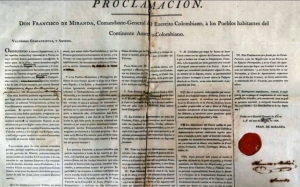
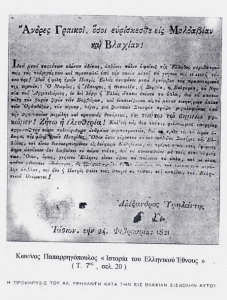
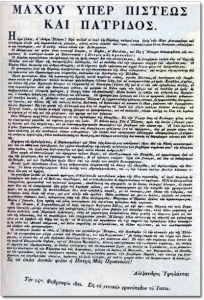
The principles of Plutarch’s “Parallel Lives” are the chosen method to organize, analyze, synthesize, and complete the topic of this paper. Applying this method, an attempt will be made to highlight the special characters of Miranda and Ypsilantis. For this purpose, Miranda’s proclamation “To the inhabitants of Colombian America” will be compared with Ypsilantis’ proclamations “Fight for Faith and Motherland” and “Greek Men, those sojourning in Moldavia and Wallachia!” The analysis discovers similarities and differences between the writings of the two leaders to substantiate the hypothesis of this work about parallel lives.

Now begins the comparison of the multidimensional personalities of the two heroes. Both were members of the social and economic elite of their countries: Don Francisco de Miranda was born in Caracas in 1750. His father was a wealthy merchant from the Canary Islands who earned the title of Captain of the Order of the Militia of the White Men of Caracas. Prince Ypsilantis was born in Constantinople in 1792, to an important and wealthy Phanariot family. His father was the ruler of the principalities of Moldavia and later Wallachia, and his grandfather was the Grand Dragoman of the Sublime Porte.

Miranda and Ypsilantis were well-educated: Miranda studied Philosophy, Law, History, Mathematics, and Geography, and Ypsilantis received a broad education after the Russo-Turkish War of 1806 when his family fled to Russia. They were also multilingual. Miranda, in addition to Spanish, spoke English, French, Latin, and Ancient Greek, and Prince Alexander, in addition to Greek, also spoke Russian, French, German, and Romanian. Their education included military training. In 1771, Miranda went to Madrid, where he received military training to obtain the rank of Captain in the Royal Army. In 1810, Ypsilantis entered the school of the Corps of Imperial Attachés of Czarist Russia.

Proclamation of Francisco de Miranda

Before the outbreak of the wars of independence in their respective countries, both gained extensive military experience in foreign armies, serving in high positions, even as generals. The Venezuelan participated in the United States’ War of Independence and the French Revolution. He served briefly as a general in the French army. The Greek distinguished himself in the wars against Napoleon as a lieutenant colonel in the Russian army when he lost his right arm, at the age of 21, at the battle of Dresden. Four years later, the Tsar promoted him to General.

Their ultimate goals were to gain political and diplomatic allies to carry out their plans to liberate their homelands. Both belonged to Masonic communities of their time and through this, they were assisted in gaining contacts with high European society to reach alliances for their patriotic cause. To this end, Miranda traveled to Europe, meeting, among others, Catherine II and Prince Potemkin of Russia, Gustavus III of Sweden, George Washington, Samuel Adams, Thomas Jefferson, James Madison, and Thomas Paine of the United States, Danton, Charles Dumouriez, and Napoleon Bonaparte of France, William Pitt and Duke Wellington of the United Kingdom, and Simón Bolívar, Andrés Bello, and Bernardo O’Higgins of Latin America.

Ypsilantis served as one of the Czar’s aides-de-camp at the Congress of Vienna in 1814 and met Count Kapodistrias, the Foreign Minister of Russia, and the founders of the Society of Friends, among others. Their intense desire and the fire of their souls for the independence of their country soon brought them to the position of the leader of their revolutionary movements. General Miranda led the patriotic army in the Latin American War of Independence, becoming the Governor of the First Republic of Venezuela. Meanwhile, Prince Ypsilantis took over the leadership of the Society of Friends, creating the “Sacred Band” of 500 university students and thus initiating the War of Independence of Greece.

When Miranda and Ypsilantis arrived at Coro and Iasi, respectively, they published their proclamations. Between them, there are important similarities. In conflicts, a clear distinction is required between the identities of the warriors. Although the translation and publication, by Miranda, of the Jesuit Juan Pablo-Viscardo y Guzman’s “Letter addressed to the Spanish Americans”, which declared that “the New World is our homeland, its history is ours”, was an important step in Latin American emancipation, the use of the term “Spanish Americans” did not allow for a distinction between the Creoles and the inhabitants of Spain.

Proclamation of Alexandros Ypsilantis

In Ypsilantis’ case, there was no such problem because there were clear differences between the Ottoman side and his own, due to different ethnic origins, language, customs, and religion. Therefore, words like “Hellenes”, “Greeks”, and “Orthodox” could distinguish his side from that of the enemy. Taking advantage of the common religion, Ypsilantis included other like-minded groups such as Serbs, Bulgarians, Romanians, etc., in his call. On the other hand, in Miranda’s case, the religion and language of the inhabitants of the Americas were the same as those of the inhabitants of Spain. The Creoles were of Spanish origin, and the ethnic origin of the Indians and Blacks was unrelated to that of either the Spaniards or the Creoles. Therefore, the generic Mirandine term “Colombian American” could provide a distinct identity for all the inhabitants of the New World (Creoles, Indians, Blacks, etc.), separating them from the inhabitants of Spain.

Miranda, like Ypsilantis, asked all citizens to participate without any distinction of class or ethnicity. Indicative of his idea of the relationship between a place and its citizens is that at the beginning of the volumes of his archive, “Colombeia”, Miranda placed an ode attributed to Alcaeus, translated by himself: “Cities are not stone or timber or the work of carpenters, but both walls and cities are to be found wherever there are men who know how to defend themselves”.

One difference between the two proclamations is the reward for those who participate in the revolution and the punishment for those who disobey. Miranda promised rewards both material and moral and threatened legal punishment, while the reward and punishment, according to Ypsilantis, would be exclusively moral. Although the revolutionary and liberation movements of that era were influenced by secular currents such as the Enlightenment and the French Revolution, Miranda and Ypsilantis could not forget that Christianity played a crucial role in shaping the identity of their peoples and that they were addressing devout Christians. Because of this, they included references to Christianity, not only to form a common identity but also to prove that their initiatives were compatible with the Christian faith. This was a risk they had to take, but it turned against them. The Church, acting as an institution of the oppressive apparatus, in order to persecute them, exploited a phrase of St. Paul, who held that all powers are ordained by God and those who resist the powers, resist the ordinance of God. Santiago Hernández Milanés, Bishop of Mérida, and Gregory V, Patriarch of Constantinople, excommunicated Miranda and Ypsilantis respectively, slandering them as traitors and enemies of the fatherland, seeds of Satan, apostates, vain, etc.

On the other hand, the proclamations demonstrated the tragic and miserable condition of the people, full of barbarity and tyranny. Interestingly, Miranda appended to his proclamation the impassioned letter of the Jesuit Viscardo y Guzmán, which described all that the New World had suffered for three consecutive centuries. Moreover, they promised a just and democratic society in which the people could choose their representatives and leaders. Another obvious similarity between the proclamations is the assessment that the timing of the revolutions was right. They stated that the struggle for independence would be easy and that the people could gain their freedom with little effort. Probably, the underestimation of the enemy’s power was deliberate, in order to raise the morale of the people.

Proclamation of Alexandros Ypsilantis

The leaders based their optimism on the promise of the support of Divine Providence and foreign troops: Miranda promised the intervention of the British fleet, and Ypsilantis implied Russia was “a Mighty power”. They also pointed to contemporary paradigms of other countries that won their independence, asking their peoples to imitate them. Miranda’s proclamation contains references to the War of the Oranges, possibly the Eighty Years’ War, the American War of Independence, and the Act of Mediation. Interestingly, Ypsilantis also uses the paradigm of the Spanish constitutional period of 1820-1823, known as the “Liberal Triennium”. His reference to the military achievements of Ancient Greece can be interpreted as a reference to the national heritage of his countrymen. Although there is no such reference in the proclamation of the Venezuelan hero, Miranda was inspired in his youth by Greek literature and traveled to Greece in 1786. Among other places, General Miranda visited Marathon and Salamis to feel, reflect, and experience firsthand the feelings, plans, and military positions of the Ancient Greeks against the despotism of the Persians.

The last and most tragic similarity between the lives of Miranda and Ypsilantis was their abandonment by their allies after a military defeat, their surrender into the hands of the enemy, and their imprisonment far from their homelands. After the fall of Puerto Cabello to Domingo Monteverde’s royalist army, the President of the First Republic of Venezuela, Miranda, signed the Capitulation of San Mateo, an action considered submissive by Miranda’s former allies. After a series of unfortunate events, Miranda was arrested and eventually transferred to the Cuatro Torres prison where he died in 1816. Ypsilantis’ fate was similar: Ypsilantis did not receive any Russian support, as he had expected. After the defeat of his Sacred Band at the Battle of Dragashani and being abandoned by his local allies, he fled to Austria where he was arrested. Although he was not extradited to the Ottoman Empire, he was imprisoned in the castle of Munkács under inhumane conditions and died very young in 1828. His last wish was to have his heart transferred to Greece. Cenotaphs of both heroes have been erected in their homeland as the recognition of their remains is not possible. But for such heroes, this was not important as they knew the famous phrase of Pericles’ epitaph which Miranda himself translated: “For to famous men all the earth is a sepulcher”.

While the forerunners Viscardo y Guzmán and Rigas Feraios contributed to the emancipatory process with passionate writings, the first leaders Miranda and Ypsilantis were also the generals who launched the independence revolution of their homelands and became Martyrs of the Struggle. For this reason, it can easily be observed that the lives of Francisco de Miranda and Alexander Ypsilantis were parallel. The sacrifice of the two leaders, fortunately, was not in vain. Others continued what they started, and their homelands were eventually liberated. The Greek historian Philemon wrote of Ypsilantis, something that could also be said of Miranda: “Thus the Leader was directly abandoned, but the revolution was indirectly protected; the person was destroyed, so that the Fatherland could be saved”.

Antonia Kyriakoulakou,

Doctoral candidate of the UNIR International University of Rioja, Spain

The SHP and the Museum of Philhellenism both pay tribute to the great French Philhellene Juliette Récamier.

French-born Jeanne Françoise Julie Adélade Récamier (1777-1849) hosted one of Paris’s most influential philosophical salons, attracting politicians, intellectuals, writers, and artists. She was the wife of banker Jack Récamier and a graduate of a Lyon convent school.

At 19, Récamier had already established an extensive social network among the elite of Paris, and her charm and unique personality helped to spark a revolution in early 19th-century fashion. It was one of the earliest to adopt the “Greek style,” which took inspiration from classical antiquity and mirrored the imperial style popular during the First Empire.

In 1819, he was associated with the French writer, politician, and great Philhellenic Chateaubriand. Récamier was a prominent member of the Paris Philhellenic Committee and one of the most influential women in French Philhellenism. Madame Recamier corresponded with the Philhellene French soldier Olivier Voutier (1796-1877) while he was in Greece. She later published Voutier’s lengthy letters, titled “Letters on Greece,”in which he describes Greek culture, landmarks, and battles. The Philhellenic Committee benefited from the sales of the book that swayed the French to support the Greek Revolution.

Récamier was a key figure in the philhellenic movement. Her relationship with the romantic writer, politician, and Philhellene François-René de Chateaubriand (1768-1848) sparked and sustained a lifelong affection for Greece and the Greek people that lasted through the Greek War for Independence. Recamier donated substantial amounts of money to the Greek Revolution out of her own coffers and through fund-raising efforts.

At the age of 72, on May 11, 1849, in Paris, Juliette Récamier succumbed to the cholera epidemic. Her life was full of intensity; she inspired the passions and cultivated friendships with many notable figures of the time, including Victor Cousin, Lamartine, Balzac, François Gérard, Canova, and many others.

SHP and the Philhellenism Museum honor the great American Philhellene Julia Ward Howe, Julia Ward (1819-1910).

Famous pacifist, feminist, abolitionist, human rights activist, and poet. She wrote the poem Battle Hymn of the Republic.

Wife of the American Philhellene Samuel Gridley Howe.

She supported the struggle of the Greeks during the revolution in Crete (1866-1869) with the establishment of the “Greek Relief Committee” in Boston, raising money, food and clothes. She even dedicated a poem to Greece. To support the Cretan revolutionaries, she organized an important event in Boston with the participation of prominent musicians. Only from this event, she raised 2,000 thalers, and sent them to Greece.

Later Julia Ward came with her family to Greece and helped the Cretan refugees with money and clothes. (S99)

by Georgios Argyrakos

European philhellenism, as a historical phenomenon, has a “persistent” character, because it appears since Roman times and continues in various forms in Byzantium, in Medieval Europe, in the Orthodox Slavic world, and again in the context of Humanism and Enlightenment, etc. This accumulation of many centuries of philhellenic capital, activated a variety of incentives for philhellenic action during the Greek Revolution. One of these incentives that derives from the foundation of the European civilization, was the interest for the human being who fights for freedom. This was the view of thousands of anonymous and known Philhellenes who perceived the Revolution through this particular angle, one of which is concerned by this article.

The Swiss doctor Louis-André Gosse (1791-1873), was a typical example of a selfless Philhellene who offered a lot to Greece, purely for ideological reasons. He sacrificed his personal comfort and almost his life, just in order for him to help people who were fighting and suffering for their freedom and their rights. He did not fight with the sword and the rifle, but with a box of surgical tools (one of the few that existed in Greece at that time), and with his knowledge and organizational abilities.

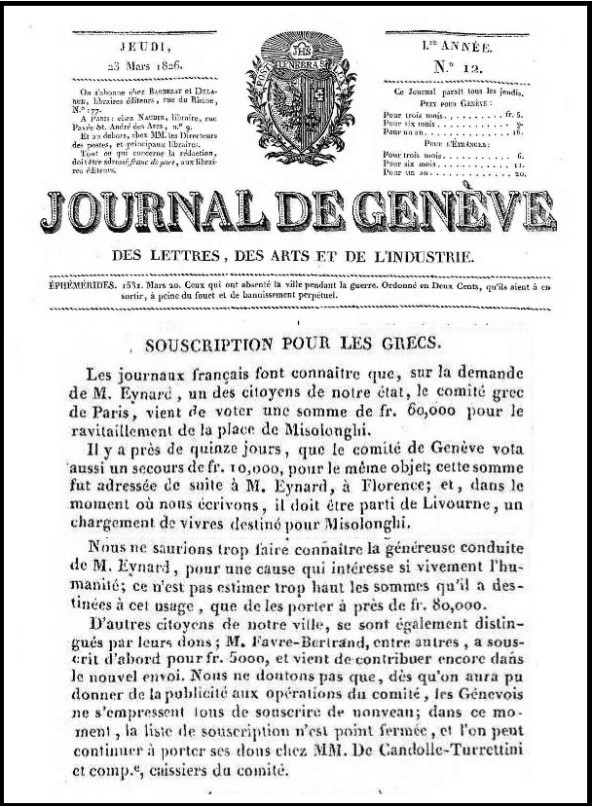
Gosse [1] was a well-known doctor in Geneva, with liberal beliefs. He was the son of the pharmacist Henri Albert Gosse, one of the founders of the Swiss Society of Natural Sciences. He studied medicine in Paris, from where he graduated in 1816. Since then, he toured Europe (Italy, Austria, the Netherlands, England and Ireland) and in 1820 he returned to Geneva, where he practiced medicine. He was politically active in the Liberal Party, through which he proposed the abolition of the public shaming of criminals and the withdrawal of various anti-Semitic measures. He was a co-founder and columnist of the «Journal de Genève», which was published on January 1826, onwards.

This journal published often news from the Greek Revolution and his letters from Greece. For the liberal circles of Europe, Greece was the last bastion in the fight for civil liberties after the suppression of the revolutions in Naples, Piedmont and Spain by the Holy Alliance. At the same time Greece was the battlefield between two worlds: A Christian European nation against a Muslim empire.

Since 1825, when Egyptian troops landed in the Peloponnese, the situation of the revolutionaries deteriorated, not to mention the disputes between them. The attempted genocide committed by the Egyptians in collaboration with the Turks, and the occupation of Messolonghi (April 22, 1826) revived the philhellenic interest in Europe, after a period of recession.

Previously, the first moves for the diplomatic recognition of the provisional Greek government had been made, while negotiations had begun between the Great Powers for military intervention in Greece. On April 4, 1826, Great Britain and Russia concluded the Anglo-Russian Protocol of St. Petersburg, which even provided for military intervention. This treaty accelerated the developments.

This was followed by the Treaty of London on July 6, 1827, which assigned a joint naval force of Great Britain, France and Russia to the Peloponnese. The treaty imposed a cessation of hostilities and provided for the use of military force in the event of non-compliance by both parties.

From the moment the Porte refused to accept the Treaty, the conflict was inevitable. It was the world’s first great intervention for humanitarian reasons, and more precisely, a demonstration of the European entity, on the basis of the same values ​​on which the European construction is still based.

While this was happening and the Revolution was in a state of disarray, Gosse decided to abandon his brilliant career and his comfortable life in Geneva in order for him to come in Greece. His decision was supported by the great Swiss Philhellene Jean Gabriel Eynard. He was a great leader of the philhellenic movement, not only in Switzerland but also of the whole Europe. In this endeavour, he had Capodistrias and the Archbishop of Hungary, Ignatius, as valuable collaborators. Eynard was collecting significant aid for Greece, and needed some trustworthy people to manage it on the field.

Gosse writes that his eagerness to come to Greece ignited one day in 1826 when Eynard showed him a moving letter from the widow of Markos Botsaris (Bouvier-Bron, p. 345). The Swiss banker soon decided that Gosse was capable of undertaking thetransport and management of a generous financial and military aid in Greece which was that raised in favor of the Greek fleet. Other trustees who had been assigned a similar role by philhellenic committees, were Dr. Bailly for the Paris Committee and Colonel Heideck for Bavaria.

Gosse would become the right hand man of Lord Cochrane who had been appointed Commander of the Greek fleet by the National Assembly of Τroizina (March – May 1827). Eynard took over all the expenses of Gosse’s mission.

Prior to his departure, Gosse met with Cochrane, who was passing through Geneva, and with Kapodistrias.

From the latter, he received information about the dire situation in which Greece was. He departed from France on December 20, 1827, he crossed the Mont-Cenis Alpine crossing at night, by sleigh, and went to Italy.

On December 31 he left Ancona and after a difficult trip, he arrived in Zakynthos on January 16, 1828, exhausted by the turbulence of the sea and the fumes from the fermentation of the flour carried by the ship.

On February 2, he went to Nafplio, which was the base of the revolutionary government and at the same time a source of intra-Greek friction. There, he met the French doctor Bailly.

His main purpose was to distribute the aid he carried, in money, weapons and food. It is often argued that the Egyptians prevailed over the Greek revolutionaries, because they were more organized as a regular army with French trainers.

According to certain sources, however, it seems that the problem of the Greeks was primarily the lack of food and ammunition. After six years of continuous war, domestic agricultural production had been wiped out due to a reduction of human resources and the destruction of crops and infrastructure.

At the same time, land transports were blocked. On February 27, 1827, the president of the Third National Assembly in Ermioni, G. Sisinis, wrote to Gosse about the terrible lack of food in the military campuses in Attica, which were in danger of being dismantled because of the famine.

He asks him to send to Karaiskakis to Elefsina 40-50 thousand ounces of flour from the one donated by the philhellenic committees of Europe. Gosse, who had immediately started working on the aid management committee, agrees and in 4 days, he sends 80 thousand ounces of corn by boat from Hydra.

On April 4, Karaiskakis wrote from Keratsini to the government that it was high time that the enemy should be stroked because at that moment, he was weaker than ever. But the army needs 7 thousand ounces of flour per day, as more Souliotes and Peloponnesians come to help. Αlso, 50-100 thousand bullet packs were needed (Vakalopoulos, pp. 114-116, See Archive of National Rebirth, Vol. 3, pp. 352. 388).

Due to the unrest that prevailed in the Peloponnese, Gosse preferred to settle in Hydra initially, and to offload the abovementioned aid in warehouses there. It seems that captains like Miaoulis disagreed with this decision, who preferred to store the aid in Poros. In March 1827, Cochrane arrived in Greece and Gosse was appointed head of the logistics   of the fleet. Τhe warehouses where the aid was stored, were finally transferred to Poros, where a small port was established. Poros is described by Gosse as an oasis of calm in the belligerent Greece. The supplies are managed by a committee, which, apart from Gosse and Bailly, it also includes Heideck, Koering, and the Milanese exiled, Porro.

The money of the aid is used to buy grain, coming from Russia and Poland via Odessa. Money is also sent for the repair of the steamer frigate “Karteria” and other ships of the Greek fleet.

At the same time, Goose offers his medical services to the fighting Greeks who were trying to recapture Athens and other parts of Attica. He was one of the doctors who tried in vain to save the life of Karaiskakis after the battle of Faliro (April 22-23, 1827). He then took care of other wounded soldiers and, with the help of a young English surgeon, he proceeded to two mutilations in the admiral’s camp. He writes that while he was effecting these mutilations (it was a horrible procedure, only with the use of a saw and without anesthesia), some people went to him asking for food. Since he did not have ink and a pen available, he signed food coupons using the blood of the wounded patients for ink and matches for a pen. A few months later he tried in vain to save the 18-year-old Paul Marie Bonaparte, nephew of Napoleon, who accidentally, but seriously injured himself with a pistol, while he was  cleaning it in the flagship frigate “Hellas” in Nafplio (Bouvier-Bron, 346).

After the failure to retake Athens and the defeat of the Greeks at Faliro, supplies and money were exhausted. On May 31, 1827, Heideck wrote to Eynard that the committee’s money were spent. Under the circumstances, the government decided to impose taxes to the islands but also to borrow from wealthy merchants, in order to support the operation of the fleet, since there was no officially independent Greek state, yet. Cochrane appointed Gosse in charge of tax collection from the islands. Because tax revenues were meager, he is assigned to ask for a loan from the merchants of Syros.

And this proves difficult, as the repayment of the loan is as uncertain as the future of the Revolution and the merchants are protected by the consulates of various European powers.

After complex negotiations with the various agents of the islands, Gosse managed to raise an amount.[2] Goose handed over part of this amount to Cochrane, and with the remainder, he organized a flotilla of two schooners and two gunboats, to fight piracy and raids by isolated Turkish, but also Greek ships. Thus Gosse, from being a doctor in the country of the Alps, he turned to a naval commander in the Aegean, further to a decision of the “Secretariat of the Navy” in June 1827. He was quite successful in this task, because Kapodistrias, in a letter dated back to March 20, 1828, recognized Gosse as an expert in naval matters and recommended Gosse to Hastings, the Philhellene captain, who was looking for officers for small ships.

In the meantime, the Swiss philhellenes continued to send weapons, money and other supplies. Gosse keeps records of the revenues and the expenses, such as expenses for salaries, purchase of food and animal feed, purchase of gunpowder, etc. At the same time, Goσse accepts requests to help Greek refugees from various areas occupied by the Turks (Vakalopoulos, 142, 143). Gosse himself describes the various occupations he had in Greece:

«I have become a real harlequin by being a conciliator, counselor, coordinator, general commissioner, treasurer, merchant, secretary, doctor. My heart has not changed, I assure you, and it will not change at all, despite the force of events, despite the contradictions …».

With external help, a small 35-ton boat is built in Poros, others are repaired, fortifications are built, and a  workshop to produce rusks (dry bread) is established (which was then a major supply for the army and navy). Other financial resources were used for the purchase of surgical tools and medicines, for helping philhellenes, etc.

In the midst of his career as a «Supply and Transportation» officer, Gosse found time to serve as a doctor at «Karteria», and participated on the battlefield which destroyed several Turkish ships in the Gulf of Itea (September 17, 1827). From Gosse’s service in «Karteria» a catalogue with the names of 94 crew members, mainly Greeks, English and Swedish is available (Vakalopoulos, pp. 155, 156).

The following month, the famous naval battle of Navarino took place, offering a new potential for an independent Greek state. The Treaty of London provided that the state borders would be defined later. Thus, in areas such as the Aegean islands, the Western Greece and Crete, the revolutionary spirit was rekindled, because people understood that they were in danger of remaining within the Ottoman Empire during the forthcoming processes.

Inhabitants of Chios who had taken refuge in Syros and other islands, with the help of French military under the command of Fabvier and Cochrane, organized a campaign to retake Chios in October 1827. Gosse helped their attempt as well, and in fact, he participated in the landing in the Turkish-occupied Chios. There, he risked his life due to the negligence of some of Fabvier’s officers. The two Frenchmen who accompanied him on a reconnaissance mission on land, left him alone in an area that was within the vicinity of the Turkish artillery of the castle of Chios. There, a shot took his hat away and forced him to leave in fear. Finally the campaign in Chios failed, mainly due to the inability of the Greek forces (regular and non-regular), and the locals to coordinate and adopt a joint plan. Fabvier was then ordered by the French Admiral de Rigny (Derigny) to leave, as the Greek Provisional Government could not support the campaign. Thus, Chios was not included in the new Greek state.

Louis-André Gosse, at an older age. Lithograph. SHP Collection / Philhellenism Museum

The plague epidemic

Gosse risked his life for the second (at least) time during the plague epidemic which appeared in the Argolic Gulf and in the villages of Achaia. The epidemic started from the expeditionary force of the Ottoman Egyptians in Methoni. A large number of European doctors (mainly French and Italian) served under Ibrahim Pasha, but they were late in diagnosing the disease. Because of the exchange of prisoners and other movements of the population, the plague epidemic first appeared in the summer of 1828, in Aegina, and then in Hydra, in Megara, in Nafplio, in other surrounding areas and in some villages of Achaia.

There was probably a simultaneous outbreak of another disease, referred in the sources of the time as «malignant fever», from which Gosse was also infected. The population was in general weakened from hunger and hardships, and was vulnerable to all kinds of diseases that were almost endemic, such as malaria, typhus, etc.

Gosse’s most important contribution to Greece was that he helped to limit the effect of the epidemic. Kapodistrias’ perspicacity and personal interest also contributed to this, as he hastened to give the Swiss doctor the necessary power, which in practice corresponded to the function of a «minister of health». The governor of Greece had himself a medical background from his studies in Padua (1794-1797).

Other doctors, as well as non-specialist citizens contributed to this battle; they manned the police and the quarantine services, the burial of the dead (the so-called «mortis»), the management of medicines, etc. Those who had studied in Italy or had medical experience from the Ionian Islands, knew and applied the quarantine measures that had been developed in the past by the Venetians, who had also founded the various «lazarettes» in the Balkans and Italy (Tsoucalas, 2021). After the outbreak of the epidemic, someone sent from Corfu to Aegina a “Sanitary Order” containing older but relevant instructions in Venetian, French, Tuscan and papal language. This formed the basis for drafting a Greek public health order for the occasion. Gosse states that «fortunately this health provision came too late», as he considered it useless and outdated (Gosse, pp. 168, 169).

It is doubtful whether foreign doctors from Northern Europe and America had ever seen victims of the plague closely. At least, Gosse mentions that in Hydra it was the first time he saw such a patient when the government called him there on this occasion and he was welcomed by Mavrokordatos himself. The latter (having also studied medicine), had already made the diagnosis: (To Gosse) “I warn you that it is a plague and I advise you to lubricate your hands”. The use of oil was a common practice for protection against the plague. Although Gosse considers it controversial, he believes that it is not completely useless (Gosse, pp. 122, 148). He describes that he approached the patient “like a soldier on the attack”, but was unable to save him.

Microbiology had not yet been developed before the 1860s and the factors that caused infectious diseases were not known (in the case of plague, it was a bacterium with intermediate hosts, rodents and fleas). However, it was known that socializing and sharing objects contributed to the spread of epidemic diseases, and isolation was a common treatment. Various medicines of the time may have helped to treat symptoms, such as fever, but not the basic cause of the epidemics.

One of the prevailing theories about epidemics was that they were caused by a «miasma» (miasma in the European medical terminology of the time) which was transmitted by air or through objects or by physical contact.

This theory had its roots in Hippocrates’ theories and was widespread in Europe throughout the Middle Ages and until the late 19th century. Gosse believed in this theory, which he confirmed from his observations in the field, and so he applied urgent isolation measures, including the construction of quarantine facilities. He produced a detailed record of his observations on the epidemic, and developed some new ideas for treatment. Apart from his book «Relation de la peste qui a régné en Grèce en 1827 et 1828», he recorded relevant details in reports and letters he sent to Kapodistrias, while collecting reports from other doctors. Among the officials of the interim government, Ioannis Kolettis, who was also a doctor, had an active role in the implementation of the public health measures. Other doctors, Greek and from abroad who were in Hydra, Poros, Spetses, Nafplio, Argos, Aegina, joined the fight against the invisible miasma. In the race against the invisible enemy, Gosse also collaborated with other European doctors who served in Ibrahim’s army, listing his names in a catalogue, as usual. The American Philhellene doctor Samuel Howe was in Greece at the same time and offered his services to the navy.

The Greek camp under Dimitrios Ypsilantis in Megarida, was affected, as were many civilians who had found refuge on the small peninsula in Vourkari, which was protected by the Wall. [3] Gosse went there to inspect the situation, assisted by the «smart and active» Pavlos Diamantidis. They also brought with them some basic medicines of the time, which Gosse mentions in a list along with the dosage: Emetics, which were tartaric acids for adults and ipecacuan syrup for children, caustic soda for cauterizing ulcers (fr. charbons) and inguinal lymph nodes, quinine for antipyretic, ammonia, sulfuric acid, herbs, including chamomile, mustard powder for «mustard-blister», honey, vinegar, lemons and oranges, syringes, scalpels, suction cups for bleeding, etc. (Bouvier, pp. 350). Gosse used a lot the sage that grew abundantly in the area as a medicine. Ιn rational terms, this did not have any pharmacological effect on plague (similarly with others), but it may had brought some relief to some patients, and at the same time, due to its previous boiling , it acted as a source of healthy water free of parasites, something hard to find under those conditions.

Ten years later, having gathered all his observations from the epidemic, he wrote that most of the treatments applied by him or other doctors, such as tartar cream (crème de tarter), bandages, acidic drinks, leeches, etc., did not bring any significant reduction in mortality, except the reduction of the cauterization of ulcers and inguinal lymph nodes with caustic potassium (sur les charbons et les bubons) which immediately stopped mortality (Gosse, pp. 142, 145). He also mentions the case of a «charlatan» in Chios who was giving patients a concoction that also contained a small amount of dried tissue from patients’ wounds. He found out that this homeopathic treatment did not work either. It was another time when academic medicine was not much more successful than empirical medicine.

In the small peninsula of the Wall, a miserable situation was prevailing as healthy people were living closely together with the sick and dying, without clean water under the terrible heat of «33 degrees Réaumur», ie 40 Celsius. He visited more than 60 patients, he cauterized the ulcers and administered emetics and quinine in several of them. He ordered the construction of temporary shelters made from branches, to protect the patients from the sun, which he placed at a distance of about 2 meters from each other, so that one could move between them without touching them. Similar quarantine facilities, but better planned, were erected in Aegina, designed by the Austrian consul, archaeologist and Philhellene Georg Christian Gropius (1776-1850). Incidentally, it should be noted that the latter’s great contribution to Greece was the rescue of many antiquities. [4] Gosse left Diamantidis at the Wall and returned to Poros, where the epidemic was adequately controlled by quarantine measures.

From his frequent contact with patients he also fell ill (not from plague) having fever and reaching on the verge of death many times. He went to the hospital to receive medical care, which was founded by the American Philhellenes Samuel Howe and John D. Russ, thanks to donations from American philhellenes in the USA. There, in a crisis of fever late at night, he decided to apply an original treatment to himself: to go boating. Dr. Russ believed that Gosse went crazy and tried to stop him. Following the patient’s insistence, Russ himself took him to a boat, gave him something refreshing, and they took a trip in the cool sea air. They went ashore near a monastery which disposed of a spring of cold water with which Gosse quenched his thirst and inflammation and managed to fall asleep after days of insomnia. He considered the spring water to be healing and sprinkled it in his room. He then moved to Syros and Naxos where he recovered.

Gosse returned to Poros where he worked to settle various issues, but, periodically, he was suffering from fever. As he writes, the inhabitants of Poros offered him great care, sending him supplies and letters of support: «Respected clergymen, ignoring the fact that I am a Protestant, they made public supplications for my recovery. … later, my socializing in Moria made me wholeheartedly appreciate the honesty of the vast majority of these people...» (Gosse, pp. xij). Of course, he does not fail to mention the intrigues and the moral collapse that prevailed among a few powerful people. His morale was then undermined and he began to think about returning to Switzerland. His mother, to whom he had a lavish affection, encouraged his thought of returning to Switzerland through her letters.

Prior to this return, he undertook a new inspection mission in another center of the epidemic, Achaia, where he was interested in investigating the course of the disease in a cold mountain climate. Gosse left Aegina on Christmas Day 1828, crossing the Isthmus of Corinth and continued to Patras by sea. After meeting with French officers of General Maison, he headed to the mountains of Kalavrita. Through snowy landscapes on January 4, he arrived to the village of Visoka, after being in danger of the cold and his fever in the mountains. He examined a number of patients and gave instructions for the application of health measures, but the disease disappeared on its own at the end of the winter.

Summing up the description of the epidemic, Gosse notes that out of the 1113 patients he identified, 783 died and 330 survived. In some areas the mortality was 100%, such as in the Megara camp and in Liguria, Argolis, while in others it was lower. For example, it was 50% in the city of Argos, and even lower in the Wall (Vakalopoulos, catalogue, pp. 205). The disease subsided in the spring of 1829, in his opinion thanks to the climate of Greece and the sparse population.

«Mission completed»

Towards the end of 1828 Gosse’s financial resources were exhausted and Goose was helped by the Epirote merchant of Syra, Apostolos Doumas, as well as by Count Frangopoulos of Naxos. For being treated so well, he wrote “I reaped the fruits of my devotion [to Greeks] and recognized that the reputation that Greeks are ungrateful is unfounded” (Gosse, p. Xj).

Gosse was even in need of borrowing 2,000 piastra from Viaros Kapodistrias. Ioannis Kapodistrias managed to extend Gosse’s stay in Greece because he was in great need of such qualified executive officers. He even wrote to his mother in order for her to give her approval to extend her son’s stay in Greece. Gosse, exhausted by his illness and financial problems, having done his duty as a doctor and administrator of the philhellenic aid, he decided to return to his homeland and rest. He left Greece in the summer of 1829. Kapodistrias expressed his gratitude in writing for the services he had offered. He was declared an honorary citizen of Kalavrita, Poros and Athens (which has not yet managed to give his name to a street). From Switzerland, he continued to correspond with friends in Greece and to be interested in Greek affairs. He continued his cooperation with Eynard who continued to send financial aid to Greece, although by the middle of 1829 the philhellenic alacrity of the Europeans was fading. After all, Greece had secured its independence, while the heroic battles and sacrifices of the Greeks, which were feeding the philhellenism of the West in the past, were diminished.

However, philhellenism continued in a different form. It aimed mainly at the acquisition and liberation of Greek slaves from the slave markets of the Mediterranean (Eynard and Ludwig I also played an important role at this time, too).

In 1838 Gosse visited Greece with his wife and King Othon honored him with the medal of the Struggle and the silver Cross of the Redeemer. The same year he published his observations from the plague epidemic in Greece. There, he summarized the findings of the already existing literature on the treatment of the plague, the treatments and the quarantine measures applied in various plague areas of Greece, statistics, etc.

It is an interesting text that concerns the history of medicine in modern Greece.

Conclusion

The case of Andre Louis Gosse shows one of the many aspects of philhellenism of 1821. He was neither an admirer of ancient Greece, nor a «romantic», he was not an Enlightenment intellectual, nor was he an Orthodox with a Byzantine education. He was a liberal man who enthusiastically viewed the national movements of the post-Napoleonic era, and at the same time, being himself a physician, he was sympathetic towards the daily needs of the people who were the subject of these movements. The Greek reality did not disappoint him and he did not lose his enthusiasm like other former philhellenes did. He was observing and noting the intra-Greek rivalries and the shortcomings of the local leaders, but he was dealing with them with compassion. He attributes these phenomena to the previous slavery and oppression by the Turks, and he was generally refers in a very positive way to the Greeks. Undoubtedly, he knew that similar or even worse things had happened in the recent French Revolution and its aftermath, while the worst of all was the Napoleonic Wars, which was in fact a civil war between Europeans.

Among the two main areas in which he worked, his most important contribution was perhaps in the field of the philhellenic aid management and the administration of certain government mechanisms. The big issue at that time (and maybe, an eternal one) in Greece, was morally sound people to be present in order for them to manage the existing financial capital without it being wasted by corruption.

His medical work was also very important, but it is questionable whether he was irreplaceable in this discipline, or not. Probably other Philhellenes and Greek doctors could have offered equally the same with what he offered, given that they (especially the Greeks) had more experience in epidemics in similar conditions in Greece. Possibly, however, the glamor of the «doctor from Switzerland» offered Gosse a prestige that Greek doctors did not have.

Vakalopoulos nicely summarizes Gosse’s contribution in the final paragraph of his dissertation on Swiss philhellenism:

Gosse, like Eynard, are two striking examples of Europeans who, despite their strong philhellenic consciousness, they face the local problems with concreteness and restrained optimism. Their attitude towards Greeks is the attitude of friends towards their beloved ones, who find it difficult to find their way, an attitude full of deep understanding of their miserable past, of mild strictness for some of their deflections and of sincere intention to help them in their great aim, which is the liberation of their homeland.”

Photo of the title of the Journal de Geneve, and news about the fundraise by Eynard, in favour of the Greeks, 23/3/1826. https://www.letempsarchives.ch.

Notes:

[1] Louis-André Gosse should not be confused with the painter Nicolas Louis François Gosse (1787-1878) who also painted some paintings related to the Greek Revolution. The first is mentioned in ancient Greek sources as “Gos(s)is”.

[2] For a detailed description of taxation and lending efforts see Vakalopoulos, p. 121 et seq.

[3] Wall of Megarida. In his work Gosse refers to it as Tychos. Vakalopoulos has rendered it as “Τycho”, but I could not confirm that this is a historically correct name.

[4] Georg Christian Gropius must have been the ancestor of the architects, among which the most famous is Walter Gropius (1883 – 1969), father of the Bauhaus school. See «Gropius (family)», https://de.zxc.wiki/wiki/Gropius (Familie) with relevant bibliography. For G.C. Gropius there is the study of Emm. Protopsaltis «George Christian Gropius and his action in Greece», Athens, 1947.

Sources – Bibliography:

Bouvier-Bron, Michelle, “La mission médicale de Louis-André Gosse pendant son séjour en Grèce (1827-1829)”, Gesnerus: Swiss Journal of the history of medicine and sciences, 48 (1991), No. 3-4, pp 343- 357.  http://doi.org/10.5169/seals-521197

Gosse Louis-André, Relation de la peste qui a régné en Grèce en 1827 et 1828: contenant des vues nouvelles sur la marche et la traitement de cette maladie. Ab. Cherbuliez et Cie, Paris, 1838. https://books.google.gr/

Tsoucalas Gregory et al., “The Greek physician and politician Ioannis Kapodistrias (1776-1831) and the plague of 1828 in Greece”, Le Infezioni in Medicina, 2021, 29(1):157-159. www.researchgate.net

Αρχεία της Εθνικής Παλιγγενεσίας, ψηφιοποιημένα στο https://paligenesia.parliament.gr

Βακαλόπουλος Α. Κωνσταντίνος, «Σχέσεις Ελλήνων και Ελβετών φιλελλήνων κατά την Ελληνική Επανάσταση του 1821», Διδακτορική Διατριβή, Ίδρυμα Μελετών Χερσονήσου του Αίμου, 163, Θεσσαλονίκη, 1975. www.apostoliki-diakonia.gr/


William Townsend Washington (1802-1827) was an American Philhellene from the State of Virginia in the United States of America. He was a Lieutenant in the US Army (4th Artillery Regiment). After attending the West Point Military Academy, he spent some time in France, where he befriended General Lafayette (Gilbert du Motier de Lafayette, 1757-1834). Upon his return to the United States, Secretary of Defense John C. Calhoun (1782-1850) assigned him a military teaching position.

Excited by the Greek issue, Washington resigned from the US Amy in order to go to Greece. He was aware of the importance his surname carried due to his relationship with the first President of the United States, George Washington. Washington used his name to promote his plans for Greece.

William Townsend Washington arrived in Greece in June 1825 as an envoy of the Philhellenic Committee in Boston. Edward Everett (1794-1865), founder of the Committee, recommended Washington to Alexandros Mavrokordatos, as he strongly believed in this young man’s devotion to the Greek Cause. Washington arrived in Greece wearing an impressive Hussar officer uniform.

This is probably the sixth American Philhellene who came to Greece as an envoy of the committees, based on all records we have up to this date. Some American Philhellenes had already visited Greece before Washington: George Jarvis in 1822; Officer Jonathan Peckham Miller, Navy Officer John M. Allen and Richard W. Ruddock arrived in 1824. The prominent American Philhellene, physician Samuel Gridley Howe, arrived in Greece in early January 1825.

During the period that Washington was active in Greece, the American Philhellene Merrett Bolles arrived from Ohio. He was a captain of the American Navy, who served in the Regular Army in Greece (1825 – July 1826) under the French Philhellene General Charles Fabvier.

Washington arrives in Greece at a very critical point of the Greek Struggle. In the winter of 1824-1825, Ibrahim landed in the Peloponnese. The Greek forces are in disarray, with many chiefs in prison. Papaflessas decides to defend the Greek positions in Maniaki, Messinia, thus preventing Ibrahim’s forces from spreading to the Peloponnese. He falls heroically in the Battle of Maniaki in May 1825. The government appoints Theodoros Kolokotronis chief commander of the army. However, the Greek forces are unable to confront the regular army of Ibrahim.

The French Philhellene Fabvier undertakes to organize a regular army (from July 1825 onwards).

In order to confront Ibrahim, the Greek government asked already in May 1825 the London Philhellenic Committee to reinforce the Greek revolutionary forces with another 4,000 men.

Already in October of the previous year, the Philhellenic Committees in the USA proposed to the London Philhellenic Committee to form and send to Greece a Legion of Philhellenes volunteers, which they would finance. The London Committee requested approval by the Greek government. This proposal was not implemented, probably because the Greek military believed that certain Greek politicians would use this Legion to strengthen their powers. The fighters in the irregular army worried that the existence of a regular army corps would mean that they themselves had to be subject to rules of discipline.

The necessity of a foreign Legion of regular army is recognized by Andreas Louriotis and Ioannis Orlandos, who also negotiated the first national loan to Greece. They suggested Charles James Napier (1782-1853), a British officer and a representative of the British authorities in Cephalonia, to lead this corps. Several Philhellenes agreed that a foreign military corps would assist the Greeks significantly in their Struggle. French Philhellene, General Roche, tried to convince general Georgios Karaiskakis about the positive influence that such a corps would have on the Greek Cause.

Washington arrives in Greece in June 1825, and raises the issue of founding a “Foreign Legion” to further strengthen the Greek Struggle. He does not imagine a corps, which would be staffed exclusively by American volunteers. Washington dreams of an international Legion, composed by Americans, French, Italians, Germans and Irish officers. He accepted that the Greek government would define the percentage of participation for each nation. The soldiers would be recruited in Ireland; in case the British government rejected this option, the soldiers would be found in Switzerland and the USA. It is understandable, that the transfer of volunteers from Ireland and Switzerland was incomparably easier than the one of American volunteers.

Washington had specific plans regarding the formation of this Legion, which he aspired to lead, as he bore a name with historical significance.

In Hydra he met the Kountouriotis family, then went on to Nafplio to meet Alexandros Mavrokordatos. In July 1825 he announces his full plan to Mavrokordatos, citing a detailed calculation of the expenses for the maintenance and transportation of the new army corps. He requests that the volunteers fighting in Greece would have the rights of a Greek citizen after the Liberation. Then Washington formally requests the Greek Administration’s approval for his plan, in order to visit the European capitals (London, Paris and Dublin) and gather his officers. After this he would lead the Legion to Greece.

For the reasons stated above, Washington’s Plan was finally abandoned.

When the Greek politicians submitted an “Act of Subordination” to Great Britain, Washington, along with other Philhellenes, strongly reacted against the possibility of Greece being put under English protection (as was the case for the Ionian Islands), after its liberation from the Ottomans. The American Philhellenes, in consultation with the French General Roche, submitted a written protest to the Greek government asking them not to proceed in such a direction.

In fact, Washington adopted a tough stance against Great Britain, and promoted (along with General Roche) the assignment of the Greek throne to a member of the French royal family. Both of them tried to impose this political line on the Philhellenic Committees in the USA and France. This attitude, however, was renounced by both countries.

This evolution in Greece disappointed Washington, who decided to leave the country in 1825. In fact, he started his journey from Smyrna. While he was in Smyrne, he was wearing a Greek attire, provoking the hateful gaze of the Ottomans. During his trip, he was informed that England would not undertake the protection of Greece. So he asked to go to Messolonghi (October 1825). There he fell ill and was transported to Nafplio.


August 27, 1825: William Townshend Washington, letter from Smyrne


His country’s attitude on the subject hurt him so much that he wrote a harsh letter criticizing strongly his own homeland.

In May 1827 he went to Zakynthos, which was under British administration. There, it is said that he fell in love with Markos Botsaris’ daughter, Vasiliki, whom he asked to marry. Markos’s brother, Costas Botsaris, refused to agree to this marriage.


The daughter of Markos Botsaris (SHP collection / Philhellenism Museum)


After Zakynthos he went to Nafplio, and joined the forces of Chief Photomaras. In fact, it is reported that he fought bravely. At the same time he worked to reconcile the warring factions of the Greeks.


Souliotis chief Nasos Fotomaras (- 1841)


During a clash between Greek factions on July 16, 1827, Washington was eventually killed by a shot fired from Palamidi towards the city of Nafplio. He was taken to the British ship Asia, where he breathed his last. He lost his life at the age of just 25, passionately serving the ideals he believed in and of course Greece, which he dearly loved.

The tomb of the American Philhellene, William Townsend Washington, is located in Hydra, the place where he was hosted when he arrived in Greece.


US Ambassador G. Pyatt at the tomb of William Townsend Washington in Hydra


One thing is certain about the American Philhellene, William Townsend Washington. He fought bravely for Greece, which he loved with an incredible passion.


Sources – Bibliography:

  • Barth, Wilhelm-Kehrig-Korn, Max, Die Philhellenenzeit. Von der Mitte des 18. Jahrhunderts bis zur Ermordung Kapodistrias‘ am 9. Oktober 1831, Max Hueber Verlag, Μόναχο, 1960
  • Βαγενάς, Θάνος, Δημητρακοπούλου, Ευρυδίκη, Αμερικανοί Φιλέλληνες Εθελοντές στο Εικοσιένα, Μάτι, Αθήνα, 2017
  • Μαζαράκης-Αινιάν, K. Iωάννης, Αμερικανικός Φιλελληνισμός 1821-1831, Iστορική και Εθνολογική Εταιρεία Ελλάδος, χ.ημ.
  • Αρχείο ΕΕΦ