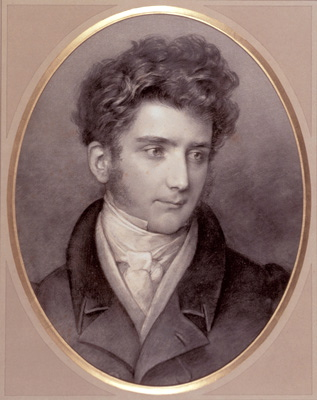
Painting of the German painter Peter von Hess (1792-1871). It shows a Philhellene in Greek uniform.


During the Greek struggle, many Philhellenes arrived in Greece and fought alongside the Greeks in many different roles and in many different contexts. However, some of them really wanted to understand the character of the Greek warriors and completely adopted the life of the Kleftes. William St Clair estimates these Philhellenes at about ten. Among them is the French Philhellene, Hyacinthe Delavillasse, almost unknown in Greek history. Any testimonies about this great Philhellene come exclusively through the works of other philhellenes or Greek comrades-in-arms.

The French Philhellene F. R. Schack, who met him in June 1826, states that De Lavillasse was born in Carpentras, France, near Avignon. He was an officer in Napoleon’s Grand Army, who was expelled by the French army and deported from France in 1820, “after serving his homeland for twenty years”. He appears to have been the victim of a political plot, and was accused of taking part in a conspiracy. According to an official list of the French Ministry of War, De Lavillasse was an infantry captain in 1817.

When he was expelled from his country, he turned his attention to the then in revolt Greece, with the Greeks fighting for freedom. He went to Greece on a Greek ship that departed from Marseilles on July 18, 1821. The same ship was carrying Alexandros Mavrokordatos (who had even chartered it and loaded it with ammunition he had bought), the French Philhellene Maxime Raybaud and 80 Greeks and Philhellenes.

The French philhellene Maurice Persat, notes that he was one of the first to arrive in Greece to participate in the Struggle. Indeed, in the Archives of Greek Paligenesia we find a first inscription referring to him as “Labilai” in 1822.

Another Frenchman, Philippe Jourdain, reports that De Lavillasse had fought in Peta, and that after the unfortunate battle and the grievances suffered by the forces of the Greeks and Philhellenes, he retreated with the rest of the suffering and sick Philhellenes who survived, to Messolonghi. From there, despite being sick with a fever, he took an active part in battles in the surrounding area. Later that year, Pouqueville reported that De Lavillasse was fighting in Argos, ill again.

Another source quoting De Lavillasse is Edward Blaquieres. He confirms his role in the siege of Patras, and in the siege of Tripolitsa, where De Lavillasse even led a corps of 80 volunteers from the Ionian Islands. According to Maxime Raybaud, after the fall of Tripolitsa, De Lavillasse joined the Regular Corps of Baleste for a while.

De Lavillasse then became a Greek citizen, and followed Kolokotronis as a captain. According to the testimony of Fotakos, he took part along with other chieftains, in the battle against Dramalis in Dervenakia on July 26, 1822, as a captain-bodyguard of Kolokotronis.

Michael Oikonomou describes a real incident for his friend De Lavillasse, after the successful battles of the forces of Kolokotronis near Patras, highlighting his unbridled enthusiasm. De Lavillasse, after reaching the gate of the “Gerokomeio” fortress, was the first to knock loudly and “with great joy for the victory of the nation”, turning to the Greeks who were watching him, shouting to them in poor Greek “come, come”. He invited them with gestures to break through the gate of the fortress and enter in it.

It is a fact that his bravery was recognized by both foreign and Greek comrades-in-arms, but also by the Greek administration. With the decision no. 154 of D. Ypsilantis, President of the Parliament, on June 24, 1822, “Captain Lavillaz” was promoted to the rank of Lieutenant Commander for his work in his new homeland. It is striking that the decision was taken on the grounds that “the French captain Mr. Lavilaz, who has suffered a lot for twelve months now, endured all kinds of deprivations, works hard for the common interest in Patras”. This decision is a presumption of his presence in Greece from the beginning and the deprivations he suffered in the Struggle.

According to Henri Fornèsy and his notes on the Philhellenes, De Lavillasse gradually rose to the rank of Colonel. In fact, for some time he served as the Chief of the staff of Kolokotronis, to which he was assigned. The information is confirmed by Greek historians, including Ap. Vakalopoulos, who describes him as a comrade-warrior of Kolokotronis.

Even more, F.R. Schack cites him in his memoirs as a man who enjoyed the full confidence of Kolokotronis: “The two men were inseparable comrades-in-arms, fought together in a hundred battles, and twenty times their swords were stained with the blood of barbarians”.

De Lavillasse had a good reputation in the army, loved Greece and longed for its freedom. In a letter published on September 6, 1823, Pouqueville expressed his concern about the internal quarrels of the Greeks, which prevented them from completing the Struggle and endangered the country’s political situation. Even more, he admits that if the Greeks were united, the Turks would have been defeated long ago.

Moreover, Maxime Raybaud, De Lavillasse’s comrade-in-arms, also expresses his greatest appreciation for him in his memoirs, commenting on his special case as follows:

This success is largely due to the brave De Lavillasse, who leading some of the irregular Moraites, was the first to enter the city and pursue the enemy as far as the walls of the fortress. Being unsatisfied with the services to which we should be limited with his half-regular soldiers, almost always unhappy, malnourished and poorly paid, this officer decided, a few weeks after Ypsilantis returned to Tripoli, to leave the Baleste battalion to go outside Patras. Due to his bravery, he quickly gathered around him one hundred of the Armatoloi of Achaia. He left his uniform to dress in the clothes of the Kleftes, the pre-eminent clothes of the war, and followed in all areas the customs of his new comrades-in-arms, sharing with them the difficulties, the deprivations and even the complete absence of cleanliness that characterizes their way of life“.

More particularly, he points out that “in this easy abandonment of civilized manners for the sake of such harsh customs is perhaps hidden a greater value than we can imagine at first, a value which is better understood if we consider that it is the only foreigner who has managed to adapt to this way of life”. “This officer, as a witness to his brilliant deeds, had only people who forgot him. Too many times he has seen Turks fall from his strikes, but he leaves it to his friends to take care of making it known to the public”.

It seems that the poverty he was facing at that time was such, that in a letter addressed by De Lavillasse to the Minister of War, Ioannis Kolettis, in May 1822, he asked him to send him “a medicament made from tobacco and a French or Albanian shirt”. The tragic situation of De Lavillasse is testified by a dramatic incident reported by Fotakos, during the invasion of Dramalis, shortly before the battle of Dervenakia. According to his testimony, De Lavillasse hid in a vineyard where Turks were going to steal grapes, he killed a Turk and took off his clothes to wear as his own were completely worn.

Despite the privations and poverty, it appears that De Lavillasse continued for several years his actions in Greece and more specifically in Roumeli (main land). This is evidenced by a letter he sent to the Secretary of Defense, asking to allow him to enlist in the “Regular Corps” organized by the French General Gerard. A corps that gathered a large number of former irregular warriors during the period of Kapodistrias.

Officer of the Light Regiments of the Regular Army of Greece (archives of GES)

Unfortunately, his traces are lost somewhere in Greece, as no further details are known about him.

William St Clair states that De Lavillasse bore the title of marquis in his country, as he came from a noble family. He was also honored with the Legion of Honor for his service in the Grand Army.

De Lavillasse is another freedom fighter, honored by Greece for his contribution to its war of independence.


SOURCES-BIBLIOGRAPHY

  • Barth Wilhelm – Max Kehrig-Korn, Die Philhellenenzeit, von der Mitte des 18 Jahrhunderts bis zur Ermordung Kapodistrias am 9 Oktober 1831, εκδ. Hueber, Μόναχο
  • Edward Blaquieres, History of the Greek Revolution, 1825.
  • Elliot Charles William James (επιμ.), Campaign of the Falieri and Piraeus in the year 1827, or Journal of a volunteer, being the personal account of Captain Thomas Douglas Whitcombe, εκδ. Αμερικανική Σχολή Κλασικών Σπουδών στην Αθήνα, [Gennadeion Monographs, τ. 5], Πρίνστον 1992.
  • Persat Maurice, Mémoires du commandant Persat, 1806 à 1844, εκδ. Plon-Nourrit et Cie, Παρίσι
  • Pouqueville François Charles Hugues Laurent, Histoire de la Régénération de la Grèce – Comprenant le précis des évènements depuis 1740 jusqu’en 1824, τ. 1, εκδ. Firmin Didot père et fils, Παρίσι
  • Raybaud Maxime, Mémoires sur la Grèce – Pour servir à l’histoire de la guerre de l’indépendance, τ. 1-2, εκδ. Tournachon-Molin, Παρίσι
  • St-Clair William, That Greece might still be free – The Philhellenes in the War of Independence, τ. 1, εκδ. Oxford University Press, Λονδίνο-Νέα Υόρκη
  • Αρχεία Ελληνικής Παλιγγενεσίας μέχρι της εγκαταστάσεως της Βασιλείας, τόμος Α΄, Αθήνα, 1857.
  • Αρχεία Ελληνικής Παλιγγενεσίας, 1821-1832, Λυτά έγγραφα Α΄ και Β΄ βουλευτικής περιόδου, τόμος 16, Αθήνα, 1999.
  • Βακαλόπουλος Απόστολος, Ιστορία του Νέου Ελληνισμού, 1961, τόμος 7ος.
  • ΓΑΚ, «Αρχείο Κυβερνήτη Ιωάννη Καποδίστρια», Γραμματεία των Στρατιωτικών» Φ. 12, 31.
  • Εθνική Βιβλιοθήκη, Τμήμα Χειρογράφων και Ομοιοτύπων, χειρόγραφο 1.697: Henri Fornèsy, «Le monument des philhellènes», 1860.
  • Οικονόμου Μιχαήλ, Ιστορικά της Ελληνικής Παλιγγενεσίας ή ο Ιερός των Ελλήνων Αγών, Αθήνα, Εκ του Τυπογραφείου Θ. Παπαλεξανδρή, 1873.
  • Πλαγιανάκου-Μπεκιάρη – Στεργέλλης (επιμ.), Αρχείο Ιωάννη Κωλέττη, σσ. 215-216, έγγραφο 250, 28 Απριλίου/10 Μαΐου 1822.
  • Σιμόπουλος Κυριάκος, Πώς είδαν οι ξένοι την Ελλάδα του ’21 – Απομνημονεύματα, χρονικά, ημερολόγια, υπομνήματα, αλληλογραφία εθελοντών, διπλωματών, ειδικών απεσταλμένων, περιηγητών, πρακτόρων, κ.ά., τ. Α΄: 1821-1822, εκδ. Στάχυ, Αθήνα 1990.
  • Φώτιος Χρυσανθακόπουλος (Φωτάκος), Απομνημονεύματα περί της Ελληνικής Επαναστάσεως, τόμος Β΄, (1821-1828), εκδόσεις Πελεκάνος, 2015.
  • Φώτιος Χρυσανθακόπουλος (Φωτάκος), Βίοι Πελοποννησίων ανδρών, Π. Δ. Σακελλάριος, 1888.


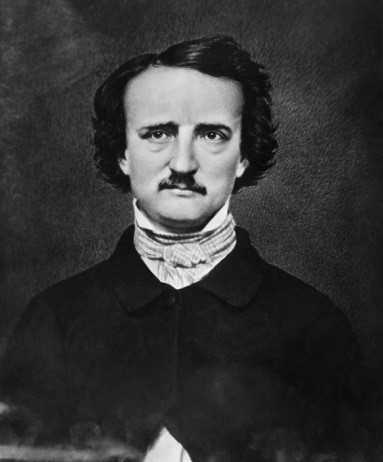
Edgar Allan Poe, portrait


Edgar Allan Poe (1809–1849) is considered a central figure of the Romantic period in the United States and of American literature in general. Even people who never consciously choose to read literature have heard his name, and many remember him instantly the moment they see a raven.

For most, Poe is the founder of detective fiction and his work has left its mark in history. Within his tales, one can establish his inclination to create stories that portray the death of a beautiful woman and his desire to explore the metaphysical world. His stories also delve into the relationship between love and hate, the communication between the inner self and the alter ego, and the power of death upon the world of the living.

While reading Poe’s narratives, one frequently comes upon references that allude to Classical literature, either Latin or Greek. In fact, there are various cases of the author’s plain use of Hellenic or epigraphs in his storytelling. For instance, readers encounter an epigraph written entirely in Greek in “The Conversation of Eiros and Charmion”—“Πνρ σ οι προσοις ω” [sic]—; hence, the impression that Poe was influenced by Classical texts while composing his tales emerges. Poe’s obsession with the Helen of Troy has also been noted by major scholars such as Kenneth Silverman, Thomas Ollive Mabbot and Burton R. Pollin. In his famed poem “To Helen”, Poe specifically urges us to remember “the glory that was Greece”, and that particular line has indeed made many believe that he was a philhellene.

Upon examining Poe’s interest in Greece, one should first and foremost keep in mind that he lived most of his life in cities that were shining examples of the Greek Revival architecture. The Bostonian author spent a great part of his life in Philadelphia. More specifically, he spent almost six years (1838-1844) in Pennsylvania’s largest city along with his young bride Virginia Clemm and his beloved aunt Maria Clemm. It goes beyond doubt that Poe was exposed to Greek Revival architecture as he most certainly walked through Avenue of the Arts, the most central location of the city whose Hellenic character is evident even today, as anyone will be able to verify by simply walking across it.

Avenue of the Arts, Philadelphia, USA

Poe’s infatuation with Hellenic texts, notions and paradigms is rather evident in several of his works. But where did this love for Greece originate from? In a way, Lord Byron may be the real reason behind all this. Kenneth Silverman wrote the following in his famed biography of Poe:

“How deeply the Byron image impressed Edgar is apparent in his six-mile swim on the James River, emulating Byron’s celebrated swim of the Hellespont, and the stories in Richmond that he had joined the Greeks, as Byron had, in their quest for independence” (1992: 41). In this regard, the most prolific editor of Poe’s works, Thomas Ollive Mabbott, also assesses that “Poe as a very young man was an imitator of Byron” (1969: xxvi).

Poe admired Byron for his bravery and his active role in the Greek Revolution against the Turks, and in fact wanted to imitate such actions. He was a supporter of the Greek cause, and his intense desire for a Philhellenic adventure, led him to claim that he left “without a dollar on a quixotic expedition to join the Greeks then struggling for liberty”. Apparently, his travel to the land of the Hellenes was imaginary and he only made it as close as England when he was much younger. Not having the means to achieve his goal, he certainly tried hard to learn Greek (even though he mostly failed to be proficient in it) and he demonstrates that through the abundance of Hellenic references in his works.

After all, as Poe himself wrote in one of his works, “nothing makes so fine a show as your Greek”.

Dimitrios Tsokanos, PhD, Lecturer in English


Cavalry gendarmes and a Gendarmerie officer


François Graillard (Gralliardos), was one of the French Philhellenes who settled permanently in Greece.

He was born on August 23, 1792, to a French noble family in Dijon, France, and was the only son of a glorious colonel in the French Artillery. According to his personal military record in France, referred by Ch. Dimakopoulou in her study on Graillard and his work, Graillard studied at the Military School of Paris and enlisted as a volunteer in the French National Guard on May 15, 1812. In two months, he was promoted to caporal, and after three months, to sergeant. At the beginning of 1813 he was promoted to a non-commissioned officer and on 29 September 1813 to second lieutenant. He had received the specialty of Engineer in the National Guard.

During Napoleon’s campaign against the Netherlands in 1812, he was distinguished for his bravery and promoted to lieutenant on the battlefield. He served in the headquarters of the Great Army and took part in the campaign against Austria and Prussia in 1813. In the battle of Leipzig he was seriously wounded and taken prisoner, but then escaped captivity. He took part in the campaign against Russia, where he was also captured. He then returned to France in 1814, the year his father died, leaving him a significant fortune. He was later promoted to captain of the General Staff, and continued his military career, participating in the campaign of Napoleon the Great in France in 1815.

He was then placed in reserve, expelled and imprisoned repeatedly in France until 1820. Graillard was a follower of the French philosopher Saint-Simon, whose theory promoted new ideas for reorganizing society on the basis of an original form of socialist principles, and a supporter of the French Revolution.

Saint-Simon (1760 – 1825), philosopher and utopian precursor of “scientific socialism”, among the founders of French Sociology.

When the Greek Revolution broke out, excited about the noble cause of Greek freedom and committed to the ideas of the French Revolution, which he always deeply advocated, Graillard decided to give up his comfortable life and take part in the Greek Struggle.

According to the French Philhellene M. Raybaud, Graillard arrived in Argos on November 20, 1821, after first landing in Kalamata with other Frenchmen, the first philhellenes to arrive in Greece. He took part in the siege and raid on Nafplio and distinguished himself in the fall of Corinth. He served as a Captain of the Mavrokordatos Staff, and took part in the Battle of Peta, where he fought bravely, got wounded, and escaped captivity. From this experience, Graillard understood the particularly negative effects that the civil conflicts between the Greeks would have on Greece.

He then took part in a mission to Athens with Raybaud. Later he participated in the first siege of Messolonghi, in October 1822, as reported by Raybaud. During a clash with the Turks at the Acheloos river, he was injured seriously for the second time in a few months, risking losing his left leg.

He developed a friendship with Dimitrios Ypsilantis, whom he considered together with Kolokotronis, as the natural leaders of the Revolution. His bravery led Ypsilantis, who also appreciated the integrity of his character, to entrust him with confidential missions in Europe in favor of Greece.

Thus, in the autumn of 1823, Graillard left for France on the orders of Ypsilantis, accompanied by his compatriot Louis Stanislas Daniel. For this mission he had received an extended leave. In January 1824 he returned to Messolonghi, and a little later he left again for France, again together with Daniel, with new orders. Their mission was to mobilize the philhellenic circles of Paris for the benefit of the Greek cause, not only financially, but also diplomatically, as Spiliadis testifies.

Letter from D. Ypsilantis dated 10 March 1824 to the Minister of Justice of France. Ypsilantis recommends the French Philhellene Louis Stanislas Daniel bearing the letter, who had undertaken many secret missions in France on behalf of D. Ypsilantis, together with Graillard.

The French philhellene Graillard had played an important role in organizing the first Philhellenic committees in France, which later officially supported the Philhellenic movement, organized fundraisers and undertook to send supplies and weapons to Greece. This emerges from Graillard’s long correspondence, and is also confirmed by Ioannis Koniaris, mayor of Athens, his close friend and heir. Actually, Koniaris delivered the funeral speech at the funeral of Graillard, which was published in the newspaper Radamanthys.

After his return to Greece, Ypsilantis, appreciating his contribution, hired him as his aid de camp. Graillard then took part in the second siege of Messolonghi, and in the Battle of Myloi (the Mills) in June 1825, during which he was wounded and promoted to the rank of Colonel, after a proposal by Ypsilantis. According to Hariklia Dimakopoulou, it was rumored that Graillard led a movement in December 1826 aiming to establish a military government under Ypsilantis. During the Kapodistrian period, Ypsilantis was the commander-in-chief of the Army of Eastern Greece, and he hired Graillard as Chief of Staff. Graillard took part in the Battle of Thebes in May 1829, but also in the last battle of the Greek Struggle, that of Petra, in September of the same year.

Governor Kapodistrias had entrusted Ypsilantis with the command of the irregular troops, which were transformed later into chiliarchies, and Graillard sought to assist the Governor in his task of “regularizing” the irregular troops.

Graillard was a staunch supporter of the Regular Army, and he issued many Orders of the day, calling on the Chiliarchs to submit daily activity reports. As expected, these orders were not carried out and were quickly considered useless by the irregular warriors, who were not prepared to change their way of life. Graillard attempted to introduce into the army the rules of the Internal Organization of the French Army, remained a dead letter, as the Greeks were not familiar to these European-style structures.

According to Hariklia Dimakopoulou, during the period of Augustine Kapodistrias, Graillard undertook the secret mission of handing over to General Guéhéneuc (General Maison’s successor in the Peloponnese), a request from the pro-French circles of Nafplion for a French monarch to take over the crown of Greece. This mission was particularly important, as it took place at a time when, following the resignation of Duke Leopold of Saxe-Cobourg, there were ongoing meetings in London where two candidates were proposed for the Greek throne. The first one was Prince Paul of Wurttemberg and the second Prince Othon of Bavaria.

Following the departure of Augustine Kapodistrias, the Government Commission assigned the administration of the Regular Army to Graillard, following a proposal by D. Ypsilantis, according to Ch. Dimakopoulou. He was assisted in these tasks by Lieutenant Scarlatos Soutsos. Graillard submitted a memorandum on the general condition of the Regular Corps for the period from November 1831 to November 1832. The state of the Corps was deplorable. The lack of financial resources had affected all military units, the morale was low, the Model Battalion, which had been formed after an extraordinary effort, was disbanded. In this turbulent climate, the Light Battalions were transformed again into irregular troops, and all this, during a particularly difficult period for Greece.

The tragic character of the situation is evidenced by a series of letters written by Graillard in his capacity of head of the Regular Corps to the War Minister Ioannis Kolettis. In these letters he addressed a desperate appeal and asked him to settle, “in the name of God”, the economic problem of the Army, in order to avoid the desertion of the troops, which was about to take uncontrollable proportions. The government, in an effort to save the army, granted a transfer of the proceeds of the Nafplion Customs to the management of the Regular Corps. Unfortunately, the situation worsened, as the rioters threatened to invade the city of Nafplio, in a desperate attempt to receive their salaries. Under the threat of complete anarchy, Kolettis decided to seek help from the French army, part of which had remained in the Peloponnese under General Guéhéneuc’s orders. This operation led to bloody clashes and disastrous results.

During Othon’s reign, in February 1833, Graillard was appointed leader of Othon’s Military House, and later became head of the first National Gendarmerie which he organized, according to French standards, in June 1833. Graillard choose himself applying meritocratic and fair criteria the first officers of the Gendarmerie, both among the former irregular warriors and the well-known chieftains, as well as the Regular soldiers and the Philhellenes who had been distinguished for their bravery and behavior. He remained in this position until 1834. He was then put in reserve, most likely because of his saintsimonic ideas, which the government certainly did not approve. In fact, a royal decree was issued in this regard, denouncing saintsimonism as a sect.

Another serious reason that apparently brought him into conflict with the government was his constant request for an increase in the number of Gendarmerie officers and for the non-participation of the political power and the army, in its work. Already after the Battle of Peta, Graillard studied and analyzed in depth the structure of Greek society, and concluded that military affairs should be carried out only by the military, without the intervention of politicians (something he tried to ensure each time he took a position of responsibility).

For all these reasons, he submitted his resignation on January 12, 1835, setting a proud example for his subordinates. This is because, according to I. Koniaris, Graillard was “a ruthless enemy of intrigue and faithful to duty”, “he walked the straight path; honor was his compass, and the duty the rule of his conduct. These were placed beyond any ambition”.

Graillard, however, did not end there his career and continued to offer his services in other areas, as he was later called up for action again. He successively served as Garrison Commander of Messolonghi, and then of Athens-Piraeus, Chief of Staff of the Ministry of the Army, Chairman of the Committee for the Revision of the rules of procedure of the Army, Commander of a Brigade, etc. On February 19, 1848, he was again appointed Chief of the Gendarmerie, and remained in that position until the abolition of the Corps Headquarters on June 24 of the same year. The Headquarters were reorganized on November 29, 1848 under the leadership of A. Vlachopoulos. On May 19, 1854, he was transferred to the army and was promoted to lieutenant general. Since then, he remained in reserve, for health reasons, and retired in Kifissia.

The most important contribution of Graillard in Greece is undoubtedly recorded in the field of the development of the Greek society, which he had studied in depth during his long stay in Greece. The fruit of his thoughts led to the production of a work entitled “Memorandum on the Law of the Development of Modern Greek Civilisation” (Mémoire sur la loi du développement de la civilisation hellénique moderne). He submitted this memorandum to king Othon in 1835, shortly before he took office as monarch, in order for him to take it into account for the governance of the new Greek state. However, his rather progressive proposals were not accepted.

At that time, a large portion of the political world, Othon himself being the first among them, gave priority to the vision of the Great Idea and the development of the army. Graillard’s proposal was for the government to focus on tackling the devastation caused by the war, in organizing production and the economy, in order to achieve the development and prosperity of the Greek people, so that the new state can play again an important role as the heir of ancient Greek civilisation. At this point he was collaborating with another Philhellene and sainsimonist, Gustave Séligmann d’Eichthal (1804 – 1886), who lived in Greece from 1832 to 1835. He was commissioned by Prime Minister I. Kolettis to organize the Office of Public Economy (which much later evolved to the Hellenic Statistical Service).

Gustave Séligmann d’Eichthal (1804 – 1886), designed the Office of Public Economy.

The efforts of the French sainsimonists, who had begun to come to Greece, were unsuccessful, and all of them were removed from public offices.

Graillard undertook later other administrative positions.

The original and spontaneous love for the Greek nation is remarkable for this Philhellene. Without ever renouncing his French origins, Graillard wanted and sought the development and rebirth of the Greek nation. He was an idealist and a lover of Greece. According to an article by General Napoleon Dokanaris of the Gendarmerie, he was the first Philhellene to reject the specific title of “Filellin”, and, consequently, the privileges that accompanied it, unlike many others. It is characteristic that in many documents, and especially in letters to his friends, he signed in Greek “Gralliardos”. He had acquired a well-deserved Greek citizenship.

In his funeral speech, Koniaris describes him as “a lively and very pleasant spirit, a high character, a soul that is at the same time stable and flexible, a mind adorned and cultivated with education”, and “with the lures of the spirit”, and underlines that he had “all the strong virtues which impose the respect, and the sweet virtues, which attract the love”.

He died in Kifissia on May 9, 1863, with the rank of Commander in Chief of the army. He was honored with the Order of the Officer of the Legion of Honor from France, with the Silver of Excellence of the Greek Independence and with the Golden Cross of the Order of the Redeemer.


SOURCES-BIBLIOGRAPHY

  • Raybaud Maxime, Mémoires sur la Grèce – Pour servir à l’histoire de la guerre de l’indépendance, τ. 2, εκδ. Tournachon-Molin, Παρίσι
  • Ανέκδοτη επιστολή του «Αρχείου Ιωάννη Κωλέττη» (Αρχειακή Συλλογή ΚΕΙΝΕ, Ακαδημία Αθηνών, Φ. 149Γ, έγγραφο 0014), την οποία απευθύνει ο Graillard στον Κωλέττη στις 8 Ιουλίου του 1832 και η οποία αποτελεί μέρος σειράς επιστολών του Graillard για το ίδιο θέμα.
  • Αντωνίου Σ. Κωνσταντίνος, Ιστορία Ελληνικής Βασιλικής Χωροφυλακής 1833-1967, τόμ. Α΄, εκδ. Χρηματιστήριον του Βιβλίου, Αθήνα 1964.
  • Ασπρέας Γεώργιος, Πολιτική ιστορία της νεωτέρας Ελλάδος (1821-1912), εκδ. Χρήσιμα βιβλία, Αθήνα 1930.
  • Βακαλόπουλος Απόστολος, Ιστορία της Ελληνικής Επαναστάσεως του 1821, εκδ. ΟΕΔΒ, Αθήνα 1971.
  • Βακαλόπουλος Απόστολος, Τα ελληνικά στρατεύματα του 1821, εκδ. Βάνιας, Θεσσαλονίκη 1991.
  • ΓΑΚ, Γραμματεία Στρατιωτικών, Φ. 121, υπόμνημα με ημερομηνία 21 Νοεμβρίου 1832, το οποίο περιγράφει ο Ανδρέας Καστάνης (ό.π. [υποσημ. 349], σσ. 36-39).
  • Δημακοπούλου Χαρίκλεια, Ο σαινσιμονιστής François Graillard περί των ελληνικών πολιτικών πραγμάτων – Παρατηρήσεις και προτάσεις [ανάτυπο από το Δελτίον της ΙΕΕΕ, τ. 22 (1979), σσ. 367-450]. Το Υπόμνημα του Graillard προς τον Όθωνα βρίσκεται στο ίδιο, σσ. 395 κ.ε.
  • Δοκανάρης Ναπολέων, «Ο Γάλλος Φιλέλληνας Φραγκίσκος Γκραγιάρ και το μεγαλειώδες σχέδιό του για την οικονομική και πολιτιστική ανάπτυξη της μεταπελευθερωτικής Ελλάδας», Στρατιωτική Επιθεώρηση, Ιούλιος-Αύγουστος 1991, σσ. 73-84.
  • Εθνική Βιβλιοθήκη, Τμήμα Χειρογράφων και Ομοιοτύπων, χειρόγραφο 1.697: Henri Fornèsy, «Le monument des philhellènes», 1860.
  • Εφημερίδα Παλιγγενεσία, Αθήνα, αρ. φ. 141, 16 Μαΐου 1863.
  • Εφημερίδα Ραδάμανθυς, Αθήνα, αρ. φ. 17, 16 Μαΐου 1863.
  • Κτενιάδης Σ. Νικόλαος, Ελληνική Χωροφυλακή – Ιστορικαί σελίδες, τ. Α΄, χ.ε., Αθήνα 1960.
  • Λαλούσης Χαράλαμπος, «O Ελληνικός Στρατός την περίοδο του πρώτου Κυβερνήτη της Ελλάδος Ιωάννη Καποδίστρια (1828-1831)», Στρατιωτική Επιθεώρηση, τ. 2 (2000), σσ. 31-41.
  • Ν. Κτενιάδης, «Φραγκίσκος Γκραγιάρ, 1792-1863, Ο πρώτος Αρχηγός της Ελληνικής Χωροφυλακής», Αστυνομική Ανασκόπηση, τόμος 9, 1978, σσ. 319-321.
  • Σπηλιάδης Νικόλαος, Απομνημονεύματα δια να χρησιμεύσωσιν εις την νέαν ελληνικήν ιστορίαν (1821-1843), τ. 1-2, εκδ. Παναγιώτου Φ. Χριστοπούλου, Αθήνα 1972.


Auguste Michel Marie Étienne Régnault (or Régnaud) de St-Jean d’Angely, was born in Paris on July 30, 1794. His birth certificate states that he was the “son of Marie-Louise-Augustine Chenié, artist, and Michel-Louis-Etienne Desrichards, an officer of the Northern Army”. In fact, his father was Michel-Louis-Etienne Regnaud (1760-1819). Desrichards was the name of an area / property that belonged to the family on his father’s mother. His mother died shortly after his birth, and Auguste Régnault was adopted by his father’s new wife, Laure Regnaud de Saint-Jean d’Angély, in 1795.

His father was a lawyer as well as a Member of the Parliament for the area of Saint-Jean d’Angély. He held many important positions and had a significant influence on Napoleon, who greatly valued and respected his opinion. He was, among other things, a State Counselor, a member of the Paris Academy, General Prosecutor of the Supreme Court, Secretary of State for Foreign Affairs of the Imperial Family (1807), while he also received the title of nobility of the Earl (Count).

Auguste Regnaud, was admitted to the prestigious Prytaneum of St Cyr (Military School), and then began his studies at the Saint-Germain Cavalry School, from which he graduated in 1812 with the rank of lieutenant. The following year he served in the 8th Hussar Regiment, and took part in the campaign in Russia and then in Saxony, where he fought in the Battle of Leipzig. On October 10, 1813, he was promoted to the aid of Lieutenant General Jean-Baptiste Corbineau, who was in turn the aid of Napoleon. Auguste Regnaud took part in the Campaign in France in 1814 and distinguished in the battle of Reims. He then served with the 1st Regiment of Hussar from the summer of 1814 until the spring of 1815. He then returned to the service of Napoleon, was promoted to captain, and was appointed officer of Napoleon’s headquarters. He fought at Waterloo and, on June 21, 1815, he was promoted to a Major by Napoleon himself on the battlefield, who recognized his bravery. This grade was deducted from him during the Restoration. Finally, he returned to his homeland after Napoleon’s second resignation, with the rank of lieutenant. He then traveled to the United States to accompany his father, who had been exiled for defending Napoleon. Once in the USA, he was arrested on August 28, 1815, for entering a foreign country without permission. Auguste Regnaud returned to France in 1816. He remained there for several years, expelled from the army, and followed a non-military life.

From the early 1820s, he was enthusiastic about the Greek Revolution, and supported the philhellenic initiatives in France, along with many other personalities of the time. In 1825 he decided to go to Greece and fight as a Philhellene volunteer on the side of the Greek revolutionaries. In Greece, he joined Colonel Fabvier’s Regular Corps, who had just taken over as commander. Auguste Regnaud undertook the formation from scratch, and the organization of a cavalry corps. In fact, he managed to train it according to the most advanced European standards. It is worth noting that he had brought with him all the necessary means for the organization of the Cavalry in Greece, which were an offer of the philhellenic committees of France. He also used these funds to purchase horses from the market. He himself refused to receive a salary from the Greek government, and even used personal money to support the work of his unit and his soldiers.

Around the end of October 1825, following an order from the Provisional Government, Fabvier went to Spetses on a mission with the Regular Corps. During this time, Captain Regnaud took over as Deputy Commander of the Army.

The cavalry corps, inspired by his example, soon excelled and received recognition under his command, especially during the campaign in Karystos. According to Henri Fornèsy, Auguste Regnaud enjoyed the undivided respect and esteem of his soldiers. During the campaign in Karystos, a small number of his men from the vanguard were killed and Auguste Regnaud just escaped death after being chased by three Turks. Then the remainder of the cavalry unit, being enraged at the loss of their comrades, pursued the enemy without waiting for an order from their leader. Auguste Regnaud, seeing that his corps was in danger, rushed across the lines of the Turkish cavalry and entered the battle to encourage his soldiers. However, the Greek Cavalry corps was small in number, it did not exceed one hundred men. Auguste Regnaud ordered a retreat which was executed by the Corps with “maximum bravery and prudence”, according to the historian Vyzantios. In this battle the Cavalry Corps lost about 20 men, as well as its famous flag, which had been embroidered by young Philhellene women in Paris and handed over to him, before his departure from France. Auguste Regnaud deeply regretted for the evolution of the campaign in Karystos, and a little later, he submitted his resignation, and left for his homeland. One of his officers, the great Portuguese Philhellene, Colonel Almeida, took his place.

Cavalry uniform of the first regular corps in Greece (GES archive).

However, his interest in the struggle of the Greeks did not stop. So Auguste Regnaud returned to Greece in 1828, as a volunteer in General Maison’s Army Corps, where he served as secretary-interpreter. The following year, Maison was promoted to General of France (Marshal). During this time, thanks to his persistent efforts, Auguste Regnaud rejoined the French army. After the revolution of 1830 in France, he was promoted to captain. On September 11, 1830, he was promoted to lieutenant colonel and then participated in the Belgian campaign from 1831 to 1833. On October 23, 1832, he was promoted to colonel and placed in the 1st Regiment of the Lancers, where he remained until 1841. Then, in December 18, 1841, he was promoted to Brigadier General and, in 1842, he commanded the 1st Corps of the Operations in Marne, and then the Meurthe Division. He held this position until 1844, when he became head of the cavalry brigade in the Moselle Corps of Operations. Between 1845 and 1848, he commanded the Versailles Cavalry Brigade and distinguished himself during the 1848 revolution for the stable and disciplined role of his Corps. He was later appointed commander of the Indre-et-Loire region, and of the 1st Light Cavalry Brigade of the Alpine Army. On July 10, 1848, he was promoted to Lieutenant General and took over the temporary command of the entire cavalry division in the Alpine Army. On November 26, 1848, he was elected Member of Parliament for the Charente-Inférieure region. On April 15, 1849, he was put in charge of the ground forces in the expeditionary force sent to the Mediterranean to restore papal power in Rome. On May 13, he was elected a representative of the Assembly for the same area. Between 1849 and 1855, he carried out a number of inspections. In 1850 he joined the Municipal Council of the Charente-Inférieure, where he remained for twenty years, as chairman of several councils.

Auguste Régnault (or Régnaud) de St-Jean d’Angely in military uniform.

General Auguste Régnault (or Régnaud) de St-Jean d’Angely.

In early 1851 (January 9-24), he served as Minister of War for a few weeks. On December 26, 1851, he served on the cavalry’s advisory committee, where he remained until 1853, when he became president for a year. On January 26, 1852, he was elected Member of Parliament. From 1862 to 1870 he was one of its vice presidents. In 1854, he commanded for a while the Imperial Guard, which took part in the Crimean War, and in 1855, he commanded the Reserve Corps in the East. Upon his return to France in 1856, he was appointed commander of the Imperial Guard in Paris, a position that he held until 1869, when he resigned for health reasons. In 1859 he played an important role in the war in Italy and was distinguished for his bravery as head of the Imperial Guard in the victory at Magnenta. The French monarch honored him for his achievements by issuing a decree on June 5, 1859, nominating him Marshal. On November 20, 1864, he inherited the title of Earl (Count) from his father by imperial decree. A title he later bequeathed to his adopted daughter’s husband, along with his last name.

Auguste Regnaud was awarded the Order of the Officer of the Legion of Honor (of which he had been a knight since 1813) in May 1831, the Order of the Senior Officer on January 12, 1849, and the Grand Cross on December 28, 1849. He also received the medal of St. Andrew’s Order, the medal of St. Helen, the Grand Cross of the Order of the Bath in Great Britain, the Pontifical Order of Pope Pius IX. Greece honored him with the medal of the Order of the Redeemer on September 27, 1835. He died in Cannes on February 1, 1870, and was buried at public expense. His body is in the Invalides mausoleum.

Auguste Regnaud was another important personality who passed through Greece and contributed to the struggle for its independence.


SOURCES – BIBLIOGRAPHY

  • Barth Wilhelm – Max Kehrig-Korn, Die Philhellenenzeit, von der Mitte des 18 Jahrhunderts bis zur Ermordung Kapodistrias am 9 Oktober 1831, εκδ. Hueber, Μόναχο 1960.
  • Comité Philhellénique de Paris, Documents relatifs à l’état présent de la Grèce, Paris, Firmin Didot, juin 1826.
  • Debidour Antonin, Le général Fabvier, sa vie militaire et politique, εκδ. Plon-Nourrit et Cie, Παρίσι
  • Frond Victor, Le panthéon des illustrations françaises au XIXe siècle, Paris, Pilon, 1866
  • https://www.napoleon.org Πρόσβαση 3/5/20.
  • Paulin Victor, Guerre d’Italie en 1859, tableau historique, politique et militaire, Paris, Librairie de l’Illustration, 1859.
  • St-Clair William, That Greece might still be free – The Philhellenes in the War of Independence, τ. 1, εκδ. Oxford University Press, Λονδίνο-Νέα Υόρκη
  • Vapereau Gustave, Dictionnaire universel des contemporains, vol. 2. Paris, Hachette et Cie, 1870.
  • Βυζάντιος Χρήστος, Ιστορία των κατά την Ελλην. Επανάστασιν εκστρατειών και μαχών και των μετά ταύτα συμβάντων, ων συμμετέσχεν ο Τακτικός Στρατός, από του 1821 μέχρι του 1833, χ.ε., Αθήνα 1901.
  • Εθνική Βιβλιοθήκη, Τμήμα Χειρογράφων και Ομοιοτύπων, χειρόγραφο 1.697: Henri Fornèsy, «Le monument des philhellènes», 1860.
  • Ηλεκτρονική βάση απονεμηθέντων παρασήμων της Λεγεώνας της Τιμής http://wwwcoulture.gouv.fr/documentation/leonore/leonore.htm, Dossier LΗ22840/50.
  • Ιστορία της οργανώσεως του Ελληνικού Στρατού, 1821-1954, εκδ. ΓΕΣ, Αθήνα 1955.


Karl Friedrich Lebrecht von Normann-Ehrenfels is inextricably linked to the organization, action and fate of the Battalion of the Philhellenes.

A descendant of an aristocratic family, Karl Normann was born on September 14, 1784, in Stuttgart, the capital of the state of Wurttemberg. His father, Count Philipp von Normann, was a distinguished lawyer and served as Prime Minister of Wurttemberg from 1806 to 1812. Karl followed a different course: at the age of fifteen he decided to devote himself to military action and enlisted in the Austrian army, where he soon distinguished himself and became an officer.

It was the time when Napoleon imposed his own order of things on Europe and German Prussia emerged to a great power. In 1803 Normann enlisted in the army of his homeland, and when Wurttemberg allied with Napoleon in 1805, he began to take part in French campaigns. In 1806 he fought alongside Napoleon against Prussia, in a war that ended in victory for the French coalition, in 1809 he was promoted to lieutenant colonel, and in 1810 he became commander of a Light Cavalry Regiment. He followed Napoleon to Russia in 1812 as head of this corps. There he was seriously injured, but survived and managed to return with what was left of his Regiment.

Even before the last survivors returned from Russia, the state of Wurttemberg was assembling new forces to support again Napoleon, who needed an army because Prussia had declared war on him. This new campaign marked the end of Karl Normann’s military career, and to some extent determined the rest of his life. During the first phase of the battle of Leipzig, during a cease of fire, Normann’s brigade came face to face with Prussian soldiers. At some point, due to a mistake (for which history is still looking for the person who caused it), a battle broke out between them. The result was that the Prussians were wounded and taken prisoner, and Normann was accused of violating the cease fire. Shortly afterwards, during the main phase of the battle (October 1813), following the example of other German states, Normann changed camp, he left Napoleon, and sided with Prussia. But he was now again still exposed to the Prussians, because although they were his compatriots, he had attacked them while they were fighting for their freedom, and at the same time, he was also exposed to the King of Wurttemberg, because he had abandoned his ally Napoleon, without his permission. When he realized that he was in danger of being arrested for treason, he fled to Vienna.

He was barred from military life, and allowed to return home only in 1817. In the meantime he had married Swiss Frida von Orelli, with whom he had two children, and lived alone on the Ehrenfels estate in Metzingen. There he was approached in 1821 by his old comrades from the army and young Philhellenes, who asked him to help the Greek cause. He was persuaded that his name would give a new impetus to the interest of the public opinion on Greece, that it would attract more volunteers and that it would help raise more money for the Greek cause. Indeed, if it were known that a reputable army officer, of aristocratic background, well educated, a veteran of numerous military campaigns, would lead a new mission with noble intentions, this would excite the public. Karl Norman agreed. He believed in the Greek cause, and had a high sense of duty and devotion to the purpose served by the Philhellenic movement of his time. He wanted to help Greece, but also to restore his name. So he left his family and travelled to Marseilles, after being appointed by the philhellenic committees as the leader of the volunteer Philhellenes.

German General Karl Friedrich Lebrecht von Normann-Ehrenfels

Karl Normann boarded with about 50 Philhellenes (this was already the 4th mission since 1821), on the ship Madonna del Rosario with which they sailed to Greece and arrived in Navarino in February 1822. They had with them weapons and ammunition, which had been bought by the philhellenic committees of Germany and Switzerland: two boxes with 50 French-made rifles, bullets, gunpowder, lead. In anticipation of an official invitation from the Greek government, General Normann began training his men in the use of the weapons and hired craftsmen to repair the walls of the city.

In those days, a Turkish fleet appeared on the west coast of the Peloponnese and landed an army with an aim to seize Neokastro. Its few defenders already suffered from a lack of food and ammunition. When Turkish reinforcements arrived from Methoni, the situation seemed so critical, that even the last men began to desert. The fortress was saved thanks to the intervention of Norman, who used the few canons available and with targeted shots forced the Turkish ships to leave. Thus he prevented the attack and successfully inaugurated his military action on Greek soil.

In the following days, Normann visited the Peloponnesian Senate in Tripoli, where he was received on many occasions with great honors. In a letter he wrote during his stay in the city, he expressed his thoughts on the situation in Greece: “The way the Turks have treated the Greeks in the past is so outrageous, that even the strictest man cannot but forgive the atrocities that the Greeks committed in the first days of the struggle. There is no family which does not want to revenge for some barbarity of the past. […]. Something important will happen this summer, I believe that the Greeks fight very well in their mountains and that they are not in danger of losing what they have won. With a little discipline they would form the best light infantry in the world. It is unfortunate that they do not have weapons.”.

He also wrote to his wife from Tripoli: “I do not know when I will return. The war will last a long time. I hope to stay in Moria and if I am as lucky as I was in Navarino, I will be able to offer you a pleasant stay in this beautiful place”.

Meanwhile, Mavrokordatos, the President of the Greek government (Executive) since January 1822, was planning a campaign to Epirus, with the aim of seizing Arta and relieving the Souliotes. Mavrokordatos envisioned a modern Greek state with a Western European orientation, and he wanted to prove the usefulness of the Philhellenes and the effectiveness of the Regular Army. The presence of General Normann was an opportunity to organize an important military campaign in Epirus.

Thus, three regular Army Corps were formed in Corinth:

1) a corps composed by volunteer fighters from the Ionian islands, commanded by S. Panas,

2) a mixed Regiment composed by regular Greeks and Philhellenes, commanded by the Italian Philhellene Tarella, and

3) the Battalion of the Philhellenes, commanded by another Italian Philhellene, Dania. This battalion consisted of two companies. One company was composed by French and Italians, and the other by Germans and Poles. This division in the Battalion of the Philhellenes reflected the timeless competition between the Germans and the French, which unfortunately sometimes manifested itself with certain side effects for the battalion, occasionally with particular intensity.

Thus, the regular forces consisted of 200 volunteers from the Ionian Islands and 320 Philhellenes. The irregular forces consisted of approximately 1,500 warriors, commanded by various chieftains from Morea, western Greece, Souli and Western Macedonia.

J.D. Elster, narrates in his book Das Bataillon der Philhellenen, 1828, the history of the campaign of the Philhellenes in Greece and the battle of Peta (SHP Collection).

It should be noted here that the enrolment of Germans and French in a joint military unit, with the aim to fight against a common enemy and to defend jointly the same ideals, could only be perceived as a utopia at that time. However, the philhellenic ideals, and the cultural heritage of Greece, functioned miraculously as a connecting link. It took the peoples of Europe more than 130 years to realize again their common destiny, and to design and form a United Europe, once more based on the same principles and values.

It is worth noting, with regard to the Regular Corps of the Greek army, that this was first founded by the French officer, Philhellene and heroic figure of the Greek Revolution, Baleste. Despite the difficulties, a lack of support and resources, and the opposition from the Greek chieftains who did not want a national regular army, Baleste had already done a very good job in training the soldiers of the small regular corps. General Norman and his officers, who were all very experienced in the war, took over and helped relying on their many years of involvement in the Napoleonic Wars.

As already stated, in addition to the regular corps, units of irregular fighters also joined the Greek forces, who were followed by certain chieftains, led by a charismatic Greek leader, Marcos Botsaris. One of the chieftains was Gogos Bakolas. Mavrokordatos was the commander-in-chief of the Greek forces, while General Norman was appointed commander of the three corps of the regular army. At the end of May 1822, the army departed from Corinth towards Epirus, through an adventurous march to Patras. The units of the Philhellenes marched on many occasions in a coordinated and impressive manner, parading while their small band was playing epic tunes. The people they met in their passage welcomed them with great enthusiasm. From the area of ​​Patras, which was then besieged by Greek forces, they sailed with ships to western Greece. A little later, this army started the final phase of the campaign, aiming to approach Arta.

The highly experienced General Norman was observing anxiously many problems of strategy. For example, he was particularly troubled by the fact that the decisions and the movements were slow. Instead of moving quickly towards Arta, without allowing the Turks to assembly an army and take the initiative, the Greek forces let valuable time be lost. On the one hand, the Turks were gathering forces with the comfort of time, and on the other hand, the Greek army was strained, and it begun to suffer from diseases and food shortages. Another big problem was the attitude of the irregulars. And especially the one of chieftain Bakolas. What also worried General Norman, and his staff, was how the units of irregulars would be integrated into the battle plan. In fact, many days before the start of the march to Arta, rumors had already circulated that Bakolas was taking a strange stance and that he was suspiciously related to the Turks. Of course, no one could believe that a Greek would be able to betray the struggle of his own compatriots. Mainly out of courtesy, Norman did not question Mavrokordatos’ assurances and leadership, and he always tried to do his best under the circumstances imposed on him.

Representation of the battle of Kompoti. Work of Panagiotis Zografos, commissioned by General Makrygiannis (SHP Collection).

The first battle with the Turks took place in Kompoti on June 22, 1822. Before the battle, the brave General and great Philhellene Normann, presented his plan. According to it, “the Philhellenes, being regular army soldiers, should not look for the tops of the mountains to defend themselves comfortably, but to remain in the important and dangerous points and not miss the opportunity to face the enemy.”. Accordingly, he deployed the Regiment and the Battalion of the Philhellenes at critical points at the foot of the hills, taking himself position on the front lines of the battle. The enemy attack was confronted successfully, and the Turks were repulsed to Arta with heavy losses. This battle, in which only Normann was in command, was the first brilliant success of the campaign and revived the morale of the men. The doctor of the Battalion, Elster, narrates in his work the “Battalion of the Philhellenes”, that after the end of the battle, when Normann was the last to return from the battlefield to the camp, even the French soldiers greeted him shouting “Long live the brave Normann!”.

The Philhellenes, already exhausted from fatigue, illness, hunger and thirst, left Kompoti hurriedly and marched overnight to Peta, where the Turkish forces were moving. The rest of the Greek forces also gathered there, and the preparation for the battle began.

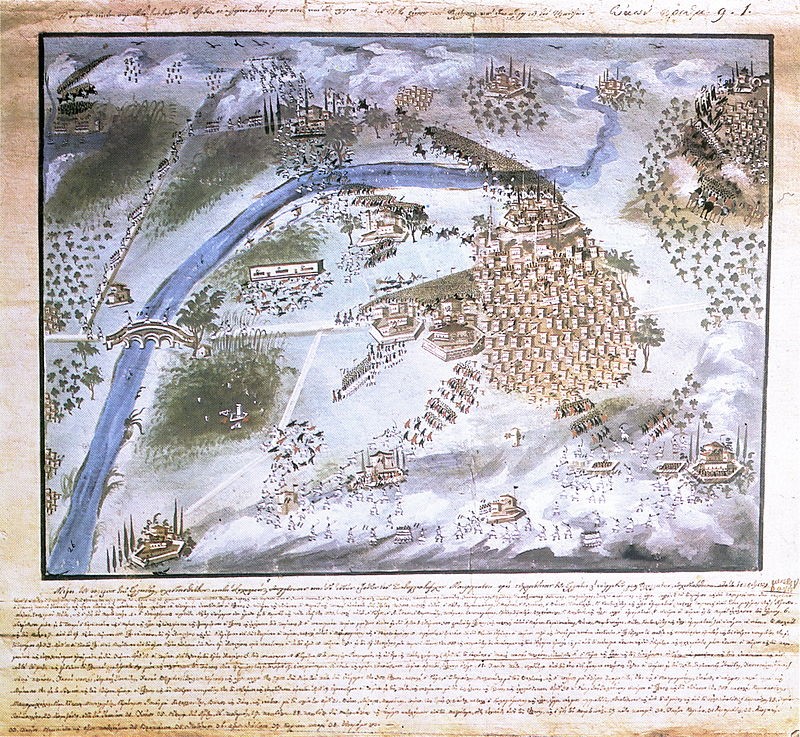
Representation of the Battle of Peta. Work of Panagiotis Zografos, commissioned by General Makrygiannis (SHP Collection).

A war council took place and it was attended by all military leaders and chieftains. Disagreements surfaced over two issues: 1) The position of the regular army in relation to the one of the irregular fighters. That is, who would be the vanguard and who would be the rearguard, and 2) whether or not fortifications (tambouria) should be built. On the first issue, the view which prevailed was that the forces should be placed in a manner to form a circle around Peta. Normann was dissatisfied with the decision and, realizing the disadvantaged position of the Greek side, he felt obliged to report his concerns in a letter to Mavrokordatos. Although he was the leader of the Greek forces, Mavrokordatos was absent from the battlefield. He had set up his headquarters in Lagada, six hours away from Peta. In his letter, Norman stressed that regular army soldiers numbered only 515. He also noted that he feared that Bacolas would leave his post and that the rest of the irregulars would not be in a position to help. Mavrokordatos was not convinced and the battle plan was not changed. Once more, the experienced General Norman, accepted this decision out of courtesy.

Following the leaders’ disagreement over the fortifications, the prevailing view was that they should be built. In fact, as many sources confirm, the “tampouria” were also used by Philhellenes. This is a rare case in which European soldiers fought in the “Greek way”. That is, with the methods of the irregulars. It is worth noting that the Philhellenes had a different sense of bravery and honor, which is depicted by a position attributed to Dania “our fortifications are our breasts”.

Unfortunately, other mistakes were made, which could not be stopped because they were beyond General Norman’s control. After the battle of Kompoti, Gennaios Kolokotronis and his unit, returned to the Peloponnese, on the orders of his father, an act which was heavily criticized afterwards. At the same time, 1,200 fighters left towards the north to help the Souliotes. They were led by the chieftains Markos Botsaris, Karatasos, Aggelis Gatsos, Georgios Varnakiotis, Alexakis Vlachopoulos and Andreas Iskos. These 1,200 fighters did not even succeed to come close to Souli. The Turks stopped them in the village of Plaka on June 29, 1822 and crushed them. Those who survived returned to Peta. The French Philhellene, Olivier Voutier mentions in his book that Gogos Bacolas (“this deceitful old man”), convinced Marcos Botsaris to move to Souli, and as soon as the unit left, he alerted the Turks to trap them in Plaka.

On the day of the Battle of Peta, a Corps from Mani also arrived in Splantza, led by Kyriakoulis Mavromichalis, to help the Greeks. However, once more this unit was not properly integrated into a single strategic battle plan. A body of Souliotes moved there and joined their positions to confront the Turkish forces sent to repel them. Kyriakoulis Mavromichalis himself was killed in this battle and his warriors decided to leave.

All these moves were not part of a general coordinated plan, and made it difficult for the Greek forces to deal with the main attack of the Turks. But again, despite their small numbers, these forces could still win.

On July 16, 1822, at dawn, the attack of the Turkish forces (7000 to 8000) who had arrived from Arta, began. General Normann woke the men up, cheered them on with warm words, and inspected all the positions of his forces moving from one to the other on horseback. He ran the battlefield to help where needed, “like a god of war”, as reported by Elster. In the beginning, the forces of the Philhellenes and the Regular Corps repulsed the outnumbered enemy troops with great success. The constant and coordinated shots hit the attackers. The key to success in this kind of war is for the soldiers to remain calm, to fill their weapons constantly and quickly, to shoot in a grouped manner, and above all to keep their positions, without allowing a rift in their ranks. The Regiment and the Battalion of the Philhellenes, formed an impenetrable wall. As St Clair notes in his work, the excellent training that the French Philhellene Baleste had begun, was paying off.

Unfortunately, a fatal thing changed the status. Chieftain Bakolas and his men, treacherously abandoned their positions (Bakolas finally changed camp and joined permanently the Turks). The Turkish forces took advantage of this gap, and infiltrated the backs of the solid and well defended positions of the Regiment and the Battalion of the Philhellenes, which resulted in the two bodies being cut off from each other. In the first attempt of the Regiment to be reunited with the Battalion, Commander Tarella fell dead and the Regiment began to retreat. Then this great man, General Norman, was put in charge and led it back to battle, encouraging them with brave words: “For the salvation of the Philhellenes! Victory or death!”. In the attack that followed, General Normann was hit by a bullet to the chest and was transported backwards to deal with his serious injury. Gradually, the Regiment began to retreat and it became progressively an easy target for the Turkish cavalry. The Philhellenes had been abandoned by all the forces of the irregulars. The forces of the Philhellenes and the volunteers from the Ionian Islands experienced a sad and unjust catastrophe. They were surrounded by the enemy at an exposed point and were exterminated.

Many scenes of incredible heroism followed. Dania, who cheered his soldiers until the last moment, was horribly massacred. Fifteen Poles, led by the Polish officer Mierzewski, gathered at St. George’s Church in central Peta and fought with incredible bravery, fighting even on the roof of the church. They were all heroically killed. A French officer, Mignac (who had clashed with German philhellenes during the campaign), also fought with unique bravery. The Turks tried to arrest him alive because he was wearing an impressive uniform and they thought that he was General Norman, the leader of the Philhellenes. Mignac refused to surrender and fought valiantly. In the end, being seriously injured in the leg, because he could not stand, he leaned on the trunk of an olive tree to stay upright and continued fighting in all directions, neutralizing fourteen Turks. His body was full of wounds, and when he broke his sword, he committed suicide by cutting his throat.

Among the volunteers of the Regular Corps, 160 soldiers from the Ionians islands and Philhellenes (one third of the force) were killed. Many of the prisoners were taken to Arta and killed by the Turks after being tortured and humiliated. Many Philhellenes were forced to walk naked for hours, holding the decapitated heads of their comrades in their hands.

The few survivors gathered in Lagada, among them the tragic figure of the day, the noble and brave General Normann. As after the battle of Kompoti, this time he arrived at the camp last and seriously wounded, on his dying horse. He presented himself to Mavrokordatos, to whom he stated: “We have lost everything, Your Highness, except our honor!”. The Battalion of the Philhellenes, and hundreds of enthusiastic European Philhellenes, and Greeks from the Ionian islands, no longer existed.

Monument in Peta, in memory of the fallen Philhellenes in the battle of Peta.

With the bitterness of the final defeat and the betrayal that caused it, General Normann (who now suffered a serious injury) headed with his comrades to Messolonghi. He stayed there, he continued to offer his services and helped fortify the city. He died shortly afterwards in November of the same year (1822), defeated by the complications of his wound, high fever and the psychological pressure he felt because of his responsibility for the battle of Peta. He had drifted young men to come and fight for the freedom of Greece, and he had done everything he could to lead them to victory. However, he was tormented by the fact that he had realized the mistakes and dangers, and the catastrophe they could cause, and he could have avoided them if he had tried to impose his views and his military authority. Unfortunately, he did not do so out of respect for the Greek administration.

The comments of the comrades in Greece of this great Philhellene General Normann, for their leader, as recorded in diaries and memoirs, are multiple. Many refer to him as “the flower of the Frank knights”, a brave and educated warrior, sensible, approachable and beloved as a father to soldiers. Others attribute to him, based on the developments in Peta, but also on events dating back to 1813 (also influenced by the differences between the Prussians and the French), a lack of confidence and indecision.

However, what no one among them disputes, is his genuine and selfless philhellenic feelings, his bravery and his sincere devotion to the interests of Greece. Ultimately, it is his virtues which prevented him from demanding complete control of the armed forces by Mavrokordatos, and from accepting that Greeks could ever betray their own comrades-in-arms, Greeks and Philhellenes.

It is worth noting here that after the battle of Peta, an imposing memorial prayer took place in Aetoliko, in which all the clergy and the people of the region participated. The French Philhellene Raybaud, describes in his book this ceremony and the pain in the faces of the Greeks and Philhellenes; among others of Mavrokordatos himself who was devastated.

Norman’s contribution to the Greek Revolution was first honored in Messolonghi, where one of the canon positions of the fortifications of 1825-26 was named after him. The body of the great Philhellene was buried there. This part of the fort was completely blown up during the fall of Messolonghi by the Turks.

The monument of the German Philhellenes in Messolonghi. The name of General Normann is mentioned first.

The name of General Normann is also placed in a central position on the Monument of the Philhellenes of the Catholic Church of Nafplio.

The Catholic Church of Metamorphosis tou Sotiros (The Transfiguration of the Saviour) in Nafplion and the Arch memorial of Philhellenes at its entrance. It mentions the name of General Norman.

A small street in the historic center of Athens, perpendicular to Ermou Street, bears the name “Normanou Street”, after the great Philhellene General Normann.

Normanou Street is named after General Norman

A stone column from 1830 in Waldkirchen, Bavaria, also mentions his struggle for the freedom of the Greeks. Finally, his name is also written in golden letters, along with that of other freedom fighters of 1821, and Philhellenes, such as Lord Byron and Fabvier, at the Propylaea in Munich.

The Propylaea in Munich. Symbol of Greek-Bavarian friendship and monument of the Greek Struggle for Independence.

The name of General Normann inside the Munich Propylaea.

General Normann was honored by France with the Order of the Knight of the Legion of Honor on December 10, 1808.

Greece and the Greeks will forever express feelings of immense gratitude for this emblematic noble German General and will always honor him for his heroic contribution to the struggle for the independence of Greece.


Bibliography and sources:

  • William St Clair, That Greece might still be free, 2008 (1972).
  • J.D. Elster, Das Bataillon der Philhellenen, 1828 (ελλην. μετάφραση Χρ. Οικονόμου, 2010).
  • Eugen Schneider, Normann-Ehrenfels, Karl Graf von, Allgemeine Deutsche Biographie 24 (1887).
  • K.Dieterich, Deutsche Philhellenen in Griechenland 1821-1822, 1929.
  • Ιστορία του Ελληνικού Έθνους τ. ΙΒ’, Η ελληνική επανάσταση, 1975.
  • Ν. Κανελλόπουλος – Ν. Τόμπρος, Η στρατιωτική δράση των Φιλελλήνων στη μάχη του Πέτα, Αργολική Αρχειακή Βιβλιοθήκη Ιστορίας και Πολιτισμού 2017.
  • ανών., Normann-Ehrenfels, Supplément à la Galerie historique des contemporains (tome 2), 1830.
  • Samuel Gridley Howe, Historical Sketch of the Greek Revolution, M.D. New York, 1828.
  • Emil von Normann: Geschichte der Gesammt-Familie von Normann. Ulm 1894, S. 148–152.
  • Regine Quack-Manoussakis: Der Deutsche Philhellenismus während des griechischen Freiheitskampfes 1821–27. München 1984.
  • Frank Ackermann: Von Ehrenfels nach Missolunghi. Das abenteuerliche Leben des Generals Carl Graf von Normann-Ehrenfels. Kilchberg 2012.
  • Graf Normann’sche Familienpapiere. — Starklof, Geschichte des königl. würtembergischen vierten Reiterregiments.


Frank Abney Hastings (1794-1828) was a British Commander and great Philhellene, with important action and contribution throughout the Greek War for independence.

He was born in 1794 and was the second-born son of Baron and general of the British infantry Charles Hastings, eleventh Earl of Huntingdon (Francis Hastings, 10th Earl of Huntingdon) and Parnell Abney. Both his parents were noble and very wealthy financially, and their son Frank could have a very comfortable life. To understand the origin of Frank Abney Hastings, we note here that the Hastings family had many distinguished members. For example, Warren Hastings, India’s first General Governor, was Frank’s cousin. In addition, the important military politician, Francis Rawdon-Hastings, later governor of India (from 1813 to 1823), was a cousin of his father.

Frank’s father noticed his son’s interest in naval matters, and directed him to join the Royal Navy from an early age. So Frank Abney Hastings enlisted in the Navy at the tender age of about 9 years old, when his peers were under the supervision of their family or nannies. Young Hastings gained quickly significant naval experience, and even from his involvement in war operations. It is remarkable that when he was 11 years old, he took an active part in the emblematic naval battle of Trafalgar and served in the two-decker “Neptune” that belonged to the fleet of Admiral Nelson. In this naval battle, the stern and a large part of the ship exploded. Hastings even took part in the Battle of New Orleans in 1815.

During his service in the British Navy he sailed all the seas of the world, had a successful career for fifteen consecutive years, specialised in artillery and reached the rank of master.

In 1807 Hastings was transferred to the 42-cannon frigate “Seahorse”, with the mission of monitoring French ships between Toulon and the Ionian Islands (then under French rule). In this phase of his career, Hastings became well acquainted with the Greek seas, and even took part in operations against the Turks (something that is not mentioned in most of his biographies). On July 5, 1808, his ship came face to face between Skopelos and Alonissos islands, with two Turkish ships, the “Badere-i-Zaffer” (with 52 cannons) and the “Alis Fezan” (with 26 cannons). Hastings’ ship was at a disadvantage. But thanks to the exemplary discipline of the crew and the high training of British sailors, after two days of conflict, the “Seahorse” took over the “Badere-i-Zaffer”, while the “Alis Fezan” fled.

Hastings was promoted and transferred to the emblematic 105-cannon frigate, “Victory”. Known as the flagship of Admiral Nelson in the Battle of Trafalgar. He then served on many other ships, undertook military and scientific missions, and got to know all the seas from the Baltic region, to America, Asia, and China.

In 1819 he took command of the hydrographic ship “Kangaroo”, with which he arrived at the port of Jamaica. There he quarreled with the admiral, who accused him of incorrectly anchoring (he placed his anchor at a point that allegedly made it difficult for the admiral’s flagship to move), and even insulted him (probably unfairly) publicly in front of his crew. Hastings was particularly addicted by the public nature of this reprimand, and went so far as to call the admiral into a duel. In fact, he considered this behavior so unfair that he even refused to testify before the Commission appointed to investigate the case. This act led him out of the English Royal Navy.

Hastings returned to England, and after a while he left in 1820 for France. He stayed with a friendly family in Caen for a year and then moved to Paris. There he met Greek patriot from Russia, Nikolaos Kallergis, who became and remained his close friend until the end of his life. In Paris he came in contact with many Philhellenes and discovered the work of Lord Byron.

Lord Byron. Portrait of the 19th century. Oil on canvas (SHP Collection).

Hastings was excited by the struggle of the Greeks and began to actively support it. He soon decided to go to Greece and enlist as a volunteer in the Greek Revolutionary Forces. He had prepared this trip wisely, being conscious of his mission. For this purpose, he even procured various instruments useful for the artillery, with the aim to be as useful as possible to the Greek forces. He also brought with him an important library with works by Edward Gibbon, Shakespeare, Walter Scott, etc.

He went to Marseille, France, and from there he left for Greece aboard of the Swedish ship “Trondjem”, on April 3, 1822, together with other volunteers and the American Philhellene George Jarvis. At the end of April 1822 he arrived in Hydra. At first, he was treated with suspicion because the British governor of the Ionian Islands, Thomas Maitland, had adopted at that time a negative attitude towards the Greeks. On the contrary, the American George Jarvis was immediately received with honors, something which bothered Hastings. In fact, this situation almost led the two great Philhellenes to a duel. Fortunately, they were separated by their mutual friend (another important Philhellene), John Hane.

Hastings came in contact with Mavrokordatos and Tombazis and insisted on his pure intentions and dedication to the struggle of the Greeks. In fact, he sent the following letter to Mavrokordatos, in French: “Because I found your Highness busy yesterday when I had the honor of appearing at your desk, I decided to take the courage to address you in writing. I will speak freely to you, convinced that your highness will answer in the same way. I will not bother you with stories on my venue to defend the Greek cause. I came uninvited and I have no right to complain if my services are not accepted. I only regret that I cannot add my name to the liberators of Greece. I will not stop wishing for the triumph of freedom and civilization against tyranny and barbarism… “.

The misunderstanding was quickly resolved, and after learning about the status of the operations, Hastings presented his ideas and proposals for the organization of a navy. Mavrokordatos and Tombazis recognized in Frank Abney Hastings, a capable soldier with valuable naval knowledge that Greece needed, and a man with deep feelings of love for Greece. So they surrounded him with their trust and treated him with due respect. It was agreed that Hastings would enlist directly in the Navy of Hydra, and on April 30, 1822, he was appointed to command an important ship of the Tombazis brothers, the “Themistocles” (war corvette).

Hastings collaborated with Tombazis and Sachtouris, he was progressively loved by Greek sailors and he easily commanded ships and Greek crews. At the same time, however, he worked diligently to train the personnel of his ship, and to impose the principles of discipline, necessary to achieve high efficiency. One of his first missions was the naval campaign of retaliation against the Turks for the massacre in Chios.

In one naval operation, “Themistocles” had come too close to the Turkish-occupied coast, attempting to disembark part of his crew on a mission to northern Lesvos. The wind suddenly stopped being favourable and the ship became an easy target for the Turkish cannons firing from the land. The rest of the crew suddenly hid to avoid enemy bullets, as it appeared that the ship would sink. Hastings worked alone with the Captain, and with coordinated interventions on the sails, trying to get the most of the minimal wind, he managed to safely remove the ship. This act, his courage and bravery, made him a hero already from his first days in the Greek Navy.

Hastings participated with “Themistocles” in many military operations. In addition to his heroism, he also contributed with his innovative proposals. So he installed on the ship various modern measuring instruments for optimal navigation and accurate use of the artillery. In fact, he constantly made innovative proposals and suggested various improvements. Many of these, such as a series of special uses of the sails, or the use of a light anchor, were accepted. Others did not have such luck. For example, the Greeks did not want to place heavy cannons on their ships; as a result, they could not attack the Turkish ships from afar. So the basic strategy for attacking enemy targets was to use fire ships, which limited their operational capabilities. Hastings also insisted to install furnaces to heat the bullets before firing them to the enemy. The Greek ship-owners did not want to implement this suggestion either, because they considered it dangerous for their ships.

Hastings realized that many of his proposals were rejected by the Greek captains because they were owners of their private ships, and did not want to endanger them. For this reason he was dissatisfied with Miaoulis and asked to be transferred to the mainland. There he received the rank of Colonel of the Artillery and was assigned the command of the Greek Artillery. This was based on a few and almost useless old cannons. Hastings tried to rely on his know-how in artillery to use it in the best possible way the cannons, during the bombing of the castle of Nafplion from Bourtzi (the small island in front of the port), which was controlled by the Greeks.

After that, Hastings organized and equipped at his own expense a corps of 50 men and joined the Greek forces guarding the routes allowing Nafplion to communicate with Corinth and receive supplies.

In May 1823, the Greek administration appointed Hastings in charge of artillery in the campaign in Crete, led by Emmanuel Tombazis, who had been appointed commander of Crete. The Greeks landed an expeditionary force of 1,200 men, which was accompanied by Hastings’ artillery. After the siege, they captured the fortress of Castelli. They then gathered a force of 5,500 men and marched towards Chania. In October 1823, Hastings got seriously ill with a high fever and left the operations before the end of the year. Unfortunately, the campaign failed and Tombazis left Crete in April 1824. The Greek forces returned to the Peloponnese.

Frank Abney Hastings, lithography, Karl Krazeisen (SHP Collection).

In addition to his constant participation in war conflicts, tireless Frank Abney Hastings never stopped planning moves and initiatives to improve the operational capabilities of the Greek fleet, modernize it, upgrade its equipment and prepare it to face successfully the Turkish-Egyptian fleet.

In this context, Frank Abney Hastings suggested equipping the Greek fleet with steam-powered warships. His proposal was based on the following logic. The Greeks had few and small ships, with few and small-range cannons, and of course several fire ships. On the contrary, the Turks had more and larger ships, with many more cannons and of longer range. Under certain weather conditions, the capable Greek sailors (with flexible handling and the combined threat of fire ships) could face the Turkish fleet. But in order to gain an advantage, they had to have fast ships at their disposal, capable to moving even without sails, even when there was no wind, with reliable, powerful and long-range cannons, and a strong armour that could withstand enemy fire.

After the campaign in Crete, Hastings studied the capabilities of Ibrahim Pasha’s navy, and concluded that the Greeks had now lost the advantage they had at sea during the first phase of the war. Their ships could no longer withstand or even approach the much larger Turkish ones, while the fire ships had gradually become useless.

Hastings submitted several memoranda to the government, in one of which he stated: “Greece cannot be effective against the Turks, without a definitive superiority over the sea, as it needed to prevent them from supporting their fortresses and resupplying their armies.”

When Lord Byron came to Greece, Hastings wrote to him twice and presented his views. He then went to meet him in Messolonghi. Lord Byron did not treat his proposals as a matter of first priority. In fact, Hastings mentions in his notes: «(I) got heartily laughed at for my pain (…) by Lord Byron and some other genius’s »

In Messolonghi he met Count Gamba (friend of Byron and brother of his last companion), who contributed later in the construction of the steamship “Karteria”. He also met Colonel Stanhope, and persuaded him of his ideas. In fact, Stanhope stated in his own writings: “Captain Hastings is looking forward to getting a steamship on his own, offering himself 1,000 pounds to the fund-raising. He argues that with a single ship carrying cannons of 32 pounds and a furnace to heat bullets, he may paralyze the blockade of Chalkis, Karystos, Nafpaktos, Patras”. And he also confirms “If Greece had 3 or 4 steamships, it would no longer have to fear another navy apart from the English”. Another important Philhellene who supported Hastings’ proposals was the British Philhellene Edward Blaquiere.

Frank Abney Hastings suggested the construction of steamships, with the aim to allow Greek forces to regain supremacy and control at sea and suggested that he personally takes care of the design of the ships. In order to fully assess his courage and insight, it is worth noting that at that time only the US Navy had one steamship, but which had never taken part in military operations.

From his correspondence with Mavrokordatos and others, it appears that Hastings was systematically putting forward his plan. At first, everyone discouraged him by saying that there were no financial resources to purchase the steamships. But then the tragic fall of Mesolonghi followed, which was mainly caused by the success of the Turkish-Egyptians in imposing a naval blockade on the city, and depriving it of the opportunity to be supplied with food and ammunition. Greek ships were never able to break this blockade. The Greek administration, which had now lost all the cities, apart from Nafplion and the islands, realized that it had to regain control of the sea and decided to use part of the second loan of Independence to build a strong fleet.

At the same time, Hastings and the Hellenic Committee of London, contacted Thomas Cohrane, who had been very successful in supporting liberation movements in South America. Cohrane was a living legend at the time. They persuaded him to join the Greek struggle. Hastings presented his plan and Cohrane asked for the construction of a fleet of six steam-powered ships, like “Karteria”.

For all these reasons, the Greek administration accepted Hastings’ proposal, and instructed him to supervise the construction of the first steamship in England. After a series of misfortunes, conflicts of opinion between different stakeholders, and thanks to the intervention of Count Pierre Gamba, Edward Blaquiere, and others, Hastings took full responsibility, and the first ship was completed. The ship was delivered in Hastings name to avoid a diplomatic incident between the United Kingdom and the Ottoman Empire.

The ship was originally named “Perseverance”, and when it arrived in Greece it received the Greek name “Karteria”. Frank Abney Hastings contributed to the design and construction of the ship, while he designed himself his state-of-the-art military equipment, which he funded entirely by paying 7,000 pounds (a huge amount for the time) from his personal fortune. At the same time, he prepared the ship for naval operations and bought with his own money even the naval navigation instruments and maps.

“Karteria” was a 125ft long, 25 wide, 400 ton, 4-masted schooner with two engines run on steam from coal-fired boilers, 16 rpm, 84 horse, driving port / starboard paddle wheels and 6 knots. Originally she was to have one 32 pound gun forward and one aft, and two 68 pounders in the middle, fired in turn with the ship rotating by her paddle wheels. Red hot shot was to be used, which was lethal for enemy sail and wood ships. She travelled under sail and the steam engines were used only in action.

“Karteria” was the most modern ship in the Mediterranean.

Dimitris Caipatzis is the writer of an important study titled: ‘KARTERIA’ THE FIRST STEAM WARSHIP IN WAR (1826), which can be downloaded here.

The steam-powered warship “Karteria” and the frigate “Hellas”. The first two ships owned by the Greek Navy. Lithography, Karl Krazeisen (SHP Collection).

The figure head of the “Karteria” steamship, Historical Museum, Athens.

The Greek administration appointed Hastings Commander of this new steamship, “Karteria”, which was at the time the jewel and pride of the Greek fleet. The long journey from London to Athens was already a challenge.

When the ship arrived in Cagliari, Sardinia, it caught fire in the engine room. Hastings sent immediately his friend and crew member, Finley, to England, with orders to bring engineers and spare parts. The damage was repaired, the ship continued its journey and at the beginning of September 1826, it arrived in Nafplion, where it was welcomed with pride and enthusiasm by the whole city. Frank Abney Hastings justified his reputation of a hero.

As soon as Hastings arrived at the port, he called the Greek administration to take care of all the formalities, to transfer ownership of the ship, which still carried the English flag. A few days later, the hoisting of the Greek flag took place, which was now proudly waving on the mast of this modern ship. This historic event was greeted by canon fire from the fortress of Nafplion.

As the historian Mendelssohn-Bartholdy reports: “The virtue meant by this name (perseverance), was to the distressed in many way Greeks, expecting help from Christian conscientiousness and the sympathy of the powerful of the world, very much-needed. Karteria and Karteria and eternally Karteria in those exposed many times to myriad dangers and embarrassment and dire anguish and total despair … » (free translation).

The Greek administration transferred Hastings from the Army back to the Navy and appointed him captain of the ship. He selected the crew meticulously and with strict and meritocratic criteria.

Frank Abney Hastings as Governor of the British Navy. Portrait from Finley’s library. Published in the work “Hastings and his work in Greece”, Athens, 1928.

The crew of “Karteria” consisted of the brave and hard-working sailors chosen by Hastings himself. Another emblematic Philhellene, American military doctor Samuel Howe, was aboard the ship, and was later replaced by another great German Philhellene, Heirich Treiber. Both expressed their admiration for Hastings in their memoirs, but have also captured images and snapshots of life on the ship and its involvement in military operations.

“Karteria” took part in many military campaigns and naval battles. This steam-powered ship caused awe and panic in the enemy when it appeared. The Turks referred to it as “the frigate of fire.”

The first mission was to support Greek forces, led by another British Philhellene, Thomas Gordon, to land in Piraeus, with the aim of liberating Athens. The landing took place on February 5, 1827.

“Karteria” gathered its fire at the Monastery of Agios Spyridon, where the Turkish troops were deployed, in order to provide cover to the Corps of 2300 men disembarked by Thomas Gordon.

The Turks sent reinforcements and 5 large cannons of long range and the “Karteria” was removed to avoid their fire. A few days later, the Turks attacked the positions where Gordon’s Corps had camped. “Karteria” intervened immediately in order to attract the fire of the Turks on it, offering valuable time to Gordon’s forces to organize their defence. Hastings’s plan succeeded and the Greeks kept their positions. Meanwhile, “Karteria” destroyed 3 of the 5 Turkish cannons. However, it also received several bullets, some of which caused damages. It was that that everyone realised the genius design of “Karteria” by Hastings. The engine room was protected inside the boat, which was designed with many different watertight compartments. If one caught fire or water, the ship could continue to sail and operate. “Karteria” sailed away when the Turkish counterattack failed, leaving Gordon’s Corps safe. The damages were repaired a little later.

The American Philhellene doctor Samuel Howe mentions in his memoirs that the shells from the Turkish forts in Attica hit the ship and bounced off without causing serious damage and praises the worthy Commander who maneuvered flexibly in the shallow waters near Piraeus.

In addition to the genius design of the ship, from a shipbuilding point of view, the design of its weapons was also genius and innovative. Hastings took into account that the wheels with the wings mounted on either side of the ship limited the space available for him to place cannons. So he decided to place less, but more powerful, in the free points of the ship, and to achieve a tremendous firepower. He based his design on his extensive experience, but also on the study of the work of the French army officer and artillery expert Henri Joseph Paixhans.

First, he equipped the “Karteria” with a safe furnace to heat the bullets before they were placed in the cannons for firing. Thus, each incandescent red bullet caused enormous damage, and provoked explosions and fires, regardless of where it hit the enemy ship. It is estimated that when a red bullet fell on the enemy ship, it had about the same effect as a fireship.

Second, originally he planned to install a 32-pound cannon in front and a rear one, and a 68-pound cannon on each side of the ship. Finally, he installed four 68-pound cannons, which fired incandescent red bullets, which caused large explosions when they found their target.

Model of the steam-powered “Karteria”. The position of the ship’s cannons can be seen. The model was presented to the Baltic Exchange in London in 1923 by the Greek shipping community.

Third, it planned to create a national navy, which would operate by naval discipline in accordance with best practices internationally, and would belong to the central state and not to private ship-owners. The crew consisted mainly of Britons, Swedes and Greeks. Among them were the Scottish Philhellene and historian George Finlay, but also the American doctor Samuel Howe and then the German doctor Heinrich Treiber.

Hastings, after blocking Eretria with the Greek fleet, took part in the naval forced which attacked Oropos in March 1827, with the aim of destroying enemy installations that coordinated the supply through Evia of the Turkish troops besieging the Acropolis of Athens.

ALLGEMEINE ZEITUNG No 121, 1 May 1827. Detailed presentation of the Battle of Karaiskakis on 15 and 16 March in Keratia or Keratsini on the left side of Piraeus, where 1,000 Greeks clashed with 1,500 enemy infantry and 500 cavalry, and defeated them. The frigate “Hellas”, the steamship “Karteria” and the ship “Nelson” of Dimitrios Paparisolis from Psara, left the bay of Eretria which they had blocked, for Oropos. There they seized, among others, two ships full of food supplies which they transported to Aegina. […]. 8th, p. 4. In German (SHP Collection).

The strategic goal of the mission was the expulsion of the Turks from Attica and the end of the siege of the Acropolis in Athens.

The attack was coordinated by the great German Philhellene of Swiss descent (and later one of the three regents until the coming of age of King Othon), Karl Wilhelm von Heideck. The Greek fleet comprised the “Hellas” frigate, “Karteria” and other ships carrying Greek troops.

“Karteria” captured two enemy cargo ships that arrived at the port with supplies (mainly flour and wheat) from Evia. Immediately afterwards, it anchored 200 meters from the shore and with a continuous bombardment it neutralized the Turkish fort and blew up its powder magazine. Subsequently, reinforcements and a strong Turkish cavalry unit arrived, and the Greek forces returned to Aegina.

Meanwhile, in the spring of 1827, Cohrane arrived in Greece and took over the duties of the Admiral of the Greek fleet. Hastings rejoiced because he thought that at last the entire Greek fleet would operate in a coordinated fashion. The strange thing was that Cohrane offered him complete autonomy and gave him the opportunity to have complete control over his ship and the organization of the operations he undertook.

After the operation in Oropos, Hastings planed his next move, always with the aim of serving the same strategic choice, which was the withdrawal of the Turks from Attica. So he turned to Volos, where the supplies from Thessaloniki and Constantinople ended. Volos was the largest supply centre for the Turkish troops in central Greece.

Hastings assembled a squadron of four ships which were rented to the government by their ship-owners (Tombazis ‘”Themistocles”, Miaoulis’ “Mars” and two smaller ones). When the squadron arrived in Volos, Hastings placed “Themistocles” and “Mars” opposite to the Turkish forts. “Karteria” turned against the Turkish units that had been deployed in trenches, and the cargo carriers and their escort boats that were found in the port.

After a fierce battle that lasted 4 hours, all the Turkish positions had been neutralized, their gunpowder depots had been blown up and all the Turkish ships had sunk or were seized. “Karteria” had fired a total of 300 shells (i.e. about one shell every 48 seconds). Greek fishermen informed Hastings that the Turkish warships had moved in the Gulf of Trikeri in Pelion, at a point that provided them with support from the surrounding forts, to protect themselves. Hastings devised a new plan and attacked the next day, sinking or neutralizing most of the ships he found in Trikeri. Two members of the “Karteria” crew were killed in the clash. One of them was a brave British Philhellene, especially loved by the crew, named James Hall. The loss angered the rest of the crew, and another British sailor attempted to retaliate by killing all Turkish prisoners. Hastings, who complied with a code of honour that imposed to respect prisoners, was forced to arrest this sailor.

The Greek squadron, which had suffered several casualties in the meantime, took the road back to the naval base in Poros. During the return trip, Hastings’ squadron captured another 4 cargo carriers coming from Evia bringing supplies to the Turkish army in Attica.

In May 1827 the crew of “Karteria” reacted because they were unpaid for a long time. Hastings briefed Cohrane and the government. Once again, the great Philhellene covered the salaries with his own money. And it was neither the first nor the last time he did so.

In the summer of 1827 a series of operations were organized against the forces of Ibrahim. In fact, one of them was intended to capture and arrest Ibrahim himself, but it was cancelled due to bad weather. In September, the Greek fleet, consisting of 23 ships (including “Karteria”), led by Admiral Cohrane, took up positions in the Ionian Sea, targeting Messolonghi and the western part of Greece. The recovery of these territories was a strategic choice of governor Kapodistrias, who needed arguments to claim the borders of the new Greek state to be as far north as possible.

It is recalled that on July 6, 1827, the Treaty of London was signed, which ensured the liberation of Greece and imposed a truce on the warring parties. While the Greeks accepted it, the Turks had rejected it and continued the hostilities, so the Greeks continued military operations as well. Admiral Codrington asked Cohrane not to provoke with hostile actions. Greece accepted it and withdrew most of its fleet from the Ionian Sea. So Cohrane turned to other parts of the Aegean. But he left Hastings there with “Karteria” and a squadron, in a mission to regain full control of the area and advance the recapture of Messolonghi.

Frank Abney Hastings took advantage of this opportunity and offered one of the most emblematic and important successes of the Greek War of Independence. The naval battle of Agali, which took place in Itea in September 1827.

He himself led the squadron of the Greek navy, which included “Karteria” and 5 other ships (“Sotir”, two galleys and two cannon boats, “Bavaria” and “Philellinida”), to enter the gulf of Corinth. This was a particularly dangerous operation, because any approaching ship was at that time exposed to the crossfire of Turkish artillery for the forts of Rio and Antirrio.

On September 30, 1827, the Greek squadron reached the Gulf of Itea, where they met 11 anchored Turkish ships. The Turkish admiral had his flag on a large 16-gun flagship and he was guarding three Austrian cargo carriers full of supplies. The Greek squadron began to move around the port, waiting for the wind to become favourable. At the earliest opportunity, Hastings entered early in the morning the Salona bay, which was protected by an impregnable fortress. The Turks believed that the small squadron was trapped and they prepared to capture the ships. “Karteria” chose the best possible position, five hundred meters away from the Turkish flagship. It anchored and started firing slowly in order to control the distance. At ten o’clock in the morning a quick fire started with incandescent red shells. Soon one of them ended up in the gunpowder depot of the Turkish flagship, which exploded and scattered in small pieces all over the sea, causing thunders that were heard in all the mountains of the area.

The outcome of the naval battle was incredible. “Karteria” sank the Turkish flagship and destroyed 9 of the 11 Turkish ships parked there. Hastings seized three major carriers and their rich cargos.
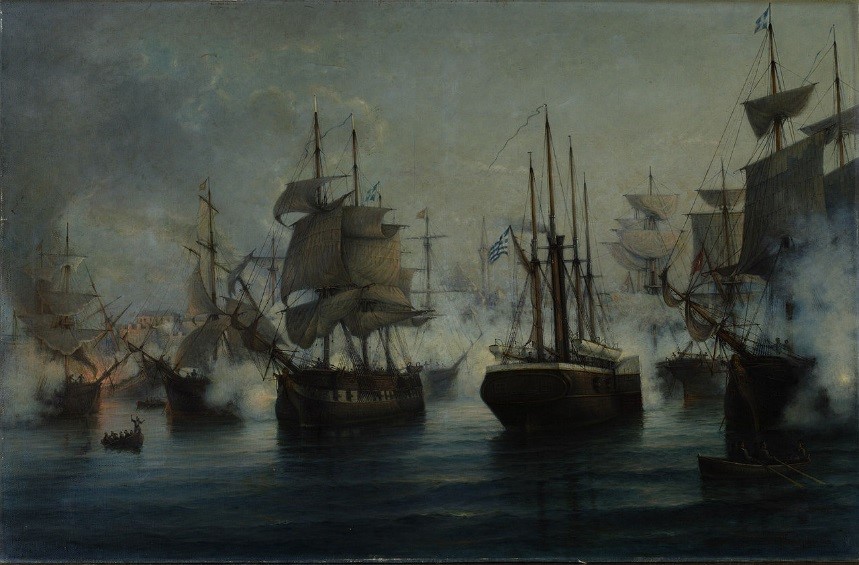
Battle of Agali or Itea in 1827. Oil painting by Ioannis Poulakas (1864-1942)

The Battle of Agali was the first major military engagement involving a steam-powered warship. During this naval battle, as well as shortly before the attack in Trikeri, Hastings tested for the first time in international military history a steamship and innovative artillery tactics, which were the subject of study and promotion, which attracted attention internationally. For example, Blackwood’s Edinburgh magazine writes about it:

“The battle of the Salona bay provided the most satisfactory evidence of the effectiveness of the armament of the steamships by heavy artillery in favour of which Master Hastings spoke so warmly and for a long time. The terrifying and rapid force, by virtue of which a so superior force was completely annihilated by the red bullets fired and the explosive shells of “Karteria”, imposed silence on the opponents of Hastings’ plans in Europe. And to all those who study the progress of the naval war, it became clear from that day that more than one state in the future would accept his position on naval artillery and they would arm many ships, following the example he gave”.

Blackwood’s Edinburgh magazine, 1827.

However, this naval battle had another serious effect. It now persuaded the Greeks to abandon the tactic of constituting a fleet by leasing private ships and to build instead a fleet that would belong to the state. Until then, the fleet for every military operation was formed by assignments to individuals. Those who contributed their ships received certificates such as the following.

WAR DIPLOMA 1826 – The Administration Committee of Greece appoints Captain Giannis G. Koutzis and his ship “Themistoklis” to the National Fleet to take part in the common fight against the enemy. Signatures of the Committee, A. Zaimis, P. Mavromichalis, Rev. Deligiannis, G. Sisinis, D. Tsamados, A. Chatzianargyrou, S. Trikoupi, A. Iskos, I. Vlachos, P. Dimitrakopoulos. Seal of the Committee and signature of the General Secretary K. Zografou. Nafplion 5 August 1826 (SHP Collection). Detail: Giannis G. Koutzis was an important captain / ship-owner of the Greek Revolution, who has not received the recognition he deserves, because he linked his name to the controversy he had with the Greek hero Bouboulina, which ended in her death.

The ship-owners who offered their ships received promissory notes to get their compensation with interests from the National Fund in three years.

Promissory note to repay 1000 gurus with interest from the National Fund, in three years (SHP Collection).

The great victory of the battle of Agali stimulated the morale of the Greeks. We remind that during this period the Greeks had lost Messolonghi, and Athens, with the result that all of central Greece was controlled by the Turks. After this victory, from the moment the Turkish fleet was destroyed in the gulf of Corinth, Hastings was now free to land troops in western Greece and supply them in time without any problems. Thanks to these developments, the units of Kostas Botsaris, Kitsos Tzavellas, Dimitrios Ypsilantis and the Regular Corps of the British General Church, were deployed in western and eastern Greece. A series of military operations were launched to ensure that the Greek forces which landed secure positions, which would allow Greece to claim more territory, critical to have enough geographical space for a viable state.

The Admiral of the Greek Navy, Cohrane, congratulated Hastings on his great victory: “You have done a lot and worthwhile to open the transport communications. Take care now of them, the position is dangerous if my information is true, the enemy fleet arrived to Patras. I grant you all the freedom to do whatever you think is best for the public service.”

Hastings headed to Patras with the goal of blocking the port. When he arrived in Rio, he received heavy fire from the Turkish forts, which he bombarded with his squadron, inflicting significant blows to the Turks. In fact, the marks left by “Karteria’s” red missiles on the forts remained indelible in time and are still visible today.

The fortress in the port of Rio, near the city of Patras.

These days, one of the most emblematic events of the Greek struggle for Independence took place, as well as a historic moment for Philhellenism.

At one point while “Karteria” and Hastings’s squadron were patrolling the area, the crew spotted a large Austrian-flagged cargo ship heading to Patras to supply the Turks.

It is noted that since March 1822, the Greek Administration had declared a blockade to all the Turkish-occupied ports of Greece.

Decision of the Greek administration, of March 13, 1822, declaring the blockade of all the ports of Greece from Epirus, the Peloponnese, up to Thessaly, and all the Aegean islands including Crete. It is signed by Mavrokordatos (President of the Executive) and Negris (Minister of Foreign Affairs).

The Austrian Consul contacted Hastings to demand the safe entry of the Austrian ship into Patras. Hastings replied: “Being the Austrian consul, of course you have been informed that the Greek government has declared the blockade of Patras and that a Greek warship is patrols the port.”

It is recalled that at that time the Austrian Empire was a superpower, and that its diplomatic representative was aware of the power and prestige of his position. So the Consul replied to Hastings: “My state does not recognize the Greek government, nor does it accept the validity of its actions.”

Hastings was adamant: “Sir, I have been ordered to ratify these acts by force of arms, and I must ask you to go immediately to the Austrian carrier and have the master come here with the supporting documents.”

The Austrian Consul considered that he could impose his position, and replied: “I think I am speaking to an English and because neither Austria nor Turkey are at war with England, you must respect the Austrian flag.”

To this challenge, the great Philhellene and hero of the Greek Revolution, responded with words that have now gone down in history, and show the greatness of this man: Sir, you speak, to a Greek officer, commanding the squadron of the blockade and if the Austrian ship is not set immediately under my command, I will sink it. As I will also shoot the Turkish camp; you have only five minutes, he said, taking out his watch and asked the Consul to leave. The Consul left without believing that Hastings would dare to carry out his threat. The great Philhellene, however, waited for exactly 5 minutes, and immediately afterwards ordered the bombing of the ship, which sank in a short time. At the same time, “Karteria’s” guns neutralized Turkish cannons on land.

The successes of Hastings worried the Turkish-Egyptian forces, who, after realizing the pressure exerted on them by the Greek naval forces, tried to take initiatives to confront the Greeks. These developments had angered Ibrahim Pasha himself, who had called for Hastings to be arrested and punished by example. Even Cohrane himself had advised Hastings to stay in the Gulf of Corinth in a safe place to avoid Ibrahim’s revenge.

These moves by Ibrahim, however, offered Admiral Codrignton the pretext he was looking for to neutralize the Turkish-Egyptian fleet, since they were now officially violating the truce and continued to attack the Greeks. The strategic goal was to deprive Ibrahim of his ability to receive supply from Egypt, so that he would be forced to leave the Peloponnese. This great Admiral, an admirer of Lord Byron, had already received clear instructions from the Prime Minister of the United Kingdom, a friend of Lord Byron and a Philhellene, George Canning several months ago, to expel Ibrahim from the Peloponnese as soon as possible, “either with the use of diplomatic language or with the persuasion of arms.” Canning (one of the high level internationally personalities to whom Greece owes its freedom and independence) had made his position clear long ago, and this was known to the international public opinion.

Gazette de France, March 10, 1827. “George Canning sent a new official memorandum to the sultan for peace in Greece. He called for an immediate end to hostilities on land and at sea and for a diplomatic solution to the Greek problem. It seems that Britain and Russia would do anything to stop the war.” SHP Collection.

Thus, the Allied fleet entered Navarino. But Codrington’s intentions were well known to Ibrahim, and because he knew that his large fleet could not confront the smaller but more experienced one of the allies, he considered he had set a trap attracting them to enter the Navarino gulf. Indeed, in this narrow space, Ibrahim could rely on the cannons of his own ships (about 90) plus the cannons of the forts from land, while the allies had only 28 ships. Despite the multiple firepower, the panic and failure of Ibrahim’s shooters, turned the “trap” he was preparing into the grave of his plans. These were to erase Hellenism from Peloponnese and central Greece, implementing a plan of genocide and uprooting, that would lead to the end of Greek history. Ibrahim’s fleet was destroyed, and more than 60 ships sank with most of their sailors chained in their places.

Thomas Whitcombe circle of, The Naval Battle of Navarino, October 20, 1827, SHP Collection.

After the naval battle of Navarino, Frank Abney Hastings had now regained full control of the Greek seas with “Karteria” and his squadron. In November 1827, Hastings resumed operations. The next target was Messolonghi, which was the key to control Western Greece.

The first move was to reach Vasiladi, a strategically important stronghold for Messolonghi, which Miaoulis had tried to capture without success. Hastings devised an intelligent plan to capture one after the other the forts that protected the islets of the Mesolonghi lagoon (Vasiladi, Dalmas and Aetoliko). It is noted that the waters are very shallow in the area and ships had to stay at least three kilometers away.

The siege lasted about a week due to bad weather. The first shots missed their target because of the long distance. Hastings equipped small boats that could move flexibly in the shallow waters of Messolonghi and used them to block Vasiladi and Aetoliko from Messolonghi, waiting for the right weather conditions to attack.

The attack began on December 27, 1827. “Kartheria” and “Elvetia” were bombing from the east, while the small boats were firing from the inside of the lagoon. The first shots were very successful. They hit the fort, destroyed the water tank, and opened a large crack in the wall. The fifth shot was fired by Hastings himself, who adjusted the cannon and succeeded with a well-aimed shot at the Turkish gunpowder depot. The blast destroyed most of the Turkish cannons and forced the Turks to surrender. The British Philhellene, Captain Hane, landed in Vasiladi, took control of the fort, and captured 39 Turks. Hastings treated the prisoners in an exemplary manner, he disembarked them elsewhere and allowed them to return to Messolonghi. A detachment of the Greek army was stationed at the occupied fort. The Turkish commander who was released sent a lamb and a sword to Hastings from Messolonghi as a gift.

This victory, which now brought the Greek forces close to liberate Messolonghi, took place on the day that Ioannis Kapodistrias crossed the Ionian Sea to assume the duties of the first Governor of the new Greek state.

After this success, Hastings had to confront a new payroll problem. The Navy owed to the crew of “Karteria” 3 salaries. Unable to continue and face his crew, Hastings and other officers submitted their resignation to Kapodistrias. The ship’s doctor, the Philhellene Heirich Treiber, was among them. He left and eventually moved to Athens, leaving “Karteria” without her doctor.

Governor Kapodistrias invited Hastings immediately to Poros, and managed to persuade him. In fact, he accepted all his suggestions for the reorganization and operation of the Greek Navy.

The main focus of Hastings’ proposals was to develop a national navy that would belong to the government, and not to hire ships from individual ship-owners. The new Governor had appreciated Hastings’ abilities and personality, and had decided to entrust him with the general coordination of the naval forces, according to the contents of a letter to him: “To Captain Hastings. The Government for which you are willing to be useful in its purposes assures you with pleasure that it assigns to you the management of maritime affairs. … you may use Mr. Georgios Economidis as personal secretary?”. This great man agreed to withdraw his resignation and continue his mission for the shake of Greece.

Hastings’ first move was the foundation of the first Greek naval base in Poros and the planning of the administrative operations. Shortly afterwards, he left to complete his mission.

After the fall of the fortress at Vasiladi, the next strategic step to occupy Messolonghi was Aetoliko. Hastings had to cooperate with the Regular Corps, which was commanded by General Church, with whom he did not maintain the best relations. Despite the disagreements, the sense of duty that both Philhellenes had, and their love for Greece, helped to put aside their differences and find a common acceptance solution.

Church describes their relationship as follows: “Hastings, who acquired the noblest virtues of spirit and heart, was unfortunately irritable and awkward, which often made it difficult to cooperate with him.” It should be noted that Hastings had suffered greatly during his participation in the war of independence, due to the inability of the Greek administration to coordinate the actions of the Greek forces, and to support him in his work with quick decisions. Church was aware of this situation, and he states: “It must be stated, in the honour of Hastings, that he continued to put himself in great difficulty and for a long time in the past by providing himself money for the crews and that he was fed up with the little attention that the provisional government was paying to him, to the point that being irritated by this fact, he showed his wrath in Vasiladi.”

Hastings returned to “Karteria” to continue his valuable work and to realize his great vision. To liberate Messolonghi, the place where Lord Byron left his last breath, and through this act to support the Greek forces to regain control of Western Greece, and to create accomplished facts that would facilitate Kapodistrias to negotiate the expansion of the Greek borders to the north.

Thus, in May 1828, he participated in a joint operation in Western Greece, with the terrestrial Greek forces, commanded by the British General Church. The Greek fleet blocked Aetoliko, the stronghold of Messolonghi.

Hastings had designed special explosive missiles to bomb Mesolonghi. He then bombarded Aetoliko for five hours without stopping, preparing the landing of the Greek forces. The shells caused fires throughout Aetoliko, which was burning, and destroyed the fortifications in many places and the Turkish garrison itself.

Unfortunately, while everything seemed to evolve according to the plan, the lack of strict discipline and coordination, the big problem that caused a lot of trouble to the Greek forces during the liberation war, did not allow the original plan to be implemented properly.

According to the plan, it was decided that all forces from land and sea would attack simultaneously, a specific time on May 25, 1828.

However, when it became clear that Aetoliko was falling, the units of the irregular forces who were associated to the terrestrial forces, did not obey the plan, and moved on their own to enter first the fort with the aim of looting. The Regular Corps of the terrestrial forces, commanded by General Eumorfopoulos and the Earl Briosio, considered that the attack was starting prematurely and they also moved out of the plan against the fort. This premature move also forced Hastings to start earlier and move with his men so as not to leave the terrestrial forces exposed to the Turkish fire.

Hastings’ sailors launched the final assault, without cover. This evolution concentrated much more enemy fire on them than what they expected.

This great and heroic figure of the Greek Revolution, Frank Abney Hastings, disembarked from his ship and led his own comrades-in-arms to the front line to assist the ground forces. He was constantly standing on his small amphibious boat, giving instructions and courage to his sailors. In fact, witnesses report that he was constantly shouting and repeating the word “Forward” loudly, and his sailors were excited and cheering him on.

This phase was another of the heroic moments of the Greek War of Independence. As soon as they reached the shore, a Turkish shell hit the landing boat. Three sailors were killed and twenty were injured. Frank Abney Hastings was seriously injured in his left arm and fell unconscious. At that moment, there was a great commotion. A bullet hit General Eumorfopoulos on the front and killed him instantly. Shortly afterwards, another heroic figure of the Greek revolution, the enthusiastic Philhellene Briozio, fell, while Lieutenants Gaiben, Stelvach and many other fighters were wounded.

Hastings was withdrawn from the battle and taken to “Karteria”. There, his sailors took care of his wound, as well as they could, because, as indicated above, the doctor of the ship had been transferred to Athens and is replacement had not arrived. This great man recovered slowly and asked to take action again as soon as possible, assuring his comrades-in-arms that “he had nothing serious.” In fact, he started working again, preparing a new plan to attack Aetoliko. On May 28, 1828, he prepared a detailed report to the Government, in which he described the events and the conduct of each officer, and even dealt with the last detail, such as the granting of a pension to the widow of Papapanos, the head of his artillery, who died in action. There he stated that he was preparing to attack Aetoliko again.

At this stage, no one suspected how serious the injury of the great British Philhellene was. Even Kapodistrias himself issued the following order from Poros on May 26, 1828 (old calendar): “The Governor of Greece to its leader of the naval forces of the Corinthian gulf. The Government, attaching its letter of gratitude, for those who excelled on May 11, hastens to offer to You in particular the gratitude of which, even at this last hour, you are worth exposing Your life in danger for the interests of Greece, which you support continuously since the beginning of the struggle. You bring the honourable samples of Your devotion to Greece to your Corps and recall in the memory of the people the glory which two years ago was poured into the places where you are already fighting. In Poros, May 26, 1828, the Governor “.

His comrades-in-arms informed the responsible chief doctor (Gosse), who, without knowing the details of the injury, also considered that it was not something to worry about. When he later saw the wound up close, he found that it was evolving into gangrene and asked for Hastings to be transported immediately to Zakynthos, where there were more means to cut off the injured hand. The wounded man now suffered unbearable pain and because he understood that his end was near, he wrote his will, and appointed the new Commander and vice-Commander of “Karteria”. During his transfer to Zakynthos, he left last breath on the ship that transported him, crossing the sea that he had loved and delivered now free to the Greeks.

He died on June 1, 1828, at the age of 34, plunging the Greek army and Greeks into grief and a deep mourning.

One of Frank Abney Hastings’ officers, Lt. Master Papa Mikes Doukas, from Psara, describes these historic moments in his memoirs: “And in the morning we went to the frigate and the English (in Zakynthos) told us that Hastings was in danger, that we did his will, that he appointed Commander of “Karteria” Iosif Falagkas and vice-Commander Ioannis Sotiriadis, and that he will upgrade the other sailors afterwards if he lives. We all stayed on the frigate and at midnight the guard came and warned us that he was dead. We mourned him from the bottom of our hearts because we lost a father and not an arrogant master. After the English corrected his body and placed him in a coffin, they handed to us his remains and we brought him to Poros, where the Naval Station is.”

The sad news of the loss of the great Philhellene shocked the whole of Greece. As soon as he was informed about that, Ioannis Kapodistrias sent the following letter to the Minister of the Navy, Mavrokordatos and the two close friends of Hastings, G. Finley and N. Kallergis:

“Master Hastings no longer exists. The deadly wound he received, while giving new samples of his devotion for Greece under the walls of Aetolikon, engulfed him on June 1”. After mentioning briefly the services offered by Hastings, he underlines the duty of the Greeks to the memory of the “brave defender of our independence who received for us that mortal injury, was a kind man, a brave soldier and sailor. So he deserves a war and therefore naval funeral par excellence” and he continues “as a gathering place for his soldiers of the blessed, Poros is selected, so that for the relics of the dead are there to show constantly to those who carry him as a brave comrade in their memory that he has not ceased to exist and that his legend is always there to support them. Finally, as a gymnasium for our young sailors, Poros demands to be the asylum in his shadow, so that his memory to be part of the imagination of the youth of Greece, guiding them as a spirit to acquire the virtues and knowledge which adorn this memorable person”.

General Church himself had acknowledged Frank Abney Hastings’ superiority. In fact, he stated in an official document, which is today in the British Museum, the following: “The death of Hastings was a great loss for Greece. He had made significant sacrifices in the service in which he eventually sacrificed his life. He was a coldblooded and fearless man of great practical and scientific education, always ready for operations and great courage. He was highly esteemed and had a reputation among the Greeks, and his military career was marked by many successes in favor of his adopted homeland and his own structure. After the loss of its noble master, the hitherto powerful “Karteria”, the terror of the enemy became a ship of ordinary class, it is true that it still bared the terrible guns, the ones invented by Hastings, firing under his command fire and death against the enemy in all directions, but he no longer existed, and by missing the hand which commanded and the soul which strengthened the achievements of “Karteria”, her subsequent services were insignificant as in the past they were great and glorious.”

The governor Kapodistrias demanded that the body of Hastings be embalmed and transferred to the Church of the Orphanage of Aegina. It was carried the following year with a multi-day ceremony to Poros, with his favourite ship, the “Karteria”, with Ioannis Kapodistrias himself being part of the crew. The ship was accompanied by an honorary squadron of Navy warships, in which many of its comrades were on board. Spyridon Trikoupis addressed the funeral speech. The details of the ceremony are reported below.

The funeral ceremony of Frank Abney Hastings

The general order of the funeral ceremony, which was attended by the Governor Kapodistrias himself, was assigned to the Minister of the Navy Mavrokordatos, G. Finley and N. Kallergis.

The new Commander of “Karteria”, Captain Falagkas, handed over the embalmed body of Frank Abney Hastings to Captain Fabricius, leader of the squadron, on June 6, 1829. The flags were flying everywhere at half-mast and the ships’ antennas were inclined. Only cannon shots could be heard.

The coffin arrived in Loutraki on June 13. Thousands of Greeks from Perachora and Corinth accompanied the deceased to Kalamaki. The deadly silence was interrupted only by cannon fire from the ships and the fortress of Acrocorinth.

In Kalamaki, the coffin boarded the ship “Athena” and sailed to Aegina. The Philhellene, comrade-in-arms and friend of Hastings, and historian G. Finley, describes the scenes with the following words: “Perhaps never-before warriors mourned a more sincere and deeply brave foreigner for his premature loss. When the numerous Greek sailors who served from time to time under his command learned of his death, they immediately raised money and they organized at the cathedral of Aegina a memorial service by the Greek clergy, together with a parade and presentation of arms, as possible during those times of turmoil”.

Then, all the members of the headquarters, the Interim Commander of Aegina and all the officers of the warships that had arrived in Aegina, placed the coffin of Frank Abney Hastings in the church of the Saviour in the Orphanage. The whole clergy, the political and military authorities, the Philhellenes, and the Governor had gathered there with a delegation from Panhellenion. A funeral prayer followed and the funeral procession began. The front of the procession was composed by a unit of 100 sailors wearing a black sign of mourning on their uniforms, 4 naval officers followed with their swords on their shoulders and then 8 officers carrying the coffin. They were accompanied by 4 masters holding the four ends of the coffin cover. Immediately after, the governor Ioannis Kapodistrias and the political and military authorities. All participants wore black mourning signs on their left arm.

The procession ended at the port and the coffin was placed in a small boat, covered with mourning cloth. The boat carried Hastings’ coffin to his favourite ship, “Karteria”, for his last voyage to Poros. When the coffin arrived in Karteria, all the ships lowered their flags and inclined their antennas. This was followed by 34 cannonades, as was the age of the great Philhellene.

Then all the ships started together, sailing at low speed with the magnificence that Frank Abney Hastings deserved. When they arrived at the Naval Station in Poros, they anchored. The officers carried the coffin, followed by Ioannis Kapodistrias. Cannon fired again to honour the great Philhellene.

At the Naval Station an Infantry battalion, delegations from the Navy, the Regular Corps, all the captains, the officers and the crew of “Karteria”, lined up to pay tribute to the brave Commander. They accompanied him with great emotion to his last home.

After chanting a short wish, Foreign Minister Spyridon Trikoupis delivered a farewell speech on behalf of the government and the Greek nation. The last worship of the dead followed and the attendees, starting from Ioannis Kapodistrias, threw a handful of soil on the grave of this great man. The Battalion of the Regular Corps and navy honours detachments, saluted with three gun shots.

The funeral ceremony ended again with 34 artillery shots, in memory of the work and contribution of the great Philhellene, hero and national benefactor, Frank Abney Hastings, who excited the souls of all Greeks.

The General Gazette, when referring to Frank Abney Hastings, used the term “the more than Greek”.

In his speech, Spyridon Trikoupis recalled that Frank Abney Hastings “… he died on May 20, leaving a memory of selfless Philhellenism, glorious struggles in favour of freedom and an integer character…”.

Lord Byron had described Hastings as “intelligent and scientific” who “unites great courage & coolness as well as enterprise”.

Speaking about Hastings and “Karteria”, Finley said: “What the Greek fleet could have become if Captain Hastings had lived, only those who knew him and saw what measures he took to recruit naval officers could have imagined.”

The other important Philhellene, General Thomas Gordon, also mentions in his biography: “If there was a truly selfless and useful Philhellene, that was Hastings. He never received any reward. He spent most of his fortune to keep “Karteria” combative and strong, the only ship of the Greek Navy that complied with the rules of naval discipline.”

The heart of the deceased Hastings was transported to Athens and buried in the Anglican Church of St. Paul.

In 1861, the state moved the bones of Frank Abney Hastings to the Poros Naval Station, where an obelisk monument was erected to honour his contribution to the Greek war for Independence.

In 1928, on the occasion of the 100th anniversary from his death, the Minister of the Greek Navy, Panagiotis Merlopoulos, and the Ambassador of the United Kingdom to Greece, Sir Percy Loraine, placed commemorative plaques at the monument.

The Greek state continued to remember and honour this great Philhellene and national benefactor, Frank Abney Hastings, naming in his honour a warship in 1841 and a destroyer in 1939 of the Greek Navy.

On the occasion of the 100th anniversary of his death, a monument was erected in Messolonghi, in the garden of the Heroes. A bronze commemorative medal was issued and numerous other items were published in his honour.

Commemorative medal in the honour of Frank Abney Hastings, for the 100th anniversary of his death: “Greece is grateful 1828 – 1928” (SHP Collection).

Commemorative post card of 1928 for the 100th anniversary of the death of Frank Abney Hastings (SHP Collection).

The name of Frank Abney Hastings was given to a street in Piraeus. Moreover, a main street in the historic centre of Athens bears his name, to remind Greeks and foreigners who come to visit and worship the monuments of the classical civilisation, freedom and democracy, the Acropolis and Parthenon, that it is to great, noble and brave men like Frank Abney Hastings that our civilized humanity owes the privilege to live free and with dignity.


Note by SHP:

One of the descendants of the Abney Hastings family, Maurice Abney Hastings, wrote an important book that presents the work of the great Philhellene and his ancestor, Frank Abney Hastings. Maurice Abney Hastings, gathered material and organized a museum in the birthplace of the great Philhellene in England. This book was presented a few years ago in Greece at an event at the Historical Museum in Athens.

Maurice Abney Hastings died on October 9, 2016 at the age of 75.

SHP also honours the memory of another great Abney Hastings.

The book by Maurice Abney Hastings, on the great Greek Philhellene Frank Abney Hastings.
Maurice Abney Hastings presents personal objects of the great Philhellene Frank Abney Hastings and information about his activities in Greece.

Sources and bibliography

  • Κωνσταντίνος Ράδος, «Ο Άστιγξ και το έργον του εν Ελλάδι», Ναυτική Επιθεώρησις, Εν Αθήναις, 1928.
  • Μεγάλη Στρατιωτική και Ναυτική Εγκυκλοπαίδεια, Τόμος 2ος, Αθήνα, 1930.
  • Ελευθεροτυπία, Περιοδικό Ιστορικά, «Φιλέλληνες», τεύχος 277, 17 Μαρτίου 2005.
  • Σπυρίδωνος Τρικούπη «Ιστορία της Ελληνικής Επανάστασης».
  • Χρήστου Γούδη «Ιστορία της Νεότερης Ελλάδος» εκδόσεις «Κάκτος».
  • Ιωάννη Ρούσκα «Ο Άστιγξ και η Καρτερία» περιοδικό «Ιστορικά Θέματα» τόμος 59.
  • Κωνσταντίνου Ράδου «Έγγραφα και σημειώσεις για την δράση του Άστιγξ εν Ελλάδι».
  • Γιώργος Αθανασίου,  POROSNEWS, 190 χρόνια από το θάνατο του Φρανκ Άμπνεϋ Άστιγξ, 2/6/2018.
  • Stephen, Leslie and Lee, Sidney, ed.s, Dictionary of National Biography (London, England: Smith, Elder, & Co, 1891), vol. 25.
  • Gordon, Thomas (1832). History of the Greek Revolution. London.
  • Finlay, George (1861). History of the Greek Revolution. Edinburgh.
  • This article incorporates text from a publication now in the public domain: Chisholm, Hugh, ed. (1911). “Hastings, Frank Abney”. Encyclopedia Britannica. 13 (11th ed.). Cambridge University Press. p. 55.
  • Frank Abney Hastings, Memoir on the Use of Shells and hot shot from Ship artillery, Ridgeway, Londres, 1828.
  • Dimitri G. Capaitzis, ‘KARTERIA’ THE FIRST STEAM WARSHIP IN WAR (1826), The Royal Institution of Naval Architects, Historic Ships, London, 2009
  • Maurice Abney-Hastings, Commander of the Karteria, Authorhouse, 2011.
  • http://www.captainfrank.co.uk/people/captain-frank-abney-hastings
  • Hellenic Army General Staff, An Index of Events in the military History of the Greek Nation, Army History Directorate, 1998.
  • Anonymous article (attributed to George Finlay), “Biographical Sketch of Frank Abney Hastings”, Blackwood’s Edinburgh Magazine, vol. 58, July – December 1843.
  • David Brewer, The Greek War of Independence: The Struggle for Freedom from Ottoman Oppression and the Birth of the Modern Greek Nation, New York, The Overlook Press, 2001.
  • Wladimir Brunet de Presle et Alexandre Blanchet, Grèce depuis la conquête romaine jusqu’à nos jours, Paris, Firmin Didot, 1860.
  • R. Morfill, “Hastings, Frank Abney (1794–1828) (revised by Andrew Lambert)”, Oxford Dictionary of National Biography, May 2010.
  • A. Phillips, The War of Greek Independence 1821 to 1833, New York, Charles Scribner’s Sons, 1897.
  • Elizabeth Roberts, Freedom, Faction, Fame and Blood: British Soldiers of Conscience in Greece, Spain and Finland, Sussex Academic Press, 2010.
  • Christopher Montague Woodhouse, The Philhellenes, London, Hodder and Stoughton, 1969.
  • J.W. Day, et al. (1998) “The Anglican Church of Saint Paul’s Athens, A Short History”.
  • William St Clair, THAT GREECE MIGHT STILL BE FREE, The Philhellenes in the War of Independence, Cambridge, 2008.


Gioachino Antonio Rossini, Paris, 1865.


Gioachino Rossini was born on February 29, 1792, in Pesaro, a small spa town of Marche, in the Adriatic. He had a birthday every four years, in every leap year… His father played the horn and his mother was a soprano. Rossini presented his first opera at the age of 18 at the Teatro S Moisé in Venice (La Cambiale di Matrimonio).

The first great success came two years later with the opera La Pietra del Paragone which was performed at the Scala in Milan 53 times within one season (1812)! Next year comes the success of Tancredi at the famous Teatro la Fenice in Venice. It is in Rome, Teatro Argentina, that he will present in 1816 and 1817 his two most famous works: “The Barber of Seville” and “La Cenerentola”, which establish him as the greatest composer of Opera Buffa.

By the time he was 30 (1822) he had written 32 of his 39 operas. His last one was the famous “William Tell”, which was presented in Paris in 1829; a play half a century ahead of its time. He became famous and settled in the capital of culture, Paris.

The great writer Stendhal (1783-1842) states in his work “The Life of Rossini”: “After Napoleon’s death, another man was found, for whom one hears every day, in Moscow like in Naples, in London like in Vienna, in Paris like in Calcutta”.

The “Siege of Corinth” (Le Siège de Corinthe) is by far the larger and most successful Philhellenic musical work. Rossini, enthusiastic about the struggle of the Greeks, but also by the effort of the Philhellenic Committees, the art of Delacroix and the texts of Chateaubriand, decides to contribute to the fund raising campaigns of the Philhellenic Committees. He transformed his older work “Maometto Secondo (1820)[1], copying the music, but also a small part of the text written by Cesare della Valle, Count of Ventignano, rewritten by Luigi Balocchi and Alexandre Soumet to a new libretto.

The work was presented for the first time at the Paris Opera, on October 9, 1826, in French, with great success and the considerable revenues were given to support the Greek liberation struggle. It was the first Live-Aid concert in history. In just one day, 30,000 francs of the time (about € 100,000) were raised. An amount equal to the annual income of a wealthy Parisian.

The opera was translated into Italian by Calisto Bassi and performed in Barcelona in 1827, while its first stage performance was in Parma on January 26, 1828, entitled L’Assedio di Corinto, and then in Genoa on June 7 of that year. The rehearsals were conducted by Donizetti himself, who also wrote an aria for the perfomance in Genoa, which became very popular with the public of the time and made Rossini’s opera even more famous.

In 1827 the opera was also presented in Brussels and Budapest. In 1830 in St. Petersburg, in 1831 in Vienna and in 1835 in New York! The opera remained popular for more than 30 years in all major opera houses and then it fell into oblivion. It reappeared in 1949 in Florence with Renata Tebaldi in the lead role. For the 100th anniversary of Rossini’s death in 1969, a memorable performance was given at La Scala in Milan, with Beverly Sills at her European debut.
The premiere of the opera in Greece, took place at the National Opera just after 167 years, in January 1993, following my persistent proposal, under my capacity as General Secretary of the Board, after I faced objections and concerns on whether the project would be popular! The play was staged with great success, directed by Mario Corradi, sets and costumes by Nikos Petropoulos. It was the first time that the internationally renowned French magazine Opera International dedicated two pages to the National Opera of Greece. [2]

Scenery N. Petropoulos, from the 1st act of the Siege  of Corinth

The text of the opera is inspired by the major event of the Greek Struggle which was the Third Siege of Messolonghi and the heroic exodus. Decisive for the mounting influence of Western public opinion in favor of the Greeks.

Critic S. Lacreteil was clear on the true meaning of the libretto:
“This opera contains references to the war of the Greeks and especially to the Greeks of Messolonghi, elements that ensure an enthusiastic success …”. So we see that the parallel between Corinth and Messolonghi in Rossini’s opera is considered clear and accepted by the public and critics who watched the performance. The Moniteur Universel newspaper wrote that “in Corinth we saw Messolonghi. With the Siege of Corinth, Rossini and the Greeks besieged and occupied Paris.[3]

At this point, it is interesting to note that the case is not related to the poem with the same name by Lord Byron. In The Siege of Corinth, Lord Byron refers to the siege of Acrocorinth by the Ottomans in 1715 and the slaughter of the Venetian guard.

In the poem published in 1816, the poet sees the historical event through the eyes of Alp, a Venetian who converted and became a mercenary of the Ottomans and Francesca Minotti, daughter of the Commander of the Guard, who refused to give his daughter to Alp. This was the reason for his conversion and the betrayal of his own people, out of thirst for revenge.

Rossini admired, without a doubt, the great philhellene poet. Fate brought him to London on a tour with his wife, the famous Spanish lyric singer Isabella Colbran (1785-1845), the day Lord Byron died in Messolonghi, April 19, 1824. On June 11, Rossini will give a concert in London and will present an Ottavino (short work for eight voices) dedicated to the death of Lord Byron he had just composed. In the piece, “The Mourning of the Muses for the Death of Lord Byron” (Il pianto delle Muse in morte di Lord Byron), Rossini himself sung the first role![4]

Isabella Colbran (1785-1845)

But let’s look at the plot of Rossini’s Opera. We are in 1458. After the Fall of Constantinople, Mehmed II II besieges Moria.[5] Cleomenes, governor of Corinth, recommends the surrender of the city to the Conqueror. However, the young officer Neoclis is in favor of a new attack! Admiring his courage, Cleomenes offers him the hand of his daughter Pamyra. In the attack, the Greeks are repulsed and Kleomenis is captured. Pamyra intervenes and so Mehmed II II recognizes in her face the woman he had fallen in love with when he came to Corinth as a spy on behalf of his father. He then offers peace to the Greeks, if Pamyra marries him. Despite her father’s appeals to leave with him and pick up Neocles, Pamyra who was in love, stays with Mehmed II.

While the weddings are being prepared, Neocles enters the Turkish camp and asks back Pamyra, who, in order to save him, says that he is her brother. She flees with Neocles and Mehmed II swears to slaughter the last Greek before sunset and to seize Pamyra.

The Greeks gather in the catacombs of Corinth, ready for the final battle. Kleomenis, Neocles and Pamyra, along with the other Greeks, invoke Marathon and, of course, Thermopylae. Priests bless the banners in the most moving scene of the play, for which Rossini wrote new music.[6]

The Turks win, but when he reaches to Pamyra, Mehmed II discovers that she along with the other Greek women, had committed suicide.
“Everyone died to protect us …” sings the women’s choir, “A God sees us from above. To escape the bondage of slavery, Corinth dies in flames, “says Ismene, while Mehmed II, as a young Nero, sings:” Hard madness, blind hatred, a night full of destruction.”
While in “Maometto II!” Anna’s suicide and a short choreography close the curtain, in “The Siege of Corinth” Rossini escalates the viewer’s anxiety by putting an entire nation to die while the Turks rejoice : “Wonderful madness, sweet image, Corinth dies in her flames, all this misery is our work “, while the Greeks mourn as they die from the depths of the stage while Corinth collapses in the flames: “Oh Homeland “.
Suicide scenes were not new to opera at the time, but the death of an entire people on stage, and with such realism, was unprecedented. The combination of music and dramatic stage action created in the “Siege” a new aesthetic of “horror” in the opera and is clearly the forerunner of the great romantic lyric works. The public’s impression of the “Siege” was utterly riveting. Leon Escudier wrote about the finale of the third act:
“The whole room, which was like fossilized during the final scene, suddenly rose like a single person, and in the last notes, it was screaming with excitement with a voice of immense admiration …”.
The newspaper’s critic La Quotidienne wrote:

“Nothing was missing from Rossini’s triumph, not only was each piece applauded repeatedly, but even after the performance everyone wanted and asked for the composer. They called him on stage for more than half an hour, until it was announced that he had left the Theater. Following his example, people followed him to his house where they gathered under his windows on the street, while a band was playing the finale of the second act of the opera … “.

The fact that Greeks were present at the performances is an indisputable fact. We have for this, the testimony of Adolf Nouri (who sang the role of Neocles), who in a letter dated October 12, 1826 writes:
“Turkish journalists have created a lot of problems for us. Many Greeks were present in the audience, but fortunately the drumbeats, the harsh sounds of the winds and even the cannons did not prevent them from coming to the Theater three times a week to watch with admiration the fate of the unfortunate Greeks who are killed by my colored scales and from my roulades … “.[7].

In the last pages of the program there was a printed “Greek Ode” with the following provocative verses: “Get up, take arms , take revenge proud Greeks …”. Such was the success of the “Siege” that King Charles X honored Rossini with the Legion of Honor. Rossini, however, denied the decoration because, as he told to La Rochefoucault, he should not accept such an honor for a rewritten work, when in fact other great French composers such as Hérold had not yet been honored.[8]

Rossini from the age of 37 until his death at the age of 76, in 1868,  that is for forty years did not write another Opera! He will write only songs, small orchestral works and two great religious works: the Stabat Mater (1841) and the “Petite Messe Solennelle” (1864).

He was the most important Italian composer of the first half of the 19th century and transformed both the style and the content of the Opera, creating the famous belcanto. He introduced a number of innovations, such as the famous Rossini crescendo and his unique ensembles. He was the master of Opera Buffa, the comic Opera, but also the reformer of the boring Opera Seria. In just five years (1824-1829) he played a key role in the French Opera, as his work influenced composers such as Adam, Meyerbeer and Offenbach, whom he called “Little Mozart of the Champs Elysees”.

He was a famous lover of the beauty of life and a great eater. He named various dishes after his works “Bocconi Gazza Ladra”, “Tarte Guglielmo Tell”, while the famous Turnedos Rossini with foie gras is his creation.
His works, especially the comic ones, exude freedom and the joy of life, something which made them very popular in his time. The interest in his work surfaced again in the 1920s and more in the 1950s. Of particular note were the unique interpretations of the roles of Rosina in the Barber, the Italiana in Algiers, or Fiorilla in Il Turco in Italia and of Armida in the opera of the same name by the great Maria Callas.

Her interpretations revived Rossini’s works and reciprocated his love for Greece.

You can listen to the Siege of Corinth here.

Maria Callas at the Scala of Milano


[1] Another work in the Turcherie series, featuring Turkish roles where the Turks are presented either as ridiculous or as violent barbarians (L’Italiana in Algeri, Il Turco in Italia), in the context of that period’s conflict between European and Ottoman forces.

[2] Petropoulos, directed a new performance of the play on June 2002 in ancient Corin

[3]   Alexis Spanidis, Rossini and Greece

[4] The Musical Times and Singing Class Circular, Vol. 41, No. 683 (Jan. 1, 1900)

[5] Mehmed II encamped outside the walls of Corinth on May 15, 1458. He used as pretext the fact that Demetrius and Thomas Palaiologos (Constantine’s brothers who still controlled the Peloponnese), did pay taxes.

[6] We note again, as in the case of La Revolution Grècque of Berlioz, the combination of ancient Greece and Christianity.

[7] Alexis Spanidis, Rossini and Greece

[8] Same as above


FOTIS PAPATHANASIOU


Portrait of François Antoine Christophe Gérard in the uniform of a French colonel, bears the emblem of the officer of the Legion of Honor, the painter Jules DELAROCHE (Paris 1895 – Versailles 1849)


General François-Antoine-Christophe Gérard was born on July 25, 1786 in Nancy, France. His father’s name was François Gérard and his mother was Marie Elisabeth Gabriel.

He served in the French Army, where he enlisted as a volunteer on October 5, 1804, in the 62nd Infantry Regiment. In 1833 he became Brigadier General and in 1848 Lieutenant General.

During his career in France, he took part in sixteen military campaigns: in 1804 in the Cotes de l’Océan, in 1805 in Ulm and Austria, in 1806, 1807 and 1808, in Prussia and Poland. In 1809 he fought in Austria, in 1812 in Russia, in 1814 with the Great Army, and in 1815 in France.

From 1829 to 1831 he served in Greece. He was a strong and fearless fighter, who was wounded five times in action: on February 6, 1807 in Eyleau, on May 21, 1809 in Essling, on July 6, 1809 in Wagram, on August 18, 1812 in Polotsk, and on February 17, 1814 in Vangis. He was distinguished for his bravery in the battles at Nogent, Mormand, and especially at Polotsk and Soissons, where he served as guard at 1814 – 1815. During the Restoration in France, he remained under a semi-paid status for six years in his hometown and then he held various positions in the army as a commander of regiments.

In 1829 he arrived in Greece. Gérard was the nephew of the great French War Minister Etienne-Maurice, Earl Gérard, who, according to some scholars, secured him while in Greece, a strong power, even after the assassination of Kapodistrias. It is recalled that Count Gérard was a member of the Philhellenic Committee of Paris and that he had actively supported the Greek War for liberation.

Etienne Maurice Gérard, first Earl Gérard (1773 – 1852), French General, politician and Marshal of France. Uncle of François Antoine Christophe Gérard.

This choice of Earl Gérard was followed and supported by his nephew. Indeed, thanks to the records of the French Police, we learn that François-Antoine-Christophe Gérard had travelled to Greece at the end of 1825, when he was still a captain, and stayed there for about nine months. He transported money and ammunition to support the Greek fighters. In his trip he was accompanied by Philhellenes volunteer fighters.

He went again to Greece in 1829 when he was a Colonel. This time he was charged by the King of France on a mission to assist Governor Kapodistrias, for the effective organization of the Regular Army, but also for the “regularization” of the irregular fighters. Governor Kapodistrias promoted him to a “Brigadier General”, and he took over, on November 21, 1829, the duties of Inspector General of the Regular Corps. The Commander of the Regular Corps was at that time another French Philhellene, General Trézel. General Gérard took over from him in September 1830 and was then appointed Commander-in-Chief of the Greek Regular Army.

General Gérard also assisted actively, with the support of the French Government, Ioannis Kapodistrias in his attempt to achieve a complete “regularization” of the irregular troops. The last battle of the Greek War for Independence took place victoriously in Petra, in September 1829. After this battle, it was decided to replace the Chiliarchies of the irregular fighters (units of one thousand men), with twenty Light Battalions, consisting of four companies each. They were placed close to the northern boarders of the continental Greece.

Uniform of a Chiliarch of the Corps of irregular fighters, Archive of the Army General Staff.

At the same time, General Gérard submitted a proposal to the Governor for the establishment of a peculiar battalion, called the “Model Battalion”.

According to the historian Konstantinos Vakalopoulos, Gerard took advantage of a number of proposals which were submitted by Kassomoulis and other chieftains who had been left out of service due to the reorganization of the military.

In this context, the Light Battalions were founded to group these ex-irregular fighters. Kapodistrias asked General Gerard to evaluate all these plans. Gerard improved and expanded them and then he submitted a final plan to the Governor for approval. The central idea of ​​the plan was in line with the policy of the Governor for the “regularization” of the irregulars, and Gérard worked with great zeal for its success.

Uniform of a soldier of the Light Battalions, Archive of the Army General Staff.

Uniform of a soldier of the infantry of the Regular Corps, Archive of the Army General Staff.

Uniform of a Lieutenant of the infantry of the Regular Corps, Archive of the Army General Staff.

In this context, the Model Battalion, as it was called, would function as a model-battalion for the training of the soldiers and officers. This would assist to train the men of the Light Battalions to study the principles of the military service and financial management. The Model Battalion was enacted by decree on December 7, 1830, and it was initially formed by four and then by six companies, each of which included 80-100 men. The uniform of the men of the Model Battalion was the traditional Greek foustanela, which pleased the old warriors and impressed the public. Their armament consisted of a rifle with a bayonet and two cartridge boxes.

Uniform of a Lieutenant of the “Model” infantry battalion, Archive of the Army General Staff.

Uniform of a Sergeant of the “Model” infantry battalion, Archive of the Army General Staff.

The Training Company constituted the core of the Model Battalion. It was staffed by Army officers and non-commissioned officers. According to the relevant decision of the Military Secretariat, the Model Battalion was conceived to operate as a “model for the new Greek Army”.

Cadet of the Military school, Archive of the Army General Staff.

It was also decided that ten men from each regiment of the irregulars would be detached to the Model Battalion, as well as a number of officers and non-commissioned officers from the Regular Army battalions. General Gérard and the government hoped that through the parallel service of officers and soldiers of the Light Battalions with their colleagues from the Regular Corps, a spirit of solidarity and cooperation would be cultivated between the irregulars (and undisciplined) and the regular soldiers of the Greek Army. However, due to the reduced willingness of the soldiers of the Light Battalions to enlist in the Model Battalion, this effort did not have the expected results.

Uniform of a General of the Regular Army, Archive of the Army General Staff.

General Gérard worked diligently and with devotion to organise the Army in a professional manner, and to design and establish the Model Battalion, with the support of War Minister Panagiotis Rodios and Governor Kapodistrias himself. For this reason, they even called him “the father of the Model battalion”.

General Gérard attached considerable importance in his mission and this is confirmed by the fact that he maintained regularly personal correspondence with French politicians (the French Ambassador Rouen, the French Foreign Minister Prince de Polignac, the French Minister of War Earl de Bourmont). He presented to them the results of his actions in Greece regarding the organization of the Army and the “regularization” of the irregulars. It is clear from his correspondence that he was placed in charge of the Regular Corps in line with an “agreement” of April 1, 1832, between Governor Kapodistrias and General Maison, and that the mission assigned to him by the French government was to restructure the army and to “organise successfully the 20 Battalions of the Palikars (Greek irregulars)”.  This led to the design of the Light Battalions, as Gérard explained in one of his letters to Prince de Polignac.

In addition, despite the confrontation that certain French political figures had with the Greek Governor (for political reasons), General Gérard, as can be seen from his correspondence, always expressed a special appreciation for Kapodistrias. For example, he wrote to the Earl de Bourmont the following about him: “SE he always shows to me great respect and trust and I respond as best I can to this noble feeling on his part […]. The Governor speaks with so kind words and shows such abnegation that I could only admire him. His transition from the first to the second line, with devotion, is an act of patriotism, which is very rare nowadays, and it certainly doubles all its glory”.

Unfortunately, things in Greece took a turn for the worse when Governor Kapodistrias was assassinated. As pointed out by professor Veremis, during the preliminary investigation that followed the assassination of Governor Kapodistrias, it appeared that General Gérard and French Ambassador Rouen, tried to protect the assassin from the rage of the crowd. Due to this incident, Augustinos Kapodistrias requested the removal of Gérard.

On the other hand, General Gérard’s feelings, were not at all friendly towards the Governor’s brother, Augustinos Kapodistrias. Gérard considered that Augustinos Kapodistrias wanted to remove him from Greece and from the administration of the Regular Corps. The British historian George Finlay states that Augustinos actually managed to stop Gérard from exercising his duties. Following these events, Gérard submitted his resignation to Minister Rodios, signing his resignation as “Former General Director of the Regular Corps” and “Colonel in the service of France, sent by his Government to the Greek Government” (October 28 / November 9, 1831). On the same day, he sent a second letter in which all French officers serving in the Greek Army were asked to return to the headquarters of the French Army in Methoni. However, this evolution should be considered within its broader context.

An important number of French officers also left with General Gerard. Unfortunately, the significant efforts made by French officers to reorganize the Army in all areas, came to an abrupt end. The change in the political climate in France and the enthronement of Louis Philippe, did not allow them to continue.

After returning to France, in 1833 General Gérard left for Belgium where he commanded a brigade for six years. In 1839 he served in the city of Rouen, and in 1848 in Nantes as a division commander. In 1851 he was pensioned and retired to his tower in Orme-Guignard, where he was especially dear to the inhabitants, who called him “the good general”. Before he died, since he had no descendants, he funded the establishment of a school for girls and an institution for the sick.

During his long career, Gérard was awarded the Order of the Knight of the Legion of Honor on July 13, 1809, the medal of the Officer of the Legion of Honor on February 18, 1814, and the Order of the Knight of St. Louis on September 19, 1821, the medal of the Knight of the Battalion of Leopold (Belgium) on 15 December 1833 and the medal of the Commander of the Legion of Honor on 14 May 1834. The Greek state honored him with the Cross of the Brigadiers of the Order of the Redeemer on 19 June 1834. He also received the medal of the officer on 14 December 1837, and then the medal of the Commander of the Battalion on August 21, 1839, of Leopold, and finally, on June 4, 1850, he received the Order of the Senior Officer of the Legion of Honor. He died on December 22, 1856 at Orme-Guignard in Moisy at the age of 70.

The Greek Army evolved, relying on the values, principles and practices established by General Gerard and the Greek nation is grateful for his contribution.


SOURCES – BIBLIOGRAPHY

  • Badel Emile, Dix ans du Souvenir français en Lorraine, Nancy, A. Crépin-Leblond, 1907.
  • Chappet Alain, Martin Roger, Pigeard Alain, Le Guide Napoléon : 4.000 lieux de mémoire pour revivre l’époque, Tallandier, 2005.
  • Charles-Nicolas-François Bourgeois, Nécrologie du général François-Antoine-Christophe Gérard, Nancy, Vagnes, 1857.
  • Chuquet Arthur, L’année 1814 : La campagne de France – Les alliés à Paris, Fontemoing et cie, 1914.
  • Delavaut et Franchet, Le livre noir, ou Répertoire alphabétique de la police politique sous le ministenère déplorable, Tome 2, Paris, Moutardier, 1829.
  • George Finlay, The Greek Revolution, Part II, Establishment of the Greek Kingdom,
  • Louis-Antoine Michel, Biographie historique et généalogique des hommes marquans de l’ancienne province de Lorraine, Nancy, C. J. Hissete, 1829.
  • Pellion Jean Pierre, La Grèce et les Capodistrias pendant l’occupation française de 1828 à 1834, εκδ. Librairie Militaire, Παρίσι
  • Veremis Thanos, Kapodistrias and the French. The formation of a Regular Greek Army, εκδ. The Center for European Studies, Graduate School and University Center, City, University of New York, Νέα Υόρκη
  • Viennet Jean-Pons-Guillaume & Trousson Raymond, Mémoires et journal : 1777-1867, Paris, Champion, 2006.
  • Άννινος Μπάμπης, Ιστορικά σημειώματα, εκδ. Εστία, Αθήνα 1925.
  • Βακαλόπουλος Κωνσταντίνος, Τα ελληνικά στρατεύματα του 1821, εκδ. Βάνιας, Θεσσαλονίκη 1991.
  • Βυζάντιος Χρίστος, Ιστορία των κατά την Ελλην. Επανάστασιν εκστρατειών και μαχών και των μετά ταύτα συμβάντων, ων συμμετέσχεν ο Τακτικός Στρατός, από του 1821 μέχρι του 1833, χ.ε., Αθήνα 1901.
  • ΓΑΚ, Γραμματεία Στρατιωτικών, Φ. 118, έγγραφα 4.473 και 4.474 (28 Οκτωβρίου/9 Νοεμβρίου 1831).
  • ΓΑΚ, Γραμματεία Στρατιωτικών, Φ. 6, σχέδιο της 6/18 Μαΐου 1830.
  • Γενική Εφημερίς της Ελλάδος, τεύχ. 82 (4 Δεκεμβρίου 1829).
  • Γενική Εφημερίς της Ελλάδος, τεύχ. 73 (10 Σεπτεμβρίου 1830).
  • ΓΕΣ/ΔΙΣ, Ιστορία της οργανώσεως του Ελληνικού Στρατού, 1821-1954, εκδ. ΓΕΣ, Αθήνα 1955.
  • Επιστολή του Gérard στον Rouen, Orsay, τ. 7, έγγραφο 343.
  • Επιστολή του Gérard στον δούκα της Δαλματίας, έγγραφο 42 (19/31 Οκτωβρίου 1831), Vincennes, Φ. 2, 4.
  • Επιστολή του Gérard στον κόμη de Bourmont, Orsay, τ. 8, έγγραφο 240 (στο ίδιο).
  • Επιστολή του Gérard στον πρίγκιπα de Polignac, Orsay, τ. 8, έγγραφο 185.
  • Εφημερίδα LEspèrance, 7 Ιανουαρίου 1837 (Νεκρολογία) και 17 Ιανουαρίου 1857 (Notice).
  • Θεμελή-Κατηφόρη Δέσποινα, Το γαλλικό ενδιαφέρον για την Ελλάδα στην περίοδο του Καποδίστρια, 1828-1831, εκδ. Επικαιρότητα, Αθήνα 1985.
  • Καστάνης Ανδρέας, Η Στρατιωτική Σχολή των Ευελπίδων κατά τα πρώτα χρόνια της λειτουργίας της, 1828-1834, εκδ. Ελληνικά Γράμματα, Αθήνα 2000.
  • Λαλούσης Χαράλαμπος, «O Ελληνικός Στρατός την περίοδο του πρώτου Κυβερνήτη της Ελλάδος Ιωάννη Καποδίστρια (1828-1831)», Στρατιωτική Επιθεώρηση, τ. 2 (2000), σσ. 31-41.


Officer of the French army during the Napoleonic Wars


The General Jean-Chrétien Louis Dentzel was a baron, and French Philhellene who took part in the Greek Revolution, as a commander of the troops of Western Greece.

Jean-Chrétien Louis Dentzel was of German descent, born in Landau, Rhineland, on May 6, 1786. He was one of eight children of Georges-Frédéric Dentzel, a reputable officer who participated in the American Revolution, and Sibille Laure Wolff. His nephew was Georges Eugène Haussmann, governor of the Seine region in Paris, who became famous for the urban reform of the city of Paris during the reign of Napoleon III. A central Avenue in Paris is named after him.

Dentzel attended Military School in Fontainebleau, graduating on September 21, 1805. He was awarded the rank of lieutenant at the age of 19. He then served in the cavalry and took part in many military operations during the first Napoleonic Empire in France, where he distinguished himself.

He was promoted many times and came to receive the rank of lieutenant colonel of the Cavalry. According to his personal register, he participated in many campaigns, served among others in the 6th Usser Regiment, and was often placed in important positions and on the side of important generals. He took part in the campaigns of Austria in 1805, Prussia in 1806, Poland in 1807, Spain in 1811, Russia in 1812, and in Napoleon’s Great Army in France in 1813 and 1814. He was wounded in three of them. From his service in the Army he gained significant experience and knowledge in matters of strategy and military organization.

At the Battle of Waterloo in 1815, he served in Napoleon’s headquarters and fought alongside his father.

Dentzel was a member of the Carbonari and participated with his friend (later also Philhellene) Fabvier, in various other conspiracies against the Bourbon regime. The two close friends had significant action of fictional dimensions in France at the time. In fact, they have even become the heroes of a novel in France for their action in 1822. For these actions, he was sentenced in 1822 to 4 months in prison and placed in inactivity in France, with the rank of Colonel. This situation did not allow him to continue his career in his country. So he retired to Frankfurt and returned to France in 1824.

At the same time, his restless spirit was thrilled by the Greek Revolution. His enthusiasm later led him to Greece. So he left France, without even informing his family, and arrived in Greece to work with Fabvier in an effort to organize the Greek Regular Army. His family was unaware of his fate and considered him dead. He arrived in Greece at the end of 1827 from Corfu. Evidence of its presence and action dates back to the beginning of 1828. It is noted here that it seems that there was another Philhellene of the same name, who served as captain with the Philhellene Frank Abney Hastings, and who was present at the same time in same wider area (Western Greece). It seems that captain Dentzel also had an important, but different, action at sea.

Jean-Chrétien Louis Dentzel took office in Greece on February 1, 1828 in Dragamesto, Aitoloakarnania, under the British General Church. He was appointed brigadier general, chief of staff of the Army of Western Greece, whose Commander in chief was Church. Kapodistrias later promoted him to a General and assigned him the command of the troops of Western Greece, replacing General Church on June 24, 1829. Dentzel, according to Herni Fornèsy, “participated with distinction in all campaigns, in Aitoloakarnania, Evrytania, that is, in Dragamesto, Karpenisi, etc.”. Several other Philhellenes and Frenchmen also served in the Army of Western Greece, which was smaller than that of Eastern Greece and did not exceed the number of 3,500 men.

Dentzel did undertake and accomplished a very important job. After the occupation of Messolonghi by the Turks, the failure of the battle of Analatos in Attica, during which Karaiskakis, but also many Greeks and Philhellenes, were killed, and the surrender of the Acropolis, the Revolution in central Greece was reprimed and the control of all territories passed to the Turks. The chieftains had crossed into the Peloponnese or accepted to submit to the Turks (accepting to worship them according to the tradition at that time). This development was particularly bad because, according to the Treaty of London of 1827, a Greek state would be established on the lands that remained controlled by the revolutionaries. The Greek Administration was trying in every way to regain control in Central Greece. In November 1927, the great Philhellene Frank Abney Hastings landed General Church and an expeditionary force in Dragamesto, in Western Greece. From there, Dentzel undertook, gradually and methodically, to fortify the positions of the Greek forces, and then to liberate the Greek villages and the Greek areas, one after the other. He treated the entire population in an excellent way, he restored the municipal administration of the officials in each community and negotiated the return of those chieftains and local populations who had accepted to submit to the Turks, getting them to support the Greek Administration. In a relatively short period of time, after constant clashes and battles with the Turks, Dentzel liberated almost all of Western Greece.

Like his predecessor, British General Church, Dentzel made efforts to reduce fraud in the army. In this endeavor he had to face many reactions. In this context, he submitted to Governor Kapodistrias a series of important proposals, such as the issuance of an individual booklet for each soldier and each officer, which would function as an identity and as an individual register, proposals that were accepted. In addition, a Gendarmerie Corps was formed in Vonitsa during his time, most likely on his own initiative.

And while everything was going well, the terrible military uprising of 1829 broke out. A group of Greek soldiers revolted, using as an excuse the inability of the government of Kapodistrias to pay their salaries timely, but also because of the rivalries between Souliotes and Roumeliotes chieftains. In fact, the insurgents abandoned their positions on the northern borders, planned to integrate the troops of Eastern Greece, led by Dimitrios Ypsilantis, in the last battles against the Turks, and to march against Kapodistrias. Augustinos Kapodistrias wanted to bring those responsible to justice. However, the Governor disagreed and decided to grant them a favor. Dentzel’s role in calming the spirits and avoiding another civil conflict was catalytic. He was reminding the Greeks that with these actions Greece would lose territories and important portions of the population would lose their freedom, and called on them to realize their responsibilities towards the homeland and God. After the order was restored, Dentzel strengthened and fortified the positions on the northern border, thwarting the plans of the Turks of Arta to invade Western Greece again.

Dentzel nurtured feelings of great love for the Greeks, showing understanding and willingness to handle developments with diplomacy. The way in which he addressed his friends speaks for his feelings and character. For example, when writing to friends like Chief Ragkos, who served under his command he signed as follows: “Your brother, General Dentzelos.” He had a great influence on the circles of the Philhellenes and the Greek chieftains and he was supported by the Philhellenic committees which were financing his efforts in the Greek army. In 1829 he even filed an application to be naturalized as Greek and get the Greek citizenship.

During his stay in Greece, Dentzel usually lived in the mountains and under hoarse/bad conditions, close to the local population and his soldiers. Due to these conditions, he became very ill, and finally lost his life.

He died on September 3/15, 1829, from an illness in Vonitsa, at the age of 43, before he was able to receive his naturalization as a Greek, which was granted and was on its way to him. Denzel was not married and left no descendants. According to Henri Fornèsy, “His death caused great sorrow to his colleagues, because of his fearless character, his abilities, the subtlety of his manners, the confidence he instilled in all the classes of the army.” He was replaced by the former commander of the Philhellenic Company, the Italian Vincenzo Pisa. His career in Greece became known in France only after his death.

In France he was decorated with the Order of the Knight of the Legion of Honor on April 24, 1812, the Order of the Knight of St. Louis on October 28, 1814, and the Order of the Officer of the Legion of Honor on November 2, 1814.

Baron General Jean-Chrétien Louis Dentzel was one of the most selfless Philhellenes who contributed much to Greece’s struggle, and most importantly at a critical time. To this great Philhellene Greece owes the fact that it managed to claim and succeed to integrate all of Western Greece into the newly formed free state.


SOURCES AND BIBLIOGRAPHY

  • École spéciale militaire, Livre d’or des Saint-Cyriens morts au champ d’honneur, Imprimerie nationale, 1922.
  • Norbert Charles De Beaulieu, Georges-Frédéric Dentzel (1755-1828) : une destinée européenne, NA, 1994.
  • Strauss-Schom Alan, The Shadow Emperor: A Biography of Napoleon III, St. Martin’s Publishing Group, 2018.
  • Valynseele Joseph. Haussmann: sa famille et sa descendance, Παρίσι, Εκδόσεις Christian, 1982.
  • Άννινος Μπάμπης, Ιστορικά σημειώματα, εκδ. Εστία, Αθήνα 1925.
  • ΓΑΚ, Κερκύρας, Καποδιστριακό Αρχείο, Φάκελοι 70, 86, αλληλογραφία Dentzel-Καποδίστρια.
  • Εθνική Βιβλιοθήκη, Τμήμα Χειρογράφων και Ομοιοτύπων, χειρόγραφο 1.697: Henri Fornèsy, «Le monument des philhellènes», 1860.
  • Εφημερίδα, Courrier d’Orient, αρ. φ. 23, 21 Οκτωβρίου 1829, σελ. 3.
  • Ηλεκτρονική βάση απονεμηθέντων παρασήμων της Λεγεώνας της Τιμής http://wwwcoulture.gouv.fr/documentation/leonore/leonore.htm, Dossier LH/734/30.
  • Ιωάννης Κορίνθιος, «Οι μυστικές εταιρείες κατά την καποδιστριακή περίοδο», Φιλολογικό Περιοδικό Παρνασσός, Τόμος Λ, αρ. 2, 1988, σελ. 233-254.
  • Κοτσώνης Λ. Κωνσταντίνος, «Ο στρατηγός Dentzel και η στρατιωτική ανταρσία στη Δυτική Στερεά Ελλάδα (1829): αυτόγραφος έκθεσίς του», περιοδικό Ελληνογαλλικά, Εταιρεία Ελληνικού Λογοτεχνικού και Ιστορικού Αρχείου, 1990, σελ. 379-407.
  • Παπαδόπουλος Ι. Στέφανος, «Η οργάνωση του Στρατού της Δυτικής Στερεάς Ελλάδας επί Καποδίστρια», ανάτυπο από το περιοδικό Ελληνικά – Φιλολογικόν, ιστορικόν και λαογραφικόν περιοδικόν σύγγραμμα, τ. 18 (Θεσσαλονίκη 1964), σσ. 144-149.
  • Παπαδόπουλος Ι. Στέφανος, «Η Επανάσταση στην δυτική Στερεά Ελλάδα μετά την πτώση του Μεσολογγίου ως την οριστική απελευθέρωσή της (1826-1832)», Θεσσαλονίκη 1962.
  • Achille de Vaulabelle: Histoire des deux Restaurations jusqu’à la chute de Charles X. Band 5. Perrotin, Paris 1850.
  • Frédéric Preney-Declercq, Les sergents de La Rochelle: Paris et Strasbourg – 1822, Μυθιστόρημα.


Jonathan Peckham Miller is one of the most important American Philhellenes present in Greece during the Greek Revolution. Miller came to Greece sent by the philhellenic committees of the USA. He fought on many fronts from 1824 to 1826, received the rank of colonel, and in the end he participated from 1827 to 1828 as a representative of the philhellenic committees this time, in the management of the important American aid to Greece, performing a valuable humanitarian work. Before leaving for the United States, he adopted an orphaned Greek boy. This child, Lucas Miltiades Miller, excelled in America and was elected member of the US Congress.

Jonathan Peckham Miller kept an exhaustive diary in Greece, especially for the second period of his presence there (1827 – 1828), which was published in a book. It records some particularly interesting facts about the type of aid that Greece received from the United States, the way it was distributed, its recipients, the needs of the Greeks, etc. At the same time, the book was published in the United States, and it constituted a key instrument to inform the public, on the situation of the Greeks and for the encouragement of the continuation of fundraising actions and the expansion of aid in other areas as well, such as that of education, the establishment of schools and the training of the population.

Miller was born in 1797 in Randolph, Vermont, USA, and died in 1847 in Montpelier, Vermont. He came from a rural family. He enlisted as a young man in the US Army, and served as a trained soldier in the War against England in 1812. He later received the rank of warrant officer, and in 1817, decided to study at the University of Burlington. After two years, a fire destroyed his campus and all his belongings. At the same time, during this period he was inspired by the work of Lord Byron, and then by the struggle for liberation of the Greeks, and became a fierce philhellene, like thousands of young people throughout Europe and America. So he decides to get in touch with the Philhellenic Committee of Boston and ask for their assistance to enlist as a volunteer in the revolutionary forces of Greece. The committee saw in Miller “a man of iron health, with a cultured spirit and full knowledge in military tactics”, as the Boston Telegraph reported on September 9, 1824, and supported him, covering his travel expenses, and securing a small monthly subsistence fee for his living in Greece.

So he left America in August 1824, and arrived in Greece via Malta. He stayed in Malta for two months. There, according to Christos Lazos, he met the Reverend Samuel Wilson (English priest) and the Reverend Daniel Temple of American descent. Daniel Temple went to Malta in February 1822, and brought with him a Greek printing press offered by an American from Paris, S. Wilder, the then head of the American press at the British Mission. With this machine, Daniel Temple printed many pamphlets with religious and propaganda content in favor of the Greeks, in Greek language. When Miller left Malta for Greece, he took with him thousands of printed leaflets to distribute in Greece. In fact, in one of his letters he expresses the joy caused by the fact that these pamphlets attracted great attention by the Greeks, who read them with great interest.

He then arrived in Zakynthos from Malta, and on November 26, 1824 of the same year, he landed in Messolonghi, and presented himself to Alexandros Mavrokordatos, to whom he delivered the letters of recommendation he had received from the Philhellenic Committee of Boston. There, he has the good fortune to meet his compatriot George Jarvis, with whom he immediately develops a close friendship. Their diaries and correspondence witness for the respect and admiration they had for each other. In fact, Jarvis teaches Greek to Miller and helps him acclimatize to the Greek reality. Miller saw in Jarvis “a man of principles and brave as a lion.”.

Miller was a pure and selfless Philhellene. He never asked the Greek administration for money. In fact, he was becoming upset when he was seeing others asking for money and salaries, while everyone knew that there were no resources.

During his stay in Greece, he often writes letters to the United States in which he highlights the struggle of the Greeks, their deprivations and their needs. In all of them, he asks the Committees to inform American volunteers who may want to come to Greece, that they had to bring money with them (at least 200 USD a year) and full armament. His letters attract a great interest and are constantly published in the American press.

Miller learned quickly Greek, wore a Greek costume (he even shaved his head like the Souliotes) and was especially loved by the Greeks. He started with the rank of captain and within two years he reached the rank of colonel. In 1824 he was present at the Assembly of Western Greece in Aetoliko.

Konstantinos Kanaris (1793 – 1877) was an important figure in the Greek Revolution of 1821 and later admiral, politician, and five times prime minister of Greece. Sketch by the American Philhellene P. Miller from Vermont, USA.

The other great American Philhellene, military Dr Samuel Howe, refers in his diary on the appearance of his friend when he returned from the Congress in Aetoliko. “You know Captain Miller. He is still the same brave man. He is a strict, wholehearted character and is a soul and a body devoted to the cause of freedom. You will laugh if you see him. He has shaved his head, he is wearing the Greek flokati, with the pistols on his belt, his yatagan and gun on his shoulders, he is a very strange figure. He serves as a captain, and he is expected to very much serve the fight”.

An interesting letter from Miller follows, in which he describes on his own his impressions from Greece.

“Messolonghi, January 5, 1823

Dear friend. I crossed the ocean and I am in Greece, the country that is so famous for its classical history, the bravery of its warriors and the love they have for freedom.

Although I was determined before I even departed to come here and I was ready for everything, I can’t help but say that, at some point, I was disappointed.

I expected to find at least a number of regiments formed, without having to be obliged to find my own bread. But this is not the case. In terms of tactics, the Greeks are very similar to our Indians. Every captain finds as many men as he can advocate with little money and leads them against the enemy. When the battle is over, the chieftains present their various accounts to the government and receive payment promises. This situation, although it slightly refutes my hopes, is not against the Greeks. We cannot demand that, even in America, troops are paid and dressed if there was no money to pay and dress them. The truth is this: there is little money in Greece. The British loan and what America has sent, are the only financial resources on which the Government can rely to activate its actions. Therefore, it is very correct to spend as little as possible.

As I asked him, colonel Jarvis gave a general account of the situation, as it was and as it is, in Greece. He seems to have a great influence on things in Greece. I think he is a very good person and I consider myself lucky to be with him. I was so upset with the attitude of the Franks that they constantly annoyed the government by asking for money so that I did not submit any application to it, but I only showed my recommendation letters to Governor Mavrokordatos.

I am sure that the beauty, humility, simplicity and virtue of women are unprecedented in any part of the world. The mountains are now covered with snow. But the valleys and plains are green with grass. Greeks do not have horse carriages or wagons. Like the Turks, they carry all their cargoes with horses, donkeys and mules. The plains of Western Greece that I saw are fertile. The wine is of god quality. It only costs sixteen cents a gallon. If the country achieves its freedom, which I have no doubt about, they will be able to open very useful trade relations between Greece and America.

I hope, dear Sir, that if the Turks do not intervene, I will have the pleasure to receive your letter as soon as possible. Do not forget that I am an old soldier and therefore I have a right to ask for this grace.

I learn the language of the country quite quickly. Greeks talk a lot about Mr. Webster (SHP Note: He refers to the American Senator Daniel Webster, who had addressed a fiery speech in favor of the Greeks in the US Congress).

I kindly ask you, dear Sir, to give my greetings to my friends in America and believe that I am faithfully

Yours J.P. Miller. “

In another letter to the Philhellenic Committee of Boston, he states that he and Jarvis were planning an operation to liberate Nafpaktos.

Miller then met the other great Philhellene, Dr. Samuel Howe. The writings of both show that they became close friends. In fact, these three fiery Philhellenes, formed an emblematic trinity, which was present in almost all military operations of the Greeks on land and at sea.

In fact, according to Samuel Howe, Miller defies dangers, hardships, deprivations, and is committed to the Greek Revolution, and even offers his services humbly, without claiming honors, with patience and faith. Both Miller, as well as Jarvis and Samuel Howe, defended the Greeks at every opportunity, even when they were accused.

For example, Miller refers in his writings on his impressions from the Congress of Western Greece in Aetoliko with the following words: “I was there and I saw a hundred Greeks discussing their problems for ten days without the slightest violent outburst. Where else could one meet two thousand soldiers who are not drunk? I have not seen a single drunk in this place … I do not believe that the beauty, modesty, simplicity and decency of women here exists in any other part of the world “.

Sketch by Jonathan Peckham Miller with a copy of his signature.

Miller was in Messolonghi during the last siege by tens of thousands of Turks. In fact, he operated a canon with great success, since, according to Dr. Samuel Howe, “his first shot was completed successfully: four dead opponents were the price.” Miller referred in his writings to the heroic resistance of the Greeks in Messolonghi. For fifteen days he himself resisted, and in the end he managed to escape the siege of the besiegers and finally it seems that he escaped just a few days before the Exodus. We deal with this issue below.

In another letter of January 14, 1825, excerpts of which follow, Miller presents to the Philhellenic Committee of Boston the situation and his impressions of his stay in Greece:

“Messolonghi, January 14, 1825

… Greeks will be liberated. The reasons why I believe this are the following: Despite the misery that exists (and I am sure there has never been a bigger one in another country), the general idea is that not only men but also women and children would prefer to die rather than be enslaved to the Turks again. If the enemy were far away, I would not take such statements seriously, but because they are only twenty miles away, they clearly show the decision of the Greeks. …

… The order and legality with which the Conference of the various provinces of Western Greece was held in Anatolikon, on December 16, 1824. I was present at the Conference. It was attended by the most important inhabitants and senior citizens of the various regions who met for ten days, during which all the affairs of Western Greece were settled amicably, although the officers and soldiers who defended the country in the last six months had received neither salaries nor clothes, nor food. There were two thousand soldiers in the city, who had arrived with their leaders. However, there were no fights or riots, and the Senate, with its order and orderliness, would be worthy of any country. When I see a hundred men – most of them armed – talking calmly about the affairs of their homeland for ten days without disagreeing, while they would have every reason to complain, I immediately conclude that they are capable of doing much. Mavrokordatos is undoubtedly the first Greek both for his talent and his influence. Although he defended his province all year without one penny, his officers are loyal, despite the fact they are fed only with hopes.

… I hope that with God’s blessing I will be able to help the Greeks. This hope comforts me in the midst of so much general misery that surrounds me. …

… Greet on my behalf the friends of Greece in America. Tell them that every day I see such misery that cannot be described. Women and children escape from the hands of the Turks, without a cloth to cover them or a piece of bread to eat. If there was a country that needed the charity of the Christian world, that must be Greece. “.

As mentioned above, these letters, apart from constituting historical sources, served another important purpose. That of informing and influencing the American public opinion, and cultivating the Philhellenic movement in the United States. In fact, they were the catalyst for the collection of funds and the conduct of fundraising events in favor of the Greeks.

It is worth mentioning another aspect of Miller’s action in Greece. In March 1825, the Reverend Samuel Wilson arrived, and Miller accompanied him on his tour of Greece. During this tour, Miller had the opportunity to distribute the leaflets printed in Malta, and it is characteristic that he noticed the thirst of the Greeks for education. Miller writes about this: “… Greeks in peace or in war are thirsty for learning and are ecstatic at the sight of a pamphlet or a Bible and are able to give a proper battle to obtain such a pamphlet that they so characteristically call it Feather. Many times in my camp I saw soldiers gathered around a colleague listening to him reading a text.”. However, the way in which he describes the Greeks is also interesting: “The peasants are modest and honest, the traders are liars, cunning, insidious, the soldiers are brave, courageous, absolutely devoted to the idea of ​​freedom … the Greek women modest, moral, beautiful. … ‘I lived like a Greek with the Greeks, I am ready to suffer for the idea of ​​religion and freedom. You can call me a crusader or whatever, but I live only to see the collapse of the Ottoman Empire.”.

Miller followed Jarvis in a series of operations in Central Greece and then in the Peloponnese, and eventually ended up in Nafplion. There, as we mentioned, he met Dr. Samuel Howe. Meanwhile, Ibrahim Pasha had occupied Tripolitsa and had launched a campaign to capture Argos and Nafplion. Miller, along with other philhellenes, joins the forces of Demetrios Ypsilantis and goes to Myloi to confront Ibrahim.

Greek forces take up battle positions. Miller’s unit, which includes many philhellenes, is fortified behind the wall of a farm. There, they are met by numerous Turkish-Egyptian troops on June 13, 1825, and one of the most important battles of the Greek liberation struggle begins. The Battle of Myloi (the Mills), in which two great Greek fighters were distinguished. Dimitrios Ypsilantis and Ioannis Makrygiannis. Miller and the Philhellenes, despite being surrounded, held their position and fought valiantly, even body to body. And while their condition was dire, General Makrygiannis intervened with few men, who struck at one side with speed, force and shouts the enemy. The Turks panicked and began to retreat. The Battle of Myloi ended with the victory of the Greek forces and the retreat of Ibrahim’s army to Tripolitsa. As many sources attest (Howe, Gordon, Humphrey), Miller fought with exemplary courage.

Shortly afterwards, in the summer of 1825, Miller fell seriously ill from malaria. Fortunately, Samuel Howe was by his side and healed him. But because his body was very weak, Howe took him with him on the ship in which he served as a military doctor, chief physician of the Greek fleet. A mission had been assigned to this fleet in Gramvousa, Crete, which at that time had revolted and was under the control of Cretan revolutionaries led by Dimitrios Kallergis. During this campaign, Miller worked as an apprentice medical assistant to Samuel Howe for two months, working for the medical care and treatment of the injured.

After this campaign, Miller wrote a letter to a relative in the United States on October 5, 1825, stating, among other things: “… I want to help for the independence and rebirth of this country … Although I have had really hard hours and moments, I bless the Most High, who put in my heart the desire to come to Greece and I am ready and willing, if that is his will, to die for her sake.”.

As mentioned above, Miller took part in another important moment of the Greek struggle for liberation, in Messolonghi. He took part in the operations to defend the city during the last siege and fought bravely to the end. Apparently he managed to escape Messolonghi shortly before the final Exodus. Evidence from various sources suggests that he left the city suddenly and unprepared, and that he had a very clear and complete picture of what happened during the Exodus.

In fact, in a letter dated May 3, 1826 to Edward Everett, the great American Philhellene and president of the Philhellenic Committee of Boston, he described in detail what was at stake during the Exodus. “… With unexpressed emotion, I am trying to tell the story of the fall of Messolonghi, and the heartbreaking situation of unfortunate Greece. Mesolonghi fell to the Turks eight days ago, after a heroic defense of eleven months and a half. Given the means of defense and the overwhelming torrent of enemies who surrounded the land and sea again, there can be no doubt that history has not seen such endurance in the past or in modern times. The details of the downfall are enough to bring tears to the eyes of the most callous and unconscious, and they will raise in action the Christian world, if indeed it can be said that there is such a thing. I am sorry, dear Sir, the anxiety in my mind dictates this expression because, who could ever believe that, in this century, while Christians exist, the infidels would have the freedom to slaughter an entire population. Messolonghi had more than eight thousands inhabitants at the time of the surrender, or rather the destruction. Only three thousands of them were able to carry weapons, the rest were women and children. We had finally come to despair in the absence of food, having already used for food all the mules and horses who were there, when the gloom of the inhabitants gave way to joy at the arrival of the Greek fleet. But hey! The brave Miaoulis found the Turkish force very large for his small naval division, after three attempts to break up the Turkish fleet, undergoing considerable losses, they retreated. The inhabitants of Messolonghi were left in the final despair. They recognized the hard fortune of those who were arrested in Aitolikon, and what atrocities would be committed by the Arabs, if the city were to surrender. They made the horrific but heroic decision to blow up their wives, daughters and sons.

I call it heroic, because the women themselves asked for it, since there was no way to prevent the Arabs from committing atrocities against women and children, if they ever had them at their disposal. So they all went to the old Turkish Sarai. The husbands and their brothers, after assembling the gunpowder, kissed them for the last time, and then gave them the matches, leaving them to set fire to the gunpowder. The men then prepared to cross the Turkish camp with the sword in hand. Of the 3,000, only a thousand are said to have survived.

What undisguised sadness prevails here. Women beat their breasts, and ask every Frank they meet “if the whole Christian world has abandoned them.”. I have to end this hasty misspelling because my heart is overflowing to such an extent that I am unable to write more. I lost all my European clothing in Messolonghi. But that is nothing. If I am lucky enough to escape, I will go to Smyrna.

My admiration for Mrs. Everett, I am glad that it is not her or the fate of the beautiful, but unfortunate daughters of Greece.”.

Another primary source is Miller’s diary after his return to Greece, during which time he managed to distribute the aid that arrived in Greece from the United States. On May 28, 1827, he refers to the conditions under which he left Greece a year ago and specifically states that he did not have “money, clothes and a passport, I had lost the last two in the fall of Messolonghi, in whose defense I had taken part. ”.

Many historians have dealt with the issue and expressed their views on whether Miller participated in the Exodus or not. However, even those who take the position that he was not at the Exodus (Christos Lazos, Thanos Vagenas, Evridiki Dimitrakopoulou), they do not claim that he was not in Messolonghi and that they he did not defend the city during the last and fatal siege. It is most likely that Miller participated during the siege until the last days and that he was given an unexpected opportunity to leave suddenly shortly before the Exodus. He may even have been close to Messolonghi when the Exodus took place, and that found himself with those who survived shortly afterwards.

The main argument of those who claim that he was not in Messolonghi, is that he might have left his European clothes there before leaving for Crete. This is hard to believe, however, because even if that were the case, he would never have left his passport there, which he needed even in Greece.

Miller eventually made it to Smyrna, from where he traveled to the United States, where he arrived in November 1826. During his time in the United States, he collaborated with the Philhellenic Committee, wrote and published numerous articles, with an aim to motivate again the public opinion and support fundraisers in favor of the Greeks.

Miller returned to Greece a little later, in March 1827, as an envoy of the Philhellenic Committee of New York, with a new and different mission this time, which had a humanitarian character. The distribution of American aid sent to the newly formed Greek state.

Portrait of Jonathan Peckham Miller.

The United States sent a total of 8 ship cargoes to help the Greeks. The first was “Six brothers” which left from New York on March 13, 1827, and the last one was “Suffolk” which left from Boston on September 13, 1828.

At the end of 1828, when the distribution of humanitarian aid was completed and he realized that Greece had now established a free state, Miller considered that his mission was completed, and he decided to return permanently to the United States. This trip is associated with a particularly moving event. Shortly before leaving, Miller met three orphaned Greek children, two boys and a girl. The situation of these children, who had no relatives left, moves Miller and another American Philhellene, Dr. John Denison Russ (a short biography is attached below). They both decide to adopt these children. Miller adopts the youngest of them, Lucas Miltiades, and Russ adopts the boy and the girl. No research has yet been done on what happened to these two children.

Painting by Lukas Miltiades Miller, adopted son of Jonathan Peckham Miller.

Monument to Lukas Miltiadis Miller.

Professor Iakovos Michailidis has recently conducted a thorough study on all children from Greece adopted at this time by Americans in the United States.

While it is not known so far what happened to the two children adopted by Russ, the young Lucas Miltiadis (now Miller), became a successful businessman in the United States, very popular in the State of Wisconsin, and was elected a member of the US Congress. He was the first Greek-American politician in the United States.

After Greece, Jonathan Peckham Miller had a particularly remarkable career in the United States, and remained as a personality consistent with his ideology and the pure feelings he shared as a Philhellene. As soon as he returned to the United States, he registered in law school. In 1831 he was admitted to the Bar Association of Berlin in Vermont.

1840 World Anti-Slavery Convention, Benjamin Robert Haydon, 1841, National Portrait Gallery, London. The painting also shows J. P. Miller.

Miller was involved in politics. He became an uncompromising defender of human rights, of women’s rights and of the abolition of slavery. For this purpose, he even submitted many proposals for resolutions to the Parliament of his State. In 1840 he took part in the International Conference on the Abolition of Slavery in London. Thanks to its action, Vermont was the first US state to abolish slavery.

Jonathan Peckham Miller highway in Randolph, Vermont, USA. Honorary plaques in his birthplace in the USA refer to his personality and the role he played in Greece, giving him the honorary title of Freedom Fighter.

The tomb of Jonathan Peckham Miller in Montpelier, Vermont, USA.

Jonathan Peckham Miller had bought in Greece one of the swords of Lord Byron, which had been lost. His daughter, Keith Miller, traveled to Greece in 1853 and eventually managed to locate the sword and returned with it to the United States. This sword is now in the Vermont Historical Society.

One of the swords of Lord Byron, brought by Jonathan Peckham Miller from Greece. The sword is now in the Vermont Historical Society in the United States.

Greece, Hellenism, and Philhellenism, but also the humanity in whole owe a lot to this great freedom fighter Jonathan Peckham Miller.


(*) Biographical note on the Americal Philhellene, Dr. John Denison Russ (1801-1881). American physician and philanthropist, born at Chebacco (Essex), Massachusetts, in September 1801. He died at Pompton, New Jersey, 1 March 1881. He was graduated from Yale in 1823, studied medicine in the United States, in London, and on the Continent. In 1826 he began practice in New York, between 1827 and 1830, he was in Greece aiding the Greek patriots, and upon his return he began the first instruction of the blind attempted in the United States. He was invited to organize the Institution for the Blind in Boston, but preferred to continue his independent work. In 1832 he became superintendent of the New York institution, a post from which he resigned in 1858. His inventions and improvements for the assistance of the blind were widely used. Latterly he was active in endeavors to improve prison discipline and further the welfare of discharged prisoners.


Bibliography – Sources

  • Άννινος Μπάμπης, Οι φιλέλληνες του 1821, Αθήναι, 1967.
  • Απόστολος Βακαλόπουλος, Ιστορία του Νέου Ελληνισμού, τομ. ΣΤ’, «Η εσωτερική κρίση 1822-1825», Θεσσαλονίκη,
  • Βήτας Αχ., Ο Αμερικανικός Φιλελληνισμός στην Ελληνική Επανάσταση, Αθήνα, 1960.
  • Booras Harris, Hellenic Independence and America’s Contribution to the Cause, Rutland, 1934.
  • Dakin D., British and American Philhellenes during the War of Greek Independence, 1821-1833, Ίδρυμα Μελετών Χερσονήσου του Αίμου, Thessaloniki, 1955.
  • Θ. Βαγενάς και Ε. Δημητρακοπούλου, Αμερικανοί Φιλέλληνες, Αθήνα, 1949.
  • Samuel Gridley Howe, Historical Sketch of the Greek Revolution, M.D. New York, 1828.
  • Samuel Gridley Howe, Letters and Journals, Boston and London, 1906.
  • Jarvis George, Letters from Greece, Γεννάδειος, Ind. 756.
  • Jarvis George, His Journal and Related Documents, 1965. Edited with introduction, prologues, sequel and notes by George Georgiades Arnakis Eurydice Demetracopoulou, Americans in the Greek Revolution, Institute for Balkan Studies, Thessaloniki, 1965.
  • Σ. Θ. Λάσκαρις, Ο Φιλελληνισμός εν Αμερική κατά την Ελληνικήν Επανάστασιν, 1926.
  • William Miller, «The Journals of Finlay and Jarvis», The English Historical Review, Vol. 41, n° 164, October, 1926.
  • Daniel Webster’s Speech, The Greek Revolution, Boston, 1824.
  • Zimmerman Carl R., Philhellenism in the American Press during the Greek Revolution, Neo-Hellenica, t. II, 1975.
  • Address of the Philhellenic Committee «For the Relief of the Greeks» to their fellow citizens, Boston 1823.
  • Michelle Arnosky Sherburne (2013). Abolition and the Underground Railroad in Vermont. The History Press. p. 93.
  • Jonathan P. Miller, in Appletons Encyclopedia.
  • Journal of the General Assembly of Vermont. Montpelier, Vermont, October 18, 1830, pg. 3, 5.
  • Delegate list, World Anti-Slavery Convention, Retrieved 3 August 2015.
  • Blackwell, Marilyn S. “‘Women were among our primeval abolitionists: Women and Organized Antislavery in Vermont, 1834–1848”. Vermont Historical Society.
  • The National Herald, article 7 September 2007, “Byron’s sword and the saga of Lucas Miltiades Miller”.
  • Jonathan Peckam Miller, The Conditions of Greece in 1827 and 1828, Harpers, New York,1828.
  • Mark Bushnell, article of 19 May 2019 “Then Again: Seeking adventure in soldiering, Randolph man found a cause”, VTDIGGER (www.vtdigger.org, contact@vtdigger.org).